|
This text is a preparatory and provisional summary of critical thought leading up to comprehensive investigations. Consider it quasi-obsolete, except for chapters 7 and 8. Criticosynthesis waymarks for a critical
philosophy
"Human reason is by nature
architectonic, Dedicated to Erik Oger, who, without ado, hit me with the criticism of Kant. Honi soit qui mal y pense !
Chapter 1 Is true conceptual knowledge possible ?
My first philosophical text, written in Dutch in 1981, was entitled :
Schetsen van een Absurde Wereldbeschouwing (Sketches of an Absurd World
View). It was rather absurdist & nihilist. At that time, studying Applied
Economics, I got taken by this love of wisdom. In 1984, just before receiving my
second bachelor's degree, College Tractaat (College Tractate) was
written. The nihilist view was out and the urge to manifest a philosophical
system poignant. |
|
Philosophy : Theory & Practice
"for what the natural light
shows to be true can be in no degree doubtful ..." TABLE OF CONTENTS I : The Spirit and Way of Life of the Philosopher.
Pushed by the love of wisdom, the philosopher is called to think, feel &
act in a way serving philosophy to the full measure of his capacities.
Whatever happens, philosophical activity must be ongoing. This calls for
a discipline of its own. The use of capitals in words like "Absolute", "God" or "Divine" points to abstraction and reason. Hence, throughout this book, in the context of ante-rational thought, words such as "god", "the god", "gods", "goddesses", "pantheon" or "divine" are not capitalized.
01. Ancient Egyptian sapience.
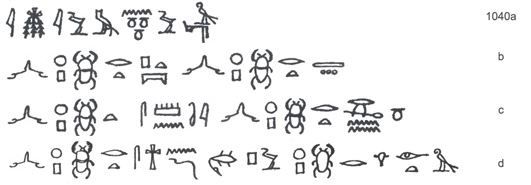
This "sAt, "sAA" or "sArt", representing the rule of Maat (justice & truth), animated more than 2000 years of Egyptian sapiental literature.
The Instruction of Hordedef
(ca.2487 - 2348 BCE, fragment) The manuscripts of Ptahhotep (ca. 2200 BCE) and Amen-em-apt
(ca. 1200 BCE), both complete, represent beginning and end of the "royal"
sapiental tradition. After Amen-em-apt, more popular, less elitist forms of
discourses take over, and the texts are no longer available in hieroglyphs or
cursive hieroglyphs (but in Demotic & Coptic). With the end of the New Kingdom
(ca. 1075 BCE), it took Pharaonic Egypt another thousand years to cease.
Starting with the Ionians, in particular Pythagoras
(ca. 580 BCE - ca. 500, Metapontum, Lucania),
philosophy was a way of life summoning the person as a whole.
Although in Greece cognition was privileged, philosophy also implied the
training of affects, volitions & sensations (cf. the four elements of creation).
Moreover, to effectively master these, a lot of effort was required. Besides
cognitive tasks, imagination, music, ritual, meditation, martial arts, dance,
singing, role-playing etc. were also practiced, addressing the entire spirit and
"one's whole way of being" (Hadot,
1995, p.21.). This "intuitive" aspect of Greek philosophy is visible in the
mysteries, with its integration of poetry, dance & song.
With Gregory of Nyssa (ca. 335 - 399), Gregory of Nazianzus
(329 - 389), Basil of Caesarea (ca. 329 - 379) and Augustine (354 - 430), etc.
we see the emergence of a Christian philosophical school, raising the issues of
Platonic and neo-Platonic thought and dealing with them in terms of Christian
theology. They devised the language of Christology and Trinitarism, introducing
Greek metaphysics into Christian theology.
Montaigne
However far doubt is systematically applied, for Descartes it does not
extend to my own existence. Doubt reveals my existence. If, as
maintained in the Principles of Philosophy, the word "thought" is
defined as all which we are conscious of as operating in us, then
understanding, willing, imagining and feeling are included. I can doubt
all objects of these activities of consciousness, but that such an
activity of consciousness exists, is beyond doubt.
Integrating the best of rationalism and empirism, Kant avoids the
battle-field of the endless (metaphysical and ontological) controversies
by (a) finding and (b) applying the conditions of possible knowledge.
From rationalism, he adopted the idea knowledge is a phenomenon
co-constructed by the subject and its natural operations. But instead of
introducing a substantial subject he worked out a transcendental apex
for the cognitive system. From empirism, he took the idea knowledge
"starts" with sense-contact, and not with a priori categories.
For
Hoogendijk (1988), wonder starts where self-evidence ends. By moving beyond
the confines of any given context, chain of events or situation, ever alert when
something new approaches, practical philosophy is an exercise in permanent
wonderment. Indeed, the finite circle of always-the-same-thing is thus abandoned
and the attitude, frame of mind and intention of the beginner are invoked.
Beginning anew calls for past & future to be bracketed, objects of memory &
expectation to be eliminated from the immediate awareness of reality-for-me, and
the perpetual present to be invited by observing what happens here and now
with as few interpretations as practically possible. Starting all over again is
an art and a science. It is like existing in the interval of the "now", in the
isthmus between what is past and not yet future.
In Classical Greek philosophy, the exchange between subjects
in philosophical conversation became hyper-symbolical, dialogal, argumentative,
objectifying, linearizing and abstract, confining the role of philosophy in
society to the study & practice of cognitive & moral states, implying logic, a
series of normative disciplines and metaphysics (particularly ontology).
The final result of such a Socratic dialogue is
self-knowledge and a personal opinion regarding a given issue. Is one
prepared, for the sake of some higher value (truth, beauty, goodness,
loyalty, courage, health, balance etc.), to reject delusional thought ?
Hence, this type of dialogue is an intensified philosophical conversation.
It never stops and is defined by a given problem or issue (problem-bound).
Solutions always point to new questions, making the dialectic recurrent.
In its critical phase, intensity is heightened and confrontations are at
times rather severe. All prejudices hindering an engaged conceptualization
of the fulfillment of life have to be abandoned and to face one's
illusions is not easy.
In terms of the specificities of the spirituality of
the practice of philosophy, their outstanding feature is the integration
of the three fundamental modes of cognition (instinct, reason, intuition).
As co-operating waves reinforcing each other through resonance, instinct
and intuition are not "kept out" and so the tribunal of reason is better
informed and equipped to judge.
Two types of rationality or ways to use reason ensue :
the direct discovery of absolute reality (suggested by mysticism, spirituality and testimony of the religions). In terms of the practice of philosophy, wisdom seeks ways to make instinct, reason & intuition cooperate simultaneously as three layers of mind. The mythical, pre-rational, proto-rational, rational, critical, creative and nondual modes of cognition are so many operational tools to address these layers, prompting the emergence of a true, good & beautiful multi-dimensional consciousness. II : A Critical Approach of Philosophy.
08. Pre-critical substantialism.
The systems of Plato & Aristotle are also a reply to
the Sophists. Protagorian relativism is wrong. To refute this skepticism,
i.e. the unwillingness to accept there is only "doxa", opinion, not
"aletheia", truth, Classical philosophy opts for substantialism, the idea
some permanence exists in the things that change. This core or essence is
subjective or objective. In the former, it is a subject modified by change
while remaining "the same", acting as the common support of its successive
inner states. In the latter, it is the real stuff out of which everything
consists, allowing the manifestation of the real world "out there". Both
Plato & Aristotle are concept-realists. Their systems are examples of
foundational thinking. Truth is eternalized and static. Concept-realism
will always ground our concepts in a reality outside knowledge.
Plato cuts reality in two qualitatively different worlds. True knowledge
is remembering the world of ideas. Aristotle divides the mind in two
functionally different intellects. To draw out & abstract the common
element, an
intellectus agens is needed. The first substance is "eidos",
i.e. the form, or Platonic idea realized in matter (cf. hylemorphism).
Transcendental logic proves the inconsistencies of skepticism. Reject
the subject, and there is no knower. Reject the object, and there is
nothing known. If there is no knower, then there is nobody stating the
transcendental subject is invalid. Hence, the thesis is self-refuting.
If there is nothing known, then there is nothing to be known, not even
the fact of rejecting the object. Both strategies lead to a
contradictio in actu exercito, and are therefore rejected.
The "theoretical" activity of the philosopher (reading, writing,
teaching) needs to be complemented by the "practical" activity of the
same philosopher (listening, advising, mediating, meditating). Without
sufficient input from real-life & real-time philosophical
crisis-management, the mighty stream of wisdom becomes a serpentine of
triviality and/or a valid pestilence of details (pointless subtlety). Suggested Reading :
Achenbach, G.B. & Macho, T. : Das Prinzip Heilung,
Dinter - Keulen, 1985. |
|||||||||||||||||||||||||||||||||||||||||||||||||||||||||
|
Clearings "... science is apparently
increasingly able to construct and reconstruct itself in response to
problem challenges by providing solutions to the problem ..." TABLE OF CONTENTS Introduction § 1 This introduction serves to
highlight a few remarkable historical landmarks in the field of
epistemology, the philosophical study of knowledge, its possibility and
expansion. § 2 Thinking is of all cultures, as
are imagination and speculation. But the solidification of the
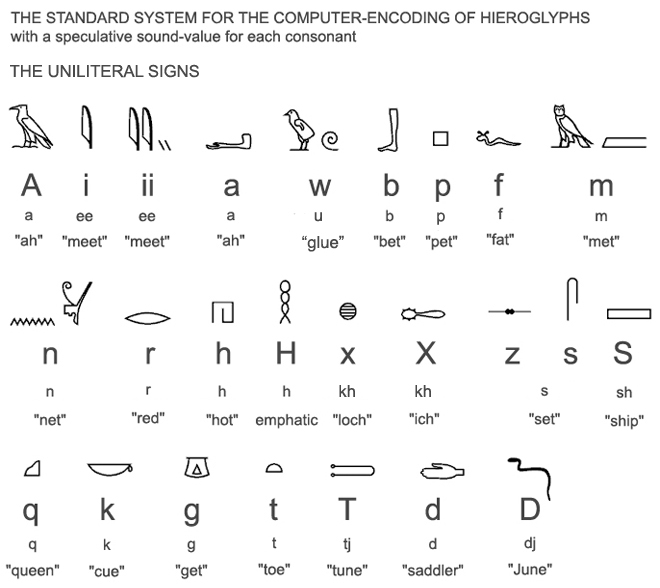
philosophical approach of thought by thought in well-formed glyphs or
signs (like signals, icons and symbols) is rather rare. Oral traditions
exist, but their historical authenticity cannot be ascertained, except
by testimony. Without signs, imposing a definitive form upon matter and
so leaving a meaningful trace, thought does not in effect leave the
mythical, neither does it initiate history, a traceable community of
sign-interpreters. Even if a scribal tradition is installed, one needs
strong media to ensure historical continuity. If texts are carved into
stone, they are likely to survive better than when recorded on very
perishable materials, like wood or clay. Although the latter have the
advantage of facilitating the speed with which signs can be recorded,
they nevertheless are less sustainable over long periods of time. To
keep them for posterity, they need to be copied again and again ...
Although these speculations were embedded in religious thought, an independent sapiental tradition existed. In the Old Kingdom (ca. 2670 - 2205 BCE), the scribes were talented individuals around the divine king and his family. By the Middle Kingdom (ca. 1938 - 1759 BCE), a scribal class emerged. These exceptional thinkers produced the masterpieces of classical Egyptian literature. They were attached to a special building in the temple precinct, the so-called "per ankh" or "House of Life" (in El Amarna, the "House of Life" abuts upon "the place of the correspondence of Pharaoh" - Gardiner, 1938). § 3 In the Early New Kingdom (ca.
1539 - 1292 BCE), Late Ramesside
Memphite theology and philosophy (ca. 1188 - 1075 BCE), was
dedicated to Ptah, the god of craftsmen and the patron deity of Memphis.
This theological move balanced the Theban hegemony of the "king of the
gods",
Amun-Re. Memphis was allegedly founded by a divine king, who, for
the first time around ca. 3000 BCE, if not a little earlier, united the
Two Lands, i.e. Upper (South) and Lower (North) Egypt.
"Thus all the
witnessing faculties were made and all qualities determined, they that
make all foods and all provisions, through this word. {Justice} is done
to him who does what is loved, {and punishment} to him who does what is
hated. Thus life is given to the peaceful and death is given to the
criminal. Thus all labor, all crafts, the action of the arms, the motion
of the legs, the movements of all the limbs, according to this command
which is devised by the mind and comes forth by the tongue and creates
the performance of everything."
§ 4
The Greek miracle did not fall out of the
sky. By the end of the Dark Age (ca. 1100 - 750 BCE), the Greek cultural
form had already acquired persistent "Aryan", Indo-European
characteristics of its own. Although mythical, they were outstanding
enough to leave their archeological traces.
The Egyptian sage never relinquished the religious. The divine was a
given and speculative thought at all times an expression of the deity.
Although deep, remarkable and vitalizing, Egyptian philosophy remained
contextualized and defined by a "milieu" it could not escape.
Exceptional individuals, like
Akhenaten, may have had access to formal thought. The Ramesside
Hymns to Amun and the
Memphis Theology also testify to this. Although more than one aspect
of Egyptian thought, like the virtual adverb clause and its
pan-en-theist henotheism, may assists speculative naturalism, no
systematic approach of wisdom ever gained ground.
From the start, ontological questions dominated Greek thought. What is the "physis" or fundamental stuff of nature (Ionic branch) ? How to know the truth as "being" (Eleatic branch) ? Can indeed anything truly be known (Sophists) ? Why is there something rather than nothing (Plato, Aristotle) ? § 5 Parmenides of Elea (ca. 515 -
440 BCE), inspired by Pythagoras and pupil of Xenophanes (ca. 580/577 -
485/480 BCE), was the first Greek to develop, in poetical form, his
philosophical insights about truth ("aletheia"). Thanks to the
neo-Platonist Simplicius (490 - 560), 111 lines about the Way of Truth
are extant. In it, the conviction dominates that human beings can attain
knowledge of reality or understanding ("noos"). But to know the truth,
only two ways are open : the Way of Truth and the Way of Opinion. These
are defined in terms of the expressions "is" and "is not". § 6 Ironically (or by force of apory
?), the idealism of Parmenides, thinking the necessity of the object of
thought, confuses between a substantialist and a predicative use of the
verb "to be" or the copula "is". That something "is" (or "Dasein") is
not identical with what something "is" (or "Sosein"). Properties
(accidents) do exist apart from the "being" of the substances they
describe. § 7 "All thinkers then agree in
making the contraries principles, both those who describe the All as one
and unmoved (for even Parmenides treats hot and cold as principles under
the names of Fire and Earth) and those too who use the rare and the
dense. The same is true of Democritus also, with his plenum and
void, both of which exist, he says, the one as being, the other as
not-being. Again he speaks of differences in position, shape, and order,
and these are genera of which the species are contraries,
namely, of position, above and below, before and behind ; of shape,
angular and angleless, straight and round." Democritus of Abdera (ca. 460 -
380/370 BCE), geometer and known for his atomic theory, developed the
first mechanistic model. His system represents, in a way more fitting
than the difficult aphorisms of Heraclitus, a current radically opposing
Eleatic thought.
§ 8 The Eleatic effort to posit the
necessity of logic & unity was turned into rhetoric by the wandering
Sophists. By so introducing the relativity of thought (skepticism and
humanism), they prompted a new quest for a comprehensive system. In it,
the various facets developed since Thales would have to be brought
together in such a way that
true knowledge would remain certain and eternal (and not
circumstantial and probable).
§ 9
In Late Hellenism, and particularly in Stoicism, language became an
independent area of study. Logic was not longer embedded in metaphysics,
but part of the new science of language (linguistics). The technical
apparatus developed by the Platonic and Peripatetic schools, as well as
the mechanics of logic had been fully mastered. An overview of knowledge
was sought, and concept-realism still prevailed. Concepts were either
rooted in universal ideas or in immanent forms. Both ideas and forms
were "real", i.e. agents working "outside" the mind and delivering the
foundation of thought and true knowledge. Throughout the Mediterranean,
the Egyptian school of Alexandria was renowned. In 529, under the
Christian emperor Justinianus, who commissioned the Hagia Sophia, the
Platonic Academy at Athens was closed. § 10
In the Middle Ages, this apory between exaggerated realists ("reales")
and nominalists ("nominales"), itself a logico-linguistic
transposition of the ontological apory between Plato and Aristotle, is
best illustrated by the confrontation between William of Champeaux (1070
- 1120), and Abelard (1079 - 1142). The latter was a rigorist dialectic
arguing against the "antiqua doctrina", and, according to the
famous Bernard of Clairvaux (1090 - 1153), an agent of Satan !
This juggling may conceal the larger issue at hand
: if extra-mental objects are particulars and mental concepts
universals, then how to think their relationship ? Does an extra-mental
foundation of universals exist ? The Greeks as well as the
Scholastics answered affirmatively. The idea of a foundation of
knowledge was still present. § 11
"Although it is clear to many that a universal is
not a substance existing outside the mind in individuals and really
distinct from them, still some are of the opinion that a universal does
in some manner exist outside the mind in individuals, although not
really but only formally distinct from them. (...) However, this opinion
appears to me wholly untenable."
§ 12
"Il y a déjà quelque temps que je me suis aperçu que, dès mes premières
années, j'ai reçu quantité de fausses opinions pour véritables, et que
ce que j'ai depuis fondé sur des principes si mal assurés ne saurait
être que fort douteux et incertain ; et dès lors j'ai bien jugé qu'il me
fallait entreprendre sérieusement une fois dans ma vie de me défaire de
toutes les opinions que j'avais reçues auparavant en ma créance, et
commencer tout de nouveau dès les fondements, si je voulais établir
quelque chose de ferme et de constant dans les sciences."
I can doubt all objects of these activities of
consciousness, but that such an activity of consciousness exists, is
beyond doubt. Thus, the "res cogitans", "ego cogitans" or
"l'être conscient"
is the crucial factor in Cartesian philosophy. Its indubitable,
intuitively grasped truth ? Cogito ergo sum : I think, therefore
I am. That I doubt certain things may be the case, but the fact that I
doubt them, i.e. am engaged in a certain conscious activity, is certain.
To say : "I doubt whether I exist." is a contradictio in actu
exercito, or a statement refuted by the mere act of stating it. The
certainty of
Cogito ergo sum is not inferred but immediate and intuitive. It is
not a conclusion, but a certain premiss. § 13
In his Treatise of Human Nature (1739) and
Enquiry concerning human Understanding (1748), David Hume (1711 -
1776) seeks to develop a science of man. As Locke (1632 - 1704), he
envisages a critical and experimental foundation.
The extra-mental reality sought can be no other than the one offered by direct or indirect empirical experience.
Suppose the observed psychological connection
between fact A and fact B is continuous. Is it necessary ? My (or our)
witnessing the connection more than once, does not imply that it will
work tomorrow. Skepticism results. The universal value of scientific
laws cannot be demonstrated, neither can the reality of the world
(within and without). Science is restricted to statements of
probability.
§ 14
"We thus see that all the wrangling about the nature of a thinking
being, and its association with the material world, arises simply from
our filling the gap, due to our ignorance, with paralogisms of reason,
and by changing thoughts into things and hypostatizing them."
The 2 forms of representation, 12 categories
(brought to unity by 3 ideas) make the object possible, rather than
vice versa. The human mind is the active originator of experience,
rather than just a passive recipient of perception, as Hume thought. The
mind can not be a
tabula rasa, a "blank tablet", so Descartes is right. The whole
transcendental system is innate. Even on the level of the transcendental
aesthetics, perceptions, the only source of knowledge acknowledged, as
Locke claimed, must always be processed to be recognized,
or they would just be "less even than a dream" or "nothing to us". Both
perceptions, representation and categorization are necessary to
constitute an object of knowledge. § 15
Kant wished to retain for science the certainty of
the sufficient ground. To understand his epistemology properly, this aim
is of paramount importance. He wished to do for philosophy what Newton
had done for physics : a universal system allowing one to explain the
movements of planets as well as those of apples. He could not accept
skepticism and the relativism it engenders. Not finding this firm ground
in the objective, outward reality (as a world of Platonic ideas or
universal forms immanent in matter), his transcendental method cleared
the foundations of the (universal) subjective apparatus of thought. By
thus viewing the subject of experience as active after the reception of
the perception (analytic object-knowledge after the aesthetic synthesis
of phenomena), all possible knowledge was about the "thing-for-us" and
never about the "thing-as-such" or reality-as-it-is.
§ 16
In the 20th century, neo-Kantianism reconstructed
parts of Kant's system. What can I know ? is answered without
presupposing that synthetic proposition a priori are possible.
The science of certainties is replaced by the science of probabilities
and approximations. Demonstrative intentions are replaced by a terminist
logic. This means modernism, as the via moderna had before, took
the next step by abolishing foundational thinking. To show this radical
move does not automatically lead to relativism or skepticism, is one of
the underlying motifs of the present exercise.
The Münchhausen-trilemma is avoided by stopping to
seek an absolute, sufficient ground for science. This happens when one
accepts genuine science is terministic. In mathematics and physics,
major changes have happened since Newton, and who is able to disprove
the revolutions of tomorrow ? Hence, the categorial system cannot be
absolute, although some of its general features are necessary in a
normative way (for we use them when we think). § 17 Also in science, the problems
posed by skepticism had to be addressed. Especially since Kant, the
question "What can I know ?" has been crucial. The apory between
"realism" and "idealism" is also without final result. The foundational
approach favored since Plato and Aristotle has caused a pendulum
movement between two criteria of truth (consensus versus
correspondence). To move beyond this, the antinomic problems of
justificationism (i.e. the foundational, fundamentalist thinking within
science) must be clear : if, on the one hand, real "sense data" are the
only building-blocks of "true" knowing, as realism maintains, then why
is the definition of the word "sense datum" not a sense datum ?
Also : how can a "naked" or "raw" sense datum be observed if our mental
framework co-constitutes our observation ? If, on the other hand, ideal
linguistic symbols and speech-situations are the exclusive arena of
truth, as idealism maintains, then how can knowledge be knowledge if it
is in no way knowledge of something (i.e. a "res" and not
only "flatus voci") ?
With the end of foundational thinking, the
confrontation between incompatible foundations is over. Scientific
knowledge is probable, historical and relative. Facts may change over
time, and nobody is able to predict for certain what the future holds.
Moreover, scientific investigations are always conducted against the
background of untestable information. Insofar as the latter is arguable,
metaphysics is possible. But the latter is never testable, only
arguable. Finally, who decides who the "involved sign-interpreters" are
and/or when a certain threshold is "critical" ? In order to define these
and other matters, science evokes a series of a posteriori
conditions representing the idiosyncrasies of the local research-unity,
the "opportunistic logic" of their fact-factory and the style of their
pursuit of scientific, factual knowledge. These conditions determine the
practice of knowledge.
§ 18
"There is a science ("episteme tis") which studies being qua being, and
the properties inherent in it by virtue of its own nature. This science
is not the same as any of the so-called particular sciences, for none of
the others contemplates being generally qua being ..."
Without scientific data, the enterprise of
metaphysics is impossible. Moreover, once such a total picture emerges,
its role is not to stand on its own, but to be a heuristic tool for
science, offering new factual research vistas. Besides the logical
consistency of its arguments, metaphysical systems can be judged as a
function of their ability to cover more factual variety, realize a
higher unification of knowledge and give more new research suggestions.
§ 19
In Jean Piaget's (1896 - 1980)
theory on cognitive development, two general functional principles,
rooted in biology, are postulated, namely organization & adaptation.
action-reflection or the interiorization of this novel action by means of semiotic factors : this is the first level of permanency or pre-concepts which have no decontextualized use ; anticipation & retro-action using these pre-concepts, valid insofar as they symbolize the original action but always with reference to the initial context ; final level of permanency : formal concepts, valid independent of the context of the original action & the formation of permanent cognitive (abstract) operators. In this way, and based on his experimental work with children worldwide, Piaget defined four layers of cognitive growth :
The first three levels correspond with "ante-rationality" (cf. supra), whereas
formal-operatoric cognition is identical with formal rationality. In his Le
Structuralisme (1970), he defines "structure" as a system of
transformations which abides by certain laws and which sustains or enriches
itself by a play of these transformations, which occur without
the use of external factors. This auto-structuration of a complete whole is
defined as "auto-regulation". In the individual, the latter is established by
biological rhythms, biological & mental regulations and mental operations. These
are theoretically formalized.
The last decades have
seen many applications of these crucial insights in the functional,
efficient (educative) side of the process of cognition. An example is
schema theory, at work across the fields of linguistics, anthropology,
psychology and artificial intelligence. Human cognition utilizes
structures even more complex than prototypes called "frame", "scene",
"scenario", "script" or "schema". In cognitive sciences and in
ethnoscience they are used as a model for classification and generative
grammar (syntax as evolutionary process).
The last mode of cognition is mentioned here ex hypothesi. § 20 These modes of thought contain two
important demarcations : the lower threshold defines the border between
ante-rational thought (mythical, pre-rational and proto-rational) and
reason. The higher threshold declares the difference between reason
(conceptual and transcendental) & immanent metaphysics (or creative
thought). prenominal : mythical, pre- &
proto-rational (instinctual) ; nominal : rational and transcendental
(rational) ; meta-nominal : creative and nondual
(intuitional). from action to ante-rational
thought
ANTE-RATIONALITY
1. MYTHICAL or PRE-LOGICAL THOUGHT : First substage :
adualism and only a virtual
consciousness of identity ; primitive action testifies
the existence of a quasi complete indifferentiation between the subjective
and the objective ; actions are quasi not
coordinated, i.e. random movements are frequent. Second substage : first decentration of
actions with regard to their material origin (the physical body) ; first objectification by a
subject experiencing itself for the first time as the source of actions ; objectification of actions
and the experience of spatiality ; objects are linked because
of the growing coordination of actual actions ; links between actions in
means/goals schemes, allowing the subject to experience itself as the source
of action (initiative), moving beyond the dependence between the external
object and the acting body ; spatial & temporal
permanency and causal relationships are observed ; differentiation (between
object and subject) leads to logico-mathematical structures, whereas the
distinction between actions related to the subject and those related to the
external objects becomes the startingpoint of causal relationships ; the putting together of
schematics derived from external objects or from the forms of actions which
have been applied to external objects. Comments : 2. PRE-RATIONAL THOUGHT :
Comments : A tremendous leap forwards ensues. The formation of a subjective focus (at the end of the mythical phase of thought) is necessary to allow for the next step : interiorization, imagination and the actual articulation of pre-concepts, leading up to pre-relations between objects, but the latter remain psychomorph. The reality of objects is always individualized or made subjective. Natural phenomena, stones, trees and animals "speak" just as do human subjects. Important objects are those with the strongest positive (attractive) subjective potential : family, teachers, ancestors, Divine kings, prophets, angels, Deities, God, etc. These "mediate" when pre-rationality fails to bridge the gap between what is stable (the architecture) & what constantly moves (the process). 3. PROTO-RATIONAL THOUGHT :
Comments : Thanks to transitivity, a formal system of concrete concepts arises. It is not combinatoric (but sequential) and not formal (abstract concept are not present). Concrete thoughts manipulate objects without reflecting upon the manipulation. The latter is stored as a function of its direct use, not in any overall, categorial, librarian or antiquarian fashion, although within a given manipulation a series may be present. The contextualism, pragmatism and use of the concrete concept is its stability. Proto-rationality is always limited by a given context. Moreover, there is no reflection upon the conditions of subjectivity (just as in the pre-rational stage objects remained psychomorph). This contextualization leaves in place uncoordinated actions and concepts which are the expression of many serious (fundamental) contradictions. As suggested earlier, Egyptian and pre-Socratic thought do not exceed ante-rationality. A more adequate understanding of the creative products of these civilizations becomes possible thanks to this Piagetian analysis of the early modes of cognition. Especially in Ancient Egypt, the power of proto-rational "closure" is exemplaric and makes clear how grand culture is not necessarily rational. from ante-rational to rational thought RATIONALITY 4. RATIONAL THOUGHT : The formal operations leave
contextual entanglements behind, and give a universal, a-temporal embedding to
the cognitive process through abstraction, categorization & linearization.
Cognition is liberated from the immediate events and able to conceptualize
logical & mathematical truths (deduction) as well as physical causalities in
abstract terms, without any consideration for their actual occurrence, if any
(cf. the inner thought-experiment). Thought is able to combine propositions.
5. TRANSCENDENTAL THOUGHT
When reflection upon the conditions of
object and subject of thought happens and the internal, transcendental
pre-conditions of the cognitive apparatus are discovered, a new mental
world is opened up. The "natural" approach is over, and a new
"transcendental" (not "transcendent" !) layer becomes active. This marks
the birth of critical rational thought. from scientific to metaphysical thought META-RATIONALITY 6. CREATIVE THOUGHT :
According to Thomas Aquinas (1225 - 1274), metaphysics has its own mode
of knowledge, ascribed to what he called the "intellectus". This
mode captures one single truth, and implies a direct, immediate intake
of knowledge which differs from the mediate ways to gather it. So "ratio"
(related to science) and "intellect" were divided. Metaphysics offers a
unique synthetical, intellectual insight regarding being-as-such. But
Thomas (like Kant), denied reason its "terminus". A direct
knowledge of what lies outside the "ratio" was deemed impossible.
It was Nicolas of Cusa (1401 - 1464) who introduced the famous
expression "intuitio intellectualis" to define the direct
knowledge of an evident truth. 7. NONDUAL THOUGHT :
This non-conceptual and non-propositional mode of thought allows us, so our
living examples teach, to integrate knowledge beyond the point of scientific &
speculative thought and relate the immanent whole achieved by immanent
creative thought with the suggested transcendent totality, or absolute reality
(ideality), the absolute Real-Ideal (or absolute coincidence of the order of
reality and the order of ideality, of being and thought).
§ 21
In the present genetico-epistemological discussion of a possible
critical theory and practice of knowledge and its growth, human
cognitive growth is not halted at the level of reason. The nature of
things is the constant dynamism of mental forms, propensities and
differences (energies, particles & forces). As long as conflicts remain,
the process continues. All actual entities are dynamical. "Panta rhei !"
(all
things are in constant flux) is
one of the more
famous sayings of Heraclitus, the pre-Socratic Greek philosopher
of Ephesus quoted by Plato. In his view, as in Whitehead's, the world is
all there is and all of that is constantly changing. This ongoingness of
the world-process or universal dynamism does not deny the presence of
architecture and lawfulness (forms of definiteness). Without these (for
example in the form of the constants of nature, the laws of physics or
biology), all this movement would have no order or coordination. Hence,
no forms would have come into actuality and nothing but the primordial
soup would have continued to exist (given the question of the coming
into being of this crucial primordial matrix is postponed, or worse,
abrogated, for indeed, who or what "banged" at the Big Bang, i.e. at t ≤
0 ?).
§ 22
If the organization of thought in general and of mind in particular may
be characterized as "dual" (sensoric versus categorial), the overall
logic behind reason, although layered, is "monadic". Reason is prepared
& equipped for the immanence of the intellect, but has to give up its
role of master and become a servant of the own-form of its own Higher
Self. This ontological necessity, in particular its constant negation
(not this, not that), reflects on the creative potential.
reason ("Vernunft") : regulating dualism with ideas converging on unity & the unconditional ; intellect : faculty or stage of cognition allowing for the creative, intuitional manifestation of one's immanent own-Self and the intellectual perception, ex hypothesi, of its unconditional transcendent core. The law of types is more fundamental to our
prosecuting reason than the law of variety, which is fundamental to our mind,
the advocate of the senses. By working with the law of types, reason invokes the
intellect, who's role Kant tried to limit to the bare, formal minimum necessary
to make the mind work properly "for all times"... He eliminated the notion of
"own-Self", i.e. the specific, unique ontological form of actual definiteness
characterizing each and every individual and crucial to promote creative
thought.
§ 23 Scientific knowledge is a system of
empico-formal propositions involving "facts" produced by an experimental
set-up or set of instrumental actions and a chain of dialogal processes, both
strategic (with asymmetrical dialogal structures based on the media money,
propaganda & money) and communicative (devoid of the latter).
Book Naught
0.
No rational thought
without, on the one hand, a transcendental object, which appears as an object of
knowledge (what ?), and, on the other hand, a transcendental subject, which -as
a subject of knowledge (who ?)- is a member of a community of
intersubjective sign-interpreters
and hence co-exists with language.
Suppose a thought without a
(thinking) subject. This implies there is no one thinking the thought. This is a
contradiction in actu exercito. Thinking the subject away implies
subjectivity. Likewise, a thought without something being thought involves
objectifying the thought which has no object. Hence, all possible thought is a
function of both transcendental subject and transcendental object. Book 1 1.
The solution to the problem of the foundation of
knowledge is an epistemology giving a valid answer to the question how true
knowledge and its development are possible ?
The échec of the ontological epistemologies was countered by Kant and his
"Copernican Revolution", culminating in neo-Kantianism and its critical theory.
The latter made a decisive step away from the foundational intent still present
in Kant (namely his synthetic propositions a priori). Object-knowledge is
relative, historical, fallible and a posteriori. This does not lead to
the skeptic "anything goes", for the principles of transcendental logic, the
norms of theoretical epistemology and the maxims of the practice of knowledge
must be accepted if the game of "true" knowledge is to be played well.
4.
Each attempt to ground epistemology leads to
unacceptable logical difficulties. For this gives or an infinite regress, or a
logical circle or a dogmatic break with the attempt of justification (the
trilemma of foundation).
The trilemma is avoided by stopping to seek an
absolute, sufficient ground for knowledge outside knowledge. The ground
of knowledge is the groundless principle of thought itself. This is the
simple fact conceptual thought is impossible without the discordant
concord of transcendental subject and transcendental object.
7.
Every cognitive act presupposes an object of
knowledge which has to be thought of as unsurmountable. If not, we commit a
contradiction "in actu exercito". 12.
Every cognitive act presupposes a subject of
knowledge which has to be thought off as unsurmountable. If not, we commit a
contradiction in actu exercito. 17.
Knowledge can be divided into mental knowledge
(aiming at an object or object-knowledge) and rational knowledge (aiming at the
mind). The former is related to the categorial scheme, the latter to the ideas. 20.
Realistic answers to the problem of the foundation of knowledge step beyond the
boundaries of all possible mental knowledge because the idea of a "reality
devoid of the subject of knowledge" (i.e. reality-as-such or Kant's
"Ding-an-sich") becomes the foundation of epistemology (so facts coincide with
this reality and the subject of knowledge becomes secondary) .
22.
By shaping the unconditionality of the object of
knowledge, the idea "reality" (the real-as-such) guarantees the unity & the
expansion of the monologous object-oriented conceptual knowledge . 26.
On the side of the object of knowledge, we must think "reality-as-such" as
knowable (without being conceptually equipped to know whether this is the case).
Facts are both intra-linguistic (are co-determined by the theories of the
subject of knowledge) and -so must we think- extra-linguistic, i.e. the
messengers of "reality-as-such". Hence, they correspond with reality-for-us.
28.
In this way, the idea "reality" regulates the
objectivity of knowledge and the idea "ideality" its subjectivity.
To notice the illusion on the side of "ideality", the use of the idea of the ideal is to be restricted likewise :
The probable, historical but paradigmatic system we hold for true is possible if (a) subject and object of knowledge are always both implied, and (b) the ideas of the ideal and the real are used to regulate the process characterizing mental knowledge, not to constitute the latter. 29. Let us distinguish between : A.on the side of the object of
knowledge : 8 The coherency-theory of
truth.
31.
One of the tasks of epistemology, is to
reflectively reconstrue the basic normative system already used by
scientists all the time.
Methodology transposes the necessities of
experiment and communication to the local research-cell in general and to the
practical logic of its specific scientific studies in particular. This causes a
variety of local coordinations of scientific activity. 35.
Two antinomian regulations are necessary to arrive at valid, i.e. true knowledge
: on the one hand, a monological regulation (the path of experiment), on the
other hand, a dialogal regulation (the path of discourse & discussion). 10 The fundamental norms of
knowledge. 37. A theory is "rational", when it (a) is logically well-fashioned, (b) does not exclude dialogal symmetry and (c) allows for dialogue & discussion. If so, it is an "arguable" theory. 11 The scientific status of a
theory. If a
rational (arguable) theory does not refuse testing, it already belongs to the
domain of science. As proto-science, it reflects the order book of science, its
tasks ahead. In particular, the specific activities planned by each
research-cell. If corroborated and approved by others, it becomes strict
science. If falsified by new experiments or disagreement about it prevails or
both, it becomes part of the large storehouse of outdated (semi-) scientific
theories. 42.
Metaphysics is speculative & theoretical knowledge
on being (ontology), the cosmos (philosophical cosmology), life (philosophical
biology), the human (philosophical anthropology) & the Divine (philosophical
Divinity). Metaphysics may be divided into : 12 Metaphysics and science.
Consider the following :
prime vertical = evolutionary field of the seer, from origin to final goal P1, P2, ... = set of orientations given to the observer within the boundaries of the sphere ; diurnal hemisphere = the realm of rational consciousness ; nocturnal hemisphere = the realm of irrational and ante-rational consciousness ; the sphere itself = the totality of all immanent realities and idealities of every observer ; beyond the sphere = the trans-rational, the ineffable. Although each observation is unique
(using a exclusive local sphere), its constituents are universal (defining the
global sphere). If each local sphere is linked with a particular
"reality-for-me", the global sphere is related to the planetary
"reality-for-us". The horizontal plane is associated with the diversity of
beings, the way they interconnect (although divergent) and their respective
"horizon" or limitations, whereas the vertical plane is used to construe the
evolutionary process in which each is involved (moving from origin -Nadir- to
final end -Zenith-), implying the dynamical convergence of each. 48.
Rationality is the privilege of subjects of
knowledge willing to communicate well, using a well-proportioned and correct
language (semantics & syntax), allowing for discourse, i.e. argumentation &
consensus (pragmatics).
Language is not only an artifact of the human being. It is not restricted to the
spoken or written word. Art & body-language are good examples of
non-verbal languages. Also in the natural world, signals and icons are used.
Signals involve the protection of territory and show who is on top. Icons try to
represent a complex network in a relatively simple image (like bees dancing the
direction to food). So in this broad definition of language, all cultural
forms are languages but not all languages are cultural forms. Culture always
implies conservation and the transmission of meaning to the next generation
(which is absent in most of the mineral, vegetal, and animal world). 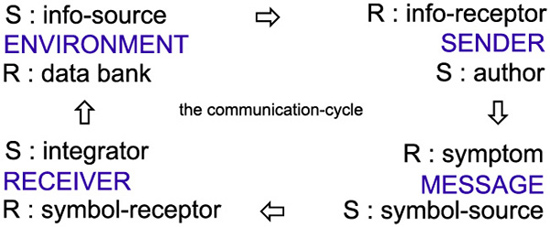
The four actors in this cycle are the environment, the sender, the message and the receiver. Each actor is stimulated by a source and in turn becomes a source of stimuli :
Each phase of the process may be flawed by possible errors in transmission : the information of the collective may be misunderstood by the sender and/or the latter may represent the info-source by means of an alienating symptom. The message itself may contain redundancy (due to noise), eclipsing the original intent of the sender. The receiver may misunderstand the symbol and integrate it inadequately, adding sullied information to the collective data bank. The more the cycle is corrupted, the less coherent a cultural form becomes. 50. Rationality implies a principle of symmetry (equality in speech and freedom of action), a language which is formally correct and a theory of argumentation. 51. Regarding the theory of argumentation, preference is given to a model of judgment built on game-theory, i.e. the definition of the logical system and rules of discussion are chosen beforehand by the discussers. Strategic speech-acts are not communicational but efficient & utilitaristic. They create the iron cage of alienation, in which humans only exchange glyphs for the sake of some outer, material goal, like the production, exchange or acquisition of some thing. By making language an instrument of some extrinsic process, the essence of communication, namely to share truth, beauty and goodness, is lost. The strategic use of language is the arena of the media power, propaganda and money. Top/bottom relationships, deception and the building up of capital for the sake of capital, are precisely devoid of the symmetry characterizing genuine communication. They depersonalize humans and turn them into objects to be manipulated and used for the sole benefit of those who have the power, the data and the money to take away a person's freedom or parts thereof. Hence, they are the language of the sadist. Those who willingly bow and comply because of the received painful benefits, those who put on the chains themselves and willingly crawl into the cage of their masters, are the masochists, as Nietzsche correctly observed. Both in philosophy and science this kind of discourse must be absent. It cannot help to attain truth and so is eliminated from the desktop of those who wish to truly communicate. In sado-masochistic contexts, equality in speech is abrogated. The slave can only speak if so allowed by his master. Freedom of action is also gone, for the movements of the slave are controlled by the master. As the slave exists for the sole benefit of the master, all communication between them is reduced to signals of obedience, icons of humiliation and strategic symbols (glyphs intending the satisfaction of the top only). If we communicate, we do so on an equal basis. Everyone is free to say what they like and nobody is able to enforce their position upon another. Besides this symmetry, the value of statements must be checked. This implies a theory of argumentation. To make sure the latter is not an idealized canon, its rules must be discussed and approved beforehand. In this way, all concerned parties agree upon the way to handle dissensus and a clear-cut assessment of statements can be made. Strong arguments back a statement and make it more likely than those unable to provide such a warrant. Book 2
52.
Consider the practice of knowledge as a dynamical interplay between, on the one
hand, dialogue and the rules of argumentation and, on the other hand,
participant observation and the rules of experimentation. 56.
Act in the practice of knowledge as if facts (reality-for-us) coincide
with reality-as-such. 60.
The rules of dialogue and argumentation are grounded in communicative action.
The latter is based on a common definition of context (negotiation) and a
problem-solving behavior (execution), coordinated by consensus. It is crucial to
avoid pseudo-communication (like in the case of the perlocution).
Communicative action turns
strategic uncertaintly into symmetry, stategy into absence of coercion and
social action into an intersubjective quest for consensus.
The division between Fregean &
non-Fregean logics is recent. Indeed, traditionally, classical & non-classical
logic are Fregean throughout. It was Aristotle who initiated Fregean deductive
reasoning by eliminating the contents of the propositions and judging their
validity exclusively on the basis of the truth-value of the logical operators
"not", "and", "or" and "if-then". The importance of this kind of approach is
unmistaken and has eventually developed into the imperative algorithms used by
most of our computers. Every step of the argument can be checked using formal
rules, devoid of semantics. Given the initial positions (the axioms), a series
of hypothesis may be inferred which, when proven correct, turn into theorems.
This formal calculus does not allow or has difficulty with stochastic variations
(the element of probability & chance) or non-linear attractors (the element of
chaos). This could be seen as the logic of formal representation, the way of the
linear straight line (instead of the non-linear curve). Formal logic tries to
develop closed, complete & consistent representations, in which no "bugs" or
randomness occur. Moreover, although impossible (cf. Gödel), it also invokes
completeness, i.e. the calculus foresees all possible logical situations
beforehand.
Whenever dissensus occurs, a new discourse is organized, preluded by a mutual agreement regarding the rules of the game of logic. These are the two meta rules, covering the measurement of truth and the validity of a given argumentation. Systems A can be called objectively better than system B, if there is at least 1 logical problem solved by A which is not by B while there is no logical problem solved by B which is not solved by A. The rules of argumentation cover the process by which validity is established. 62.
Accept specific, empirical criteria of judgment
a posteriori. They are the result of the particular way in which practical
processes of learning are institutionally concretized in the given
research-cell. 65.
Be aware function-optimalisation in intelligent systems happens among other
things by representing problems in a non-Fregean way, for example in a
mini-world, solving them there and then transferring the solution back to the
original scale. 18 Optimalisations. 67.
To produce knowledge, the maxims "test" & "talk"
must, as soon as disagreement occurs, be divided from each other and be joined
again as soon as consensus is reached. The knowledge concerned may be taken as
true. 70.
Be aware the production of knowledge is only
possible because of an opportunistic logic which states that the actors of a
research-cell develop a local "know-how" determining what works & what
does not (methodological relativism). Epilogue Suggested Reading :
Adorno, Th.W. : Kritische Modellen,
Van Gennep - Amsterdam, 1977. |
||||||||||||||||||||||||||||||||||||||||||||||||||||||||||||
|
Behaviours "Where can we go where our sins
will not touch us ? No place on Earth - no place at all. Not in the sky,
not in the midst of the sea, not in the rocky clefts of mountains." TABLE OF CONTENTS Definitions system : the totality of parts
organized in an orderly fashion ; Book Naught
0.
No action without, on the one hand, a transcendental object, i.e. a coordinated
movement & its consequence (or the prevention of such movement & its
consequence), and, on the other hand, a transcendental subject, i.e. a possessor
of conscious intent, who is the source of behaviour, accommodating desire, free
will and reason. Book 1 01. Ethics as a normative system.
4. The moral
norms uncovered by critical ethics answer :
(a)
how good actions and their propagation are possible and (b) how ethical
judgments must be performed. They take form as a necessary division, a
quaternio
or fourfold of critical ethical factors, developing the dual structure of the
logic of ethics : "I" versus "not-I". In-between subject and object, actions are
at hand. 02. The subject of action or the freedom of initiation.
11. In order to act on intent, the actor must exercise his or her free
will, i.e. be able to move in the absence of external impediments. 03. The object of action and physical determination.
17. Actions are either done to realize a goal or to
implement a value. 04. Moral science, moral philosophy & critical ethics.
23. Moral science observes, analyzes, systematizes and explains what is
present in society in terms of moral phenomena. Moral science also "tests" the
latter by way of logic, observation and pragmatism. Here justice is an option,
never a must. 05. Teleological and deontological transgressions.
31. Consequential ethics make the
goodness of an action exclusively depend on the object (goals and/or value)
desired by the free will and/or rationalized by the mind. When thinking
goodness, they eliminate "pure" reason a priori. Universalizing ethics
understand, in accord with the transcendental subject of ethics, good behaviours
in terms of the rational imperative of duty. They eliminate goals and values as
sources of goodness.
06. Moral science :
33. Moral science does not derive "ought" from nature or imperatives from
indicatives (naturalistic fallacy), but describes the moral phenomenon without
the necessity of goodness, the latter being an option, not an imperative.
07. Moral philosophy :
39. Traditional moral philosophy
gave transempirical and/or ontological grounds to what ought to be done to be
good, i.e. happy, fair and caring. Critical moral philosophy operates a
quaternio of ethical factors based on the transcendental conditions of
coordinated movement and free will, of which the first one implies ego. 08. The alter-ego and Operation Duty.
56. The patterns of communication at
work in early family-life and at school, educate the ego to open up for the
experience of the other. They transpose primate reciprocity to the level of the
ante-rational conceptualization and rational understanding of the mutual
acknowledgment of the asymmetry between the "I" and the "other". Where egoism
cherishes this, altruism aims to harmonize it. 09. The formation of conscience.
68. Conscience is the objective,
inner organ of ethical evaluation between the affective ethics of intent & the
formal ethics of duty, between the needs of the ego and the responsibility (or
the application of the moral imperative) towards all possible others. 10. Returning the call of vocation.
78. Affects urge for repeated
gratification. In esthetics, sensations are ravished by the excellent sublime.
In epistemology, the unconditional regulates thought seeking truth. In ethics,
fair volition is being called to answer vocation. 11. Goodness & Project Fairness.
85.
Good behaviour or fair and right action is (a) initiated by the free will of the
individual ego, (b) expanded as duty commands, (c) rooted and adjusted by each
individual conscience -seeking the "golden proportion" between circumstantial
desire (utility) and moral reason (duty)- and (d) finalized by returning the
call of vocation. 12. Planetary Participationism.
94. The more we seek out and answer
the call of vocation, the sooner planetary awareness will become stable in each
member of humanity. Communication and justice are just not enough. Participation
and compassion form the cap-stone of ethics. 13. Ethics and metaphysics.
101. Insofar as theoretical ethics posits the
transcendental conditions (free will and coordinated movement) and so moves
beyond the relative precepts of moral science, it cannot do so without
metaphysics, i.e. arguable but untestable statements about the universe
(metaphysical cosmology), life (metaphysical biology) and humanity (metaphysical
anthropology). 14. Ethics and the Divine.
106. Due to calling, the higher
modes of cognition (the creative and the intuitive) are unveiled as intellect to
reason and directly experienced as part of a pure potential or "own-Self"
(amongst and infinite number of other potentials) Book 2
15. The practice of ethics. With the practice of ethics, our
investigations receive a new dimension. Instead of focusing on the question
Quid juris ?, and asking for the necessary principles, conditions & norms of
ethics and its judgments, Quid factis ? aims at maxims enabling us to
apply the wheel of ethics (the dynamics of intent, duty, conscience and calling)
particularly to local contexts and circumstances, taking into account the
relative conditions of space, time & person. 16. Persons. If personhood is a hypostasis, then an
underlying reality is presupposed, like a "soul", eternal or not. This final
ground is then the axiom supporting philosophical anthropology. Consistent with
critical epistemology, critical ethics does not embrace a substantialist,
foundationalist approach, acknowledging the impermanence of all things within
the relativity of the world-system(s). 17. Health. To be able to mature, the human needs a
long life. If this life is cut short, negative sedimentations have been allowed
to interchange with gross material circumstances, although the latter can and
should be avoided as much as possible. 18. Family. Family is the extension of private life
and of the self-love of ego's. Insofar a person has family, much of what
characterizes this close communal life of the clan is unwilled by the ego,
although eventually it may contribute and make changes. Orphans may be adopted
or, in adolescence, choose a surrogate family. 19. Property. Property, or the right to use, change
and sell goods & services, defines the social status of any family. Differences
between families has determined the stratification of social formations since
the beginning of the Neolithic (ca. 10.000 BCE) and sedentariness, when the
piling of material goods became possible. 20. On the secular state. Thanks to the secular state, property is
no longer the sole asset of families, companies and religious institutions. The
state is a crucial instrument to redistribute wealth. Indeed, huge differences
in income and accumulated wealth increase poverty. To make peace, the nations
must work as a global network of care-takers. 21. On death. All things come to an end. Suggested Reading
Aristoteles : Ethica Nicomachea,
De Nederlandsche Boekhandel - Antwerpen, 1954. |
|
A Neurophilosophy of Sensation
"Experience is not what happens to You ; it's what You do
with what happens to You." TABLE OF CONTENTS I : The organs of perception.
"Each of us believes himself to live directly within the world that surrounds
him, to sense its objects and events precisely, to live in real and current
time. I assert that these are perceptual illusions, for each of us confronts the
world from a brain linked to what is 'out there' by a few million fragile
sensory nerve fibres. These are our only information channels, our lifelines to
reality. These sensory nerve fibres are not high-fidelity recorders, for they
accentuate certain stimulus features, neglect others. The central neuron is a
story-teller with regard to the afferent nerve fibres ; and he is never
completely trustworthy, allowing distortions of quality and measure, within a
stained but isomorphic spatial relation between 'outside' and 'inside'.
Sensation is an abstraction, not a replication, of the real world."
The transmission of afferent impulses is never
direct but by synaptic relays, changing the massage into a "code". In every
neuronal relay station, this coded impulse is modified. Although each sense has
its primary receiving area laid out as a cortical "map" (cf. the Brodmann
areas), the neuronal relays from the PNS to the CNS cause the preliminary
"codification" of the raw impulse hitting the reception surface of nose, tongue,
skin, ears and/or eyes. So when the impulses in some sensory pathway reach the
primary sensory areas in the CNS, preliminary codification has already taken
place (cf. Kant's distinction between experience, "Empfindung" versus
appearance, or "Erscheinung").
01. Smell : the nose feels the air. The earliest organism abided in chemical substances signaling food, poison or sex. In humans, externally located neuronal cell bodies are concentrated within the nose. These nasal-located neurons, like those of other, more ancient creatures, analyze the pheromonal, olfactory and chemical nature of the environment for data concerning food, sex, the weather and the like. Over the course of evolution, only two groups of primal sensory cells formed like-minded cells : the olfactory lobe and the optic lobe. With the expansion and axonal-dendritic interconnection of these lobes the modern brain emerged.
the olfactory bulbs & optic vesicles of the neural tube We do not smell with the nose, but with
a small, thin sheet of cells high up in the nasal cavity. This olfactory
epithelium, about 10 cm², has three main cell types : (a) olfactory receptor
cells, or neurons with axons of their own penetrating into the CNS, (b)
supporting cells, similar to glia, helping to produce mucus and (c) basal cells
which are the source of new receptor cells. Indeed, the receptor cells
continually grow, die and regenerate in a cycle lasting ca. 4 to 8 weeks. The
olfactory epithelium and the retina of the eye are both literal extensions of
the brain. The olfactory system gave rise to the evolution of the primitive
amygdala and rudimentary hippocampus ca. 500 million years ago. Because odors
are inherently slow stimuli, rapid timing of action potentials is unnecessary to
encode the timing of odors. Rather, temporal coding, based on the timing of
spikes, is supposed to encode the quality of odors, and transduce the chemical
stimulus into an electric charge. Temporal patterns of spiking would then be the
logic behind the olfactory coding. 02. Taste : tongue & water. The olfactory system is related to
eating and assists the gustatory system. Flavor can only be detected if both
nose & tongue are used together. Although completely independent of the taste
buds localized along the tongue, both system may have started out as one
chemoreceptive system becoming distinct over the course of evolution. In
reptiles and many other animals, an auxiliary olfactory organ is located within
the roof of the mouth. But, in this case too, the two systems are separate.
Indeed, some food, although smelling good, may taste terrible and have no
nutritive value. The taste test allowed for additional differentiation, although
some stuff smell & taste great whole still being poisonous. 03. Touch : bending & stretching from top to toe. The experience of touch starts at the
skin. Most sensory receptors in the somatic sensory system, are
mechanoreceptors, sensitive to physical distortions such as bending or
stretching, enabling the body to feel, to ache & to chill (in the context of
this paper, the term "somatic sensation" is avoided). Present throughout the
body, they monitor all contact with the skin as well as pressure in the heart &
blood vessels, stretching of the digestive system, urinary bladder and force
against the teeth. The axons branches characterizing each mechanoreceptor have
mechano-sensitive ion channels, not well understood. 04. Audition : the pressure of air. Sounds are audible variation in air
pressure caused by moving air molecules. When an object moves away, air is made
less dense (rarefied). Many sounds produce periodic variations in air pressure.
The frequency of sound is the number of compressed patches of air passing by our
ears each second. One cycle is the distance between two successive patches.
Sound frequency is expressed in hertz, or the number of cycles per second. The
auditory system responds to pressure waves over the range of 20 - 20.000 Hz,
decreasing with age & exposure to noise of the high-frequency end (a low organ
tone is about 20 Hz, while a high note on a piccolo is about 10.000 Hz).
Intensity of sound is difference in pressure between compressed patches of air,
and determines the loudness we perceive. The higher the intensity, the louder
the sound. The intensity range is remarkable, for the loudest sound leaving our
ears undamaged is about a trillion times greater than the intensity of the
faintest sound heard.
Once the inner ear generates the neural
response to sound, the signal is transferred to and processed in nuclei in the
brainstem, and sent to a relay in the thalamus, finally projecting to the
primary auditory cortex in the temporal lobe (Heschl's gyrus). Both audition &
sight start with sensory receptors connecting to early integration stages
(retina for sight and brain stem for audition), relay to the thalamus and then
to the sensory cortex. Nevertheless, given there are more synapses at nuclei
intermediate between the sensory organ and the cortex, the auditory pathway
appears more complex than the visual pathway. However, the cells and synapses of
the auditory system in the brain stem are analogous to the interactions in the
layers of the retina. All ascending (afferent) auditory pathways converge onto
the inferior colliculus of the midbrain. The right cochlea projects mostly to
the left primary auditory area, and vice versa for the left cochlea. 05. Sight : the eye as the space of photons. light
In physics, a quantum (plural : quanta)
is an indivisible entity of energy. For instance, the photon, being the unit of
light, is a "light quantum". In empty space, a photon moves at a constant speed,
has no rest mass and no charge. Einstein (1879 - 1955) found the relationship
between the energy of light E and its frequency ν to be : (2) E = h ×
ν, h being Planck's constant, or 6.626 × 10⁻³⁴ J·sec, used in the
quantization of energy. The energy of electromagnetic radiation is proportional
to its frequency. Emitted at high frequency (or short wavelengths) it has the
highest energy. (1) & (2) give E = h.c/λ, with c = 299.800 km/s (the speed of
light in empty space).
The conversion of light energy into neuronal activity happens in the retina. The basic flow of light in the retina is from the photoreceptors to bipolar cells to ganglion cells. The only light-sensitive cells in the retina are the photoreceptors, while all other cells are influenced by light via direct or indirect synaptic interactions with these. The ganglion cells are the only source of output from the retina. They alone form action potentials. The actual conversion of electromagnetic radiation into neural signals occurs in the 125 million photoreceptors at the back of the retina. They convert light energy into changes in membrane potential, using biochemical cascade.
influence of light/dark contrast with identical gray Each cell has four regions : an outer
segment, an inner segment, a cell body and a synaptic terminal. Light-sensitive
photopigments absorb light and trigger changes in the membrane potential of the
photoreceptor. Rod photoreceptors have a long, cylindrical outer segment, while
cone photoreceptors have a shorter segment. Rods are 1000 times more sensitive
to light, while there are three types of cones, each containing a different
pigment, making them sensitive to different wavelenghts of light. Only the cones
are responsible for our ability to see color. 06. Naked perception : stimuli & preliminary codation. "If the doors of perception were
cleansed,
In each receptor organ, a particular transduction is operational from, on the one hand, chemical (smell, taste, touch), mechanical (touch, audition) or electromagnetic energy (sight) to, on the other hand, encoded sequences of electric voltages running through neurons and their axons and dendrites.
The axons of the olfactory bulbs run through the
olfactory tracts and project directly into the olfactory cortex.
This happens without passing through the thalamus first, as is the case
for taste (gustatory afferent axons), touch (somatosensoric axons),
audition (auditory nerve) & sight (optic nerves), projecting into the
neocortex by thalamic relay.
07. Natural perception :
To reach the neocortex and become conscious
sensation, all afferent sensory inputs directly (taste, touch, audition,
sight) or indirectly (smell) enter the thalamus. The thalamus is the
gate, integrator and translator of various inputs processed into a form
readable by the neocortex. As a projector, the thalamus relays
selectively to various parts of the neocortex, and one thalamic point
may reach more than one area of the cerebral cortex. II : The sensuous cortex. The cerebrum (measuring about 11 m²) is divided into four lobes, situated underneath the corresponding bone of the skull :
the cerebral lobes Gray cortical matter is found in the cerebral neocortex, a thin layered sheet of ca. 209 neurons lying just underneath the surface of the cerebrum.
In the human, the neocortex is the set of neurons of the cerebrum where sensations, voluntary movement, learning, speech & cognition converge. Here consciousness & the sense of "I-ness" are mediated. It shares several common features with all vertebrate animals :
Computing all higher order operations is the "nominal" mode of working of the
human cerebrum and its specific, bi-modal approach : two hemispheres
processing one integrated cerebral activity from two different angles.
Abstract thoughts can be thoroughly mediated after the axonal bridge between
both, the corpus callosum has been completed (cf. Piaget's "formal-operatoric
phase" after the age of 10).
unique human hemispheral specialization after Joseph, 1993, p.44
On the horizon, there is the joint project of the two cerebral
hemispheres : cerebral activity is called to be an integration of a
duality. This is accepting the difference while opening up as many
neuronal alleys between the hemispheres (cf. the "concordia discors"
of thought - Chapter 2).
08. Primary & secondary sensory area : The stretching & bending human body (touch) is constantly
afloat in a pool of chemicals (smell & taste), air pressures (hearing) and
electromagnetic radiation (sight). The chemical senses (smell & taste) produce
odors & tastes, the mechanical senses (touch & audition) feels & sounds and the
visual sense transforms radiation into pictures of the world around & outside
us. Through them, an experience of the immediate environment becomes possible.
09. The association areas : The cortex proceeds by shaping a three stepped "neuronal sensation ladder" :
In the human brain, even after assigning primary sensory, secondary sensory, primary motor & secondary motor areas to the neocortex, a considerable amount of bark, particularly in the frontal & temporal lobes, remains : the association areas.
In these association areas of the human neocortex, sophisticated processing mediates higher order functions & operators. These areas contain neurons able to "associate" or "gather together" neural states from various parts of the brain, not only the neocortex. Information from the sensory areas, memory systems and the diencephalon (emotional states) is put together and integrated in order to optimalize the possibilities of the nervous system and execute, process, compute, mediate & enhance a conscious sensation of the world. Some of these areas are interconnected with the amygdala, hippocampus, limbic system and the autonomous nervous system.
the functional areas of the human cerebrum Four "association areas" have been discovered :
The association areas allow us to "experience" in a conscious
way, and integrate all higher order functions, such as cognition, affection,
volition and consciousness. In the formal & critical modes of thought (cf.
Chapter 2), circular consciousness circumambulates a sense of personal identity.
At best, this empirical ego is present & attentive of itself and its environment
in every cogitation, affection and/or volition. This is the "subject of
experience" confronted with an "objective" fact and its extra-mentality
(resulting from causes seemingly outside the perimeter of the ego). 10. The angular gyrus : symbol tools. In the human cerebrum, the angular gyrus and hemispheric
specialization are quite unique. Hominoids and other non-human mammals lack
an angular gyrus and their artistic, tool-making & symbolic capacities are
limited to hammering rock & throwing or manipulating leaves, sticks & twigs (Fedigan,
1992). During human evolution, hemispheric specialization was probably a response to the unique demands made by language, speech and tool construction, in short, infusing material media with conscious meaning, enabling a lasting "sediment" or "glyph". Symbolization is glyph-making insofar as the sediment or material carrier or calculator is lasting enough to bridge a new generation of listeners & talkers. Making & manipulating tools, identifying certain sounds with sensate objects (naming), as well as grammatical order are all processed in this unique cortical area. This highest neural processor of language & speech (directly related to the areas of Wernicke & Broca), is associated with handedness & tool-making. Talking & listening are the most powerful tool of the Homo sapiens sapiens (cf. the nearness of the auditory cortex). 11. The prefrontal cortex & empirico-formal concepts.
sensory areas / frontal lobe schematics The exceptional evolution of the human frontal lobes
materialized language (symbolization), tool technology & art. Branched to a wide
array of modules, they are the "senior executive" of the brain (Passingham,
1993,
Fuster, 1989) and
are primary in regard to all aspects of imagination, creativity, speech,
language (via Broca's area) and symbolic thinking. In the frontal lobes, the
coordination and regulation of attention, individuality, memory and cortical
activity is at hand. Intellectual, creative, artistic, symbolic and cognitive
processes get executed. They subserve the expression of melodic-emotional and
vocabulary-rich grammatical (well-formed) speech. Consciousness and the sense of
"I-ness" or personal identity (cf. the first person perspective of
reality-for-me) also compute in these frontal lobes. perception is S-R : S (stimulus) - R (response) model
Empirico-formal knowledge is a valid (corroborated & consensual), factual,
discursive, conceptual & propositional interpretation of perception (cf.
Chapter 2). The paradigm of science consists of a system of valid concepts. At
the core, a series of axioms are articulated. Great tenacity is displayed not
to change them. The closer one comes to the periphery, the more accepted
verisimilitude diminishes and statements less display the appearance of truth. 12. Sensations in epistemology, ethics and esthetics.
Wittgenstein wrote : With "internal process" (I), both sensation & consciousness are targeted. Sensation is the end result of a hierarchy of codes, beginning with transduction and ending as a clear & sustained conscious presence in the face of sensate objects. Sensation is the place where consciousness meets the world "out there". Conscious sensation of "this" object as "that" (volitional association area) is mediated by conceptual thought and the abstract order (verbal association area). The sensory system serves the cortex, offering afferent information to be processed. In particular, sensoric input is processed together with handedness, tool-making, symbolization, audition & speech. This verbal software is connected with all association areas of the cortex. The prefrontal lobes confirm the presence of these pre-sensate objects to a subject of conscious experience, making them sensate. In the phrase : "I see You.", the neuronal sequence is reversed. First, there are dynamical visual perceptions of shapes & colors moving from the receptor organs to the thalamus and "named" by way of the angular gyrus ("You"), then this "You" is actually "seen" by a subject of experience ("I"). This seeing and this subject of experience seeing are simultaneous.
So to consciously observe an object, is to grasp it and hold it before a
subject of experience. Sensations are always conscious and they are because
resulting from a complex inner process, involving all association areas. 13. The argument of illusion.
For Shankara (788 - 820), the main representative of Advaita-Vedânta and
an important renewer of Hinduism after the success of Buddhism in India,
"mâyâ" (deception, illusion, enchanting display) is a universal principle
inseparably united with Brahman, the absolute.
Universal illusion cannot be identified, for positing "mâyâ" turns it
into something particular, contradicting its universality. Neither can we
exclude universal illusion by assuming "being" equals "being known in
thought", for then we move ad hoc from what we assume to be the case
to the affirmation of being as knowable as such (cf. the critique of
foundationalism). We assume the mental coincides (represents) the extra-mental
and move from this assumption to the affirmation this must be the case. This
move is unlogical. Classical metaphysics makes this category mistake
(assumptions are not certainties). Metaphysical realism (mind corresponds with
reality) and metaphysical idealism (mind makes reality) are extremes to avoid.
A last word about unsubstantiality, the lack of inherent existence or "substance", i.e. "sensate objects" existing in and for themselves. If sensation is fabricated perception, then clearly the category of "substance" refers to the mental habit of attributing "eternal" states to sensate objects, for perceptions are a flowing stream of impressions, not fixed objects existing solidly in and of themselves, from their own side. This "nature" of things is therefore a conventional halting of the ongoing stream of changes which is totally dependent of a decision ad hoc by some subject of experience or a community of such subjects. Paradigm paralysis is precisely the inablility of the scientific community to reckon the spatiotemporality of perception and sensation. Of course, conceptually, we must assume "something" causes perception, but in fact this is probably only a stream of differential inputs, (vector) products of differences or energies. Epilogue
To experiment
and to argue about propositions positing connections between phenomena, i.e. to
test a proposed hypothesis, scientists rely on sensate & mental objects. The
empirico-formal propositions of strict science are mental objects representing
facts, and the latter refer to sensate objects. Suggested Reading
Aggleton, J.P. : The Amygdala, Wiley-Liss - New York, 1992. |
|||||||||||||||||||||||||||||||||||||||||||||||||||||||||||||||||||||||||||||||||||||||||||||||
|
A Philosophy of the Mind
and Its Brain
"Mentality is a real and autonomous feature of our world". Table
of Contents "Our reasonings are grounded
upon two great principles, that of contradiction, in virtue of which
we judge false that which involves a contradiction, and true that
which is opposed or contradictory to the false. And that of sufficient
reason, in virtue of which we hold that there can be no fact real or
existing, no statement true, unless there be a sufficient reason, why
it should be so and not otherwise, although these reasons usually
cannot be known by us." In the ontological assumption of naturalism, the world (all possible events) or "Nature" is a single all-embracing spatio-temporal system. Being quasi-determinist and self-enclosed, all events are probabilistically determined solely by other events in Nature, not by an absolute "hypokeimenon" ontologically transcending it. Until recently, and starting with the Greeks, naturalism was mostly essentialist and concept-realist. Objects had a substantial ground, base or foundation. Concepts conveyed absolute reality. Substance denoted whatever remained identical with itself, i.e. a thing depending upon nothing else for its existence than itself. Conceptual thought had direct access to this ultimate reality, either by remembering ("anamnesis" - Plato) or by abstracting ("intellectus agens" - Aristotle). Designating one (ontological monism), two (metaphysical dualism) or more (metaphysical pluralism) foundational substances did not alter the view of Nature as consisting of entities inherently possessing their properties from their own side. When this essentialism, to explain Nature as a whole, posited a supreme "substance of substances", it either viewed it as transcending the world (cf. a supreme idea of ideas or an Unmoved Mover) or identical with it (cf. the Stoic "pneuma"). But the notion these sufficient ground existed by its own right, without the need besides itself, remained. In the Greek mind, isolated objects were more important than connected ones. This Olympic mind fed substantialism. Process naturalism eliminates it. Indeed, with the advent of quantum mechanics, this substance-like view, mostly coupled with a strict causal determinism, was replaced by a process-like view, one embracing relativity, probabilism and a whole spectrum of law-like determinations (like neo-causality, interactionism, holistic determination, etc.). In this non-essentialist approach, all phenomena are impermanent events, arising, abiding & ceasing. Caught in an endless process of ongoing creative becoming, they do not possess an unchanging, self-identical core in and of themselves. Interconnected with all other phenomena, each event is devoid of own-nature, i.e. empty of an essence exclusively attributed to it, characterizing and distinguishing it from all other events in an unchanging, eternalizing way (cf. Emptiness, 2008 & Ultimate Logic, 2009). Things are what they do, not what remains after eliminating the accidents. The objects of Nature are no longer characterized as substances (or self-powered entities, properties or states), but as processes (P) which go the way of occasions (o1, o2, ... om). Every existing object A or  A
is
characterized by a set of occasions O
= {oA1, ... oAm}
making
A
unique. This set constitutes the occasion-continuum of
A.
Everything outside the occasion-horizon of
A
does not constitute
A.
Of course, certain occasions constituting
A
may also constitute
B,
while the occasion-continuum of each
A
remains unique. A
is
characterized by a set of occasions O
= {oA1, ... oAm}
making
A
unique. This set constitutes the occasion-continuum of
A.
Everything outside the occasion-horizon of
A
does not constitute
A.
Of course, certain occasions constituting
A
may also constitute
B,
while the occasion-continuum of each
A
remains unique.
Can we do more than accept ox as a logical primitive, a given ? Following Whitehead (1861 - 1947) and his "quantum ontology" : (a) occasion ox, an instance of the set of occasions O = {o1, ... om}, is an atomic & momentary actuality characterized by "extensiveness" ; (b) event ex, an instance of the set of events E = {e1, ... en}, is the nexus of occasions, and (c) entity enx, an instance of the set of entities En = {en1, ... enp}, is the nexus of events, while "entity" and "object" are synonymous. "The core issue for both Whiteheadian process and quantum process is the emergence of the discrete from the continuous." Stapp, 2007, p.88. Entities and events are occasions interrelated in a determining way in one extensive continuum, and an actual occasion is a limiting type of an event with only one member. Nature is built up of occasions. Events are aggregates or compounds of occasions. Entities are aggregates or compounds of events. Extensiveness is what occasions x
have in common. This
extensive plenum of the continuum of each occasion can be :(a) spatial : as in the case of geometrical objects ; (b) temporal : as in the case of the duration of mental objects ; (c) spatio-temporal : as in the case of the endurance of sensate objects. Mentality, besides materiality, is an autonomous feature of Nature, one interconnected with matter and information. To comfortably argue the point, one needs to back how the non-material, non-corporeal, non-physical aspects of Nature interact with (co-determine change in) the material operator of spatio-temporal systems composed of occasions, each having material, informational and self-determinative features. The proposed naturalism is therefore not a materialist naturalism. Neither is it a
spiritualist naturalism. Both half-truths are rejected. It stays within the order of Nature, introduces
no "transcendent significant" (Derrida), posits no transcendent,
constitutive idea beyond the series of natural determinations (Kant) ; not on the side of the material, nor on the side of the non-material
operators of Nature, namely information & consciousness. If a supreme "logos"
is considered, then
merely as an immanent architect, but not as a transcendent creator.
Rather a subtle fire than a transcendent spirit, a Caesar of sorts
overtowering Nature
(monotheism). Valid metaphysics is necessarily immanent. Transcendent
metaphysics and its poetry, being non-conceptual and nondual, is, while
influencing the subject of experience, ineffable in an excellent &
exemplary way. Hence, although transcendence is not rejected and may be
cognized, it is deemed non-conceptual, nondual & ineffable.
This table compares, in the context of naturalism,
the kind of stuff introduced (material, non-material or both) with the
ontology at hand (accepting substances as in essentialism or not, as in process thinking). Let us review these six
monisms : Applying the last position to neurophilosophy, I argue interactionism hand in hand with monism. The brain is a spatiotemporal material entity, defined by space, time, mass, force, etc. Adding the perspective of organization, it is a compound of matter (hardware) computing code or information (software) attended by the conscious mind (consciousness) or not (unconscious). The human mind (and in a lesser degree the mind of all higher primates) is an extraordinary society of occasions, a temporal, mental entity, determined by sensations, volitions, affects, thoughts & (self) consciousness, a cognizing awareness, capable of solving problems by operating signals, icons and symbols in a well-ordered way, a intentional, percipient participator, a meaningful conscious choice, a wave-collapsing observator, etc. The human mind interacts with the body and its information precisely because, on the most fundamental level, it is not made out of ontologically different "stuff" than the brain. Neuronal events are occasions. Mental intentions are also occasions. That distinct logics accommodate the distinctness between these occasions is clear. But this does not necessarily implies there is an ontological difference (another kind of being, made of different stuff). The key to this interactionism ? All occasions are material, informational & sentient. Given brain and mind, the central question is how to relate both ? Let us first touch a few logical, epistemological, ontological, physical, phenomenological & ethical issues involved here. Logic What about the pivotal difference between a monist or a non-monist
central axiom ? Epistemology Epistemology answers two questions : How is valid knowledge possible ?
and How can knowledge be produced ? The first question brings in two
disciplines : transcendental logic, uncovering the logical structure of
conceptual thought itself, and theoretical epistemology or theory of knowledge,
unveiling the normative structure of empirico-formal knowledge and its validation. How a
particular research-cell produces such knowledge is summarized by the maxims
of applied epistemology. Together, this trinity of factors covers the
rationale of valid conceptual knowledge and its production.
This transduction implies an automatic
interpretation from receptor organ to thalamus. To do so,
evolutionary, biological software is present. This is integrated (a) in
the hardware of the receptor organ (transduction), (b) in the peripheral
nervous system (coded relays) and (c) in the brain (thalamus). Ontology The metaphysical study of existence or ontology asks
: What is the sufficient ground of all things ? and What kind of
things are there in existence ? For the monist, there is only one
sufficient ground allowing for various, distinct kind of things.
Distinguishing objects does not lead to designating another sufficient
ground.
"To perceive a complex means to perceive that its constituents are combined in such and such a way. This perhaps explains that the figure can be seen in two ways as a cube ; and all similar phenomena. For we really see two different facts. (If I fix my eyes first on the corners a and only glance at b, a appears in front and b behind, and vice versa.)" Wittgenstein, L. : Tractatus Logico-Philosophicus, 5.5423, my italics. 3. Is the act of observation by itself a material force ? If it were, then it would be possible to describe this act in purely public terms, i.e. exclusively using a third-person language of some kind. But this is not the case. In fact, as the famous "cube" of Wittgenstein (a Gestalt switch) shows, here attention defines observation, and the structure of "my" or "your" attention must contain private indexicals to describe it. If it contains a single private indexical (and in fact it contains more), then one cannot say all observation is purely public and therefore purely physical. 4. Hoyle (1986) concludes random events and change occurrences are insufficient to account for the complexity of living organisms. He compared this chance with the event the junk pieces of a Boeing 747 would completely reassemble by a single gust of wind ! So, we can either choose to investigate the possibility of natural higher-order at work in the universe or believe in the ongoing mathematical miracles of a blind nature morte. Likewise, Maxwell (1831 - 1879) pointed out the contrast between the evolution of species, featuring biological changeability, and the existence of identical building blocks for all observed actual physical entities. Calculate the odds of spontaneous emergence, given the effectiveness of Newton's laws on the mesolevel (the inverse-square law of gravity being optimal for the becoming of the Solar system), our knowledge of what happens in stars (in particular the production of carbon and oxygen) and the cosmology of the Big Bang ! Doing so, a choice has to be made between either a (natural) intelligent design (which does not necessarily imply creationism of any kind) or a monstrous random and blind sequence of accidents producing a gigantic complexity, which seems rather unlikely. Finally, although mathematically, the equations of physics, representing the fundamental architecture of the order of the physical world, also produce outcomes when other quantities of the same natural constants are put in, the world would be lifeless and barren (instead of a haven for incredible complexity) if even a small amount of these values would be changed. This points to the weak anthropic principle : life & consciousness were pre-planned to emerge and the physical world accommodated this. 5. This positions can be attacked by the same logic used above. Human consciousness, intention, intimacy, personal life, "reality-for-me", the first-person perspective etc. all involve private indexicals, i.e. words referring to components of mental states. They imply a special ostensive definition featuring private access only. Moreover, they are completely defined by other words alone and thus private ostension is coupled with semantic isolation. Indeed, these are the only words available to talk about human sentient experience. Hence, unless a human being has actually experienced the referent of one or more private indexical, no understanding of it is possible. The brain however, is described by public indexicals. They too are always definable by description, but never completely by other words alone. Their description requires a normal ostensive definition, i.e. a verbalization including at least one non-private component. Hence, they can be intersubjectively validated, while private indexicals only privately. This is the symmetry-problem handicapping the reduction of mind to brain. For if mind is fundamentally only brain, then nothing belonging to mind should not belong to brain. If a single instance of mind can be found which cannot be reduced to or be made to "emerge" from brain, then mind involves another distinct (not different) working principle than matter and the brain. And this is precisely the case. Mind is private, brain is public and any reduction is henceforth problematic. Moreover, besides this lack of symmetry between brain and mind, there is a semantic problem. The "meaning" derived from brain is a manifold or plurality, while the mind cannot be apprehended without some experience of unity, of a plurality brought to unity and conscious of itself as a unity. This distinctness points to the presence of at least two ontological operators or aspects, not only one. 6. Of course, if "mind" is but another word, function, secretion or emergent property of matter, then the demise of the manifold defined as "brain" is also the end of the mind and its conscious apprehension of itself. In that case, volition, emotion, thought & (self) consciousness disappear when the lifespan of the brain is exhausted. The mind stops being secreted or determined by the dead brain, and so, mutatis mutandis, the mind stops being mind. If however, the case can be made brain and mind belong to two different sets, worlds, aspects or operators of the same universal occasion-continuum of Nature, then another situation may be at hand. The elements of the brain return to the physical order to be recycled, while the future of the mind may be different. As this moment of consciousness is followed by the next moment, the moment consciousness is not longer interacting with the brain may also be followed by another moment of consciousness, albeit disembodied or subtly embodied. "When finally a brain stops acting altogether, or decays, that special stream of consciousness which it subserved will vanish entirely from this natural world. But the sphere of being that supplied the consciousness would still be intact ; and in that more real world with which, even whilst here, it was continuous, the consciousness might, in ways unknown to us, continue still." James, 1989, pp.85-86, my italics. Let us now consider some spiritualist (idealist) tenets without the restrictions imposed by transcendental logic. 1. Non-physical ideality is the only reality. 2. Physical reality originates from personal natural forces. 3. Physical reality functions with the intervention of immaterial forces. 4. Life & consciousness emerge in the material universe by transcendent design. 5. Every typical "human" feature is determined solely by the universal mind. 6. When the body dies, consciousness survives (there is life after death). Apply the principles of transcendental logic on ontological speculations : 1. The object of thought cannot be "taken out" and replaced by a mental monad. Doing so contradicts the fact all possible thought and all possible knowledge are always about something, i.e. must presuppose an extra-mental reality in order to be called "knowledge" at all. Hence, non-physical ideality cannot be the only reality, for then all facts would be solely defined by our theories and in no way possess, so we must assume, the credentials of "reality-as-such" or the absolute state of affairs in the world. 2. The fact physical reality has its own domain is clearly demonstrated by the advancements in science, in particular physics, chemistry, biology & cosmology. Here, natural forces are at work (at least at the macro- and mesolevel of existence) independent & separate from any conscious observer. While on the microlevel the observer, by the very act of observing, participates in the collapse of the wave-function (cf. Bohr, Van Neumann), it is not the case the observer determines what is present before the collapse or is able to cause a particular outcome after the collapse. The observer merely "makes" reality to actualize, but not what kind of reality. 3. Although one should not a priori deny the possibility of co-determining non-physical agents like information & consciousness, the principle of parsimony forces us not to multiply entities when simpler explanations are possible. Besides material execution (matter), we may -in the case of human beings- reckon with theoretical abstraction & validity (theory - information) and percipient, sentient participation (consciousness). 4. Creationism goes one step too far. Although a natural higher-order intelligence can be rationally explained (cf. Ockham on the First Conserver or Kant on the "architect" of the universe), one logically cannot step outside the natural order and posit a transcendent Being (a Creator-God) without seriously crippling reason and moving beyond discursive thought. On purely fideist grounds one may believe as one pleases, but this does not necessarily produce correct & valid thinking, quite on the contrary. The debate regarding intelligent design must, as Kant clearly pointed out, stop at the natural order and never move beyond it. We should therefore not try to explain the world from a transcendent perspective, one per definition no concept can cast, but limit ourselves to explaining the natural order in natural terms. "The utmost, therefore, that could be established by such a proof would be an architect of the world, always very much hampered by the quality of the material with which he has to work, not a creator, to whose idea everything is subject. This would by no means suffice for the purposed aim of proving an all-sufficient original Being. If we wished to prove the contingency of matter itself, we must have recourse to a transcendental argument, and this is the very thing which was to be avoided." Kant, I. : Critique of Pure Reason, B653. 5. Clearly the brain influences the mind. There can be no discussion about that ! Although the driver of a car is not the car, the way the car moves about influences the driver and his decisions. An ongoing interaction is at hand, not a unilateral causation (from mind to brain, or from brain to mind). Stating the mind always takes precedence over the brain (denying downward causation) is neglecting the fruits of hard scientific labour and cannot be justified. But logically too there are problems. Only by negating the facts of natural evolution can one blind oneself for the fact so many human features are close to primate behaviour. If the universal mind would be the "model" used to profile humans, then clearly this mind is also reptilian & mammalian ? 6. Considering the possibility consciousness may switch from "body" after ending its interaction with its brain (accepting the driver leaves the car and asking what happens next) is not the same as "filling in" what happens after the demise of the brain with stories of an afterlife resembling this-life. How many religious systems have not viewed the afterlife in terms of what we know of our life here on Earth ? "Let us reflect in another way, and we shall see that there is great reason to hope that death is a good, for one of two things : - either death is a state of nothingness and utter unconsciousness, or, as men say, there is a change and migration of the soul from this world to another. Now if you suppose that there is no consciousness, but a sleep like the sleep of him who is undisturbed even by the sight of dreams, death will be an unspeakable gain. For if a person were to select the night in which his sleep was undisturbed even by dreams, and were to compare with this the other days and nights of his life, and then were to tell us how many days and nights he had passed in the course of his life better and more pleasantly than this one, I think that any man, I will not say a private man, but even the great king, will not find many such days or nights, when compared with the others. Now if death is like this, I say that to die is gain ; for eternity is then only a single night. But if death is the journey to another place, and there, as men say, all the dead are, what good, O my friends and judges, can be greater than this ? If indeed when the pilgrim arrives in the world below, he is delivered from the professors of justice in this world, and finds the true judges who are said to give judgment there, Minos and Rhadamanthus and Aeacus and Triptolemus, and other sons of God who were righteous in their own life, that pilgrimage will be worth making. What would not a man give if he might converse with Orpheus and Musaeus and Hesiod and Homer ?" Plato : Apology, 32. These considerations show how both ontological materialism and ontological spiritualism, being extreme, antinomic positions, are off-track. Materialism cannot explain the presence of the mind, in particular consciousness, and spiritualism cannot explain the executive effectiveness of matter. Accepting all occasions as individuals endowed with (potential) materiality, code & sentience allows one to think process & multiplicity, as well as explain interactionism without the use of different ontological principles, but adhering to one only, namely occasions and their multiple distinct aspects. Physics Is it surprising, given
the long dogmatic hold of Catholic spirituality on free study and the
success of physics since Galileo, Kepler & Newton, XIXth century science
embraced a metaphysical research program dedicated to materialism ?
Despite German Idealism and Protest Philosophy, Marxism and logical
positivism followed their lead. The success of the Industrial Revolution
spawned a belief in endless growth and the end of human suffering thanks
to technology. Mental events were but "superstructures" erected on a
materialist base, and in such a view, "downward causation", or mind
influencing body (brain) was impossible. The Newtonian model reduced all
determinating factors (lawful relationships between events) to causality,
absolute time, absolute space and an "atomic" perspective. Newton himself
knew this worldview conflicted with the nature of light (was it a particle
or a wave ?), as well as with his own law of gravity. For not only was
F = G m1.m2/r² not a causal law (but one based in interaction or a mutual,
simultaneous influence), but, more disturbingly, how could F
travel in a vacuum ? Newton rejected "actio-in-distans",
but found no better conjecture. Phenomenology Traditional philosophical
phenomenology (Husserl, Heidegger) feels called to go back "to the things
themselves", the true nature of phenomena. Because this is viewed in terms
of an "eidos" or essence of something existing inherently, it
remains essentialist (substantialist). Put aside this epistemic claim of
conceptual access to the absolute nature of things, viewed substantially,
the importance given to intention & the "first person" perspective can not
be overlooked. Ethics Even if we reject Nature
to possess an inherent sense of justice, fairness & goodness, then we must
at least accept the possibility of an actual conscious choice. If
the word "conscious" is taken serious, then one must, and not only in
principle, be able to choose without outside determinations. Suppose this
is rejected, then a sense of goodness -as necessitated by
ethics- cannot be established. Freedom of choice is a moral
imperative. Let me briefly summarize
the salient points of process ontology. naturalism I : Beyond Materialism & Spiritualism. Let ab initio, free study in general and the metaphysical background of neurophilosophical
research, study & reflection, be as uncommitted as
possible. This means ontological operators, or aspects of actual
occasions, events, entities & states of existence should not
beforehand be
reified into substances, i.e. ontologized. Ontologizing the conditions
of the possibility and advancement of knowledge also leads to
epistemologies unable to think the possibility of knowledge without
logical self-defeat (cf.
Clearings, 2006). Likewise, the prolegomena to any possible
metaphysics receives from the normative disciplines (the "hard core" of
philosophy) the directive to consider the totality of what exists,
without focusing on the existence of the occasion from its own
side, inherently itself, above any possible determination &
conditioning. Metaphysics must consider process before essence, becoming
before being. MATERIALISM 1. The Epistemology of Materialism. Can materialism be coupled with non-substantiality,
i.e. with the process-nature of all things ? Or, does singling out
matter (or physical objects) always lead to the notion the "stuff"
defining matter exists from its own side, own-powered, i.e. autarchic
and with an inhering nature ? Suppose criticism prompts
materialism to divorce essentialism, is process-materialism then possible ?
This would be a view embracing non-substantiality and the primacy of
matter. Historically, materialism never
explained itself that way. In the West, and this until the quantum,
substantial physical objects were always viewed to
exist from their own side only. 2. The Metaphysics of Materialism. The metaphysics of materialism is a series of
untestable but arguable statements affirming matter (or physical objects
as described by physics) is the fundamental "stuff" of Nature. 3. The Criticism of Materialism. "The principal argument against
materialism is not that illustrated in the last two sections : that it
is incompatible with quantum theory. The principal argument is that
thought processes and consciousness are the primary concepts, that our
knowledge of the external world is the content of our consciousness and
that the consciousness, therefore, cannot be denied." SPIRITUALISM 4. The Epistemology of Spiritualism. It goes without saying spiritualism faces the same
problems as materialism, albeit reversed. While materialism does not wish
to attribute an irreducible status to the subject of experience,
spiritualism tries, in vain, to assimilate or eliminate the object of experience, i.e.
the fact valid empirico-formal knowledge must be knowledge about something
extra-mental. The third person is not just a linguistic category for
plural, non-dual communication between minds. Its public feature
reflects (a) the intersubjective (already given with the second
person) and (b) objective facts, deemed to represent reality-as-such. 5. The Metaphysics of Spiritualism.
Grosso modo, the metaphysical view embraced by spiritualism is not satisfied
by merely designating a universal mind or "logos", but it tries to
describe this in terms of an inherent order, structure, architecture
etc. organizing the world. This supreme mind and its order exist
inherently, from their own side. The material world is a mere
reflection, densification, or manifestation of this primordial spiritual
mentation. The first texts proposing such a view were composed in
Ancient Egypt (cf. the
Memphis Theology at the end of the Ramesside Period). In Greek
philosophy, two proponents of this view influenced the Western mind for
centuries : Plato (428 - 347 BCE) & Pythagoras
(ca. 580 BCE, island of Samos, Ionia - ca. 500, Metapontum, Lucania).
Before Thomas of Aquinas (ca. 1225 - 1274), Plato had a very prominent impact
on Plotinus (240 - 270 CE), neo-Platonism and Augustinian thought, whereas
Platonism itself was strongly influenced by the Eleatic school (cf.
Parmenides of Elea, ca. 515 - 440 BCE, a pupil of Xenophanes, ca.
580/577 - 485/480 BCE). The latter was inspired by Pythagoras.
Shabaka Stone : LINE 53
(Memphis
Theology)
"There comes into being in
the mind.
There comes into being by the tongue.
(It is) as the image of Atum.
Ptah is the very great, who gives life to all the gods
and their Kas. It all in this mind and by this tongue."
For Plato, strongly influenced by Pythagoras and the
Eleatics, there is a real, Divine world of ideas "out there" or,
as in neo-Platonism,
"in here", a transcendent realm of Being, in which the things of this
fluctuating world participate. Ideas are the unchanging aspects of a
thing.
"He has revolved around the whole of the Two Skies. 6. The Criticism of Spiritualism.
6.1 Criticism of
Personal Experience. 7. An Ontology beyond Materialism & Spiritualism. To ask metaphysics to empirically prove its
speculative insights, is like asking a dentist to transplant a heart.
Metaphysics does not deal with experiments, tests and the validation of
propositions by way of facts. The only two ways to validate its
speculative statements are logical clarity (correctness or
well-formedness) and argumentative backing. Its aim is not to
conquer new factual ground, but to encompass as many valid speculations
& scientific facts as possible to formulate a comprehensive view or
Gestalt on all possible objects of thought. And should it surprise
valid metaphysics, while allowing speculation, backs its arguments with
science ? In general philosophy, the "mind/body problem"
refers to the relationship between the human brain and the human mind.
There is a problem because mental phenomena (occasion, events, entities,
objects) seem to be sui generis, unique in their characteristics,
irreducible and not explicable in terms of physical phenomena only.
Moreover, both phenomena seem to interact causally, nomologically and
explanatorily. Before formulating the panexperiential interactionism, let us
summarize the various positions.
8.4 Occasionalism. As Schopenhauer (1788 - 1860), in his
The World as Will and Representation, Whitehead understands human
experience as constituting the model or ideal type of the processes
characterizing Nature in general. The full subjective immediacy of the
human living experience is taken as the starting-point. Replacing this
anthropocentrism brings in human experience as quintessential, and
natural process as enfeebled. We can then entertain an ontological
hierarchy, stretching from a single actual occasion, and its extremely
low-grade subjective mode, to the full-blown conscious & living
experience of a human being. This makes it easier to postulate
experience beyond the human, not ending evolution with human actuality.
9.3 How Brain-Mind Interaction
Happens.
h emispheral interaction - sensory system- liaison brainPopper & Eccles, 1983, p.375 - with reference to Popper's worlds : world 1 = physical objects ; world 2 = conscious I - world 3 = mental objects ; world 1 = matter ; world 2 = consciousness - world 3 = information
"In our present understanding of the mode of
operation of neural machinery we emphasize ensembles of neurons (many hundreds)
acting in some collusive patterned array. Only in such assemblages can there be
reliability and effectiveness (...) The modules of the cerebral cortex are such
ensembles of neurons. The module has to some degree a collective life on its own
with as many as 10.000 neurons of diverse types and with a functional
arrangement of feed-forward and feedback excitation and inhibition. (...) By
definition there would be restriction to the modules of the liaison brain, and
only then when they are in the correct level of activity. Each module may be
likened to a radio transmitter-receiver unit. (...) It can be conjectured that
the self-conscious mind scans this modular array, being able to receive from and
give to only those modules that have some degree of openness."
mind & brain interacting Eccles rejects the idea the interface between mind and brain is the field
potential generated by all neural events. In his modular view, specific
ensembles of neurons (modules with as many as 10.000 neurons), each act as a
radio transmitter/receiver unit. The mind's attention works on these cortical
modules with slight deviations. The mind scans the cortex for "open"
modules and modifies its behaviour by these slight deviations. If probability
fields are taken in, these deviations are then caused by recalculating the
chances and superimposing this probability field at the end of each vector
eventuating a physical potential in deterministic evolution. The second question, namely Where does the interaction happen ?, kept Descartes busy for many years, and he found no satisfactory solution. One was to conjecture the soul operated through the pineal gland, found in the limbic system ! The soul supposedly gave this gland a tiny push, which was thought to be magnified by a chain of physical causes and effects. The nerves were small tubes in which "animal spirits" moved. They were physical in nature, composed of highly "rarefied blood". Descartes choose this gland because it is very light and mobile, hence a suitable sensitive instrument responsive to the minute pushes of the soul. Besides the notion small deviations are necessary, Descartes' solution failed because the pineal gland is occupied with another task (namely with the production of hormones). The mode of interaction proposed by Eccles is based on the idea a degree of correspondence (not identity) exists between the experiences of the mind and the events in the "liaison brain", the area of the brain actually interacting with the mind. The active role of consciousness (of subjectivity) is acknowledged. The mind selects & integrates the modules of interest (attention) and integrates all neuronal activity to provide for the unity of conscious experience. For Eccles, the "liaison brain" is the dominant hemisphere of the neocortex, in particular the linguistic areas, as well as a large area of the prefrontal cortex. Some modules are "open" to the world of mind and it is through them the mind influences the probability field determining their activity. A change in attention will make some activities less probable and put others to the fore. Because "closed" modules can be influenced by "open" ones, they may be opened by means of impulse discharges along the association fibbers from the "open" modules. Again, small changes may cause large shifts in the total activity of the neuronal networks at hand (cf. chaostheory). As consciousness may also direct its attention to parts of the "old cortex" (such as the limbic lobes, or more deeper, the ganglia in the brainstem), conjecture the mind may directly influence the three levels of the brain. The older the structure, the less likely this influence will be unmixed with other, purely neuronal mechanisms. From a panexperientialist view, the interaction between the brain and the mind is a large-scale example of what happens when the final causation at work within a single actual occasion enters the stream of efficient causation of another actual occasion. The crucial factor is the assignment of a coefficient to elements of a frequency distribution in order to represent their relative importance, in this a series of possibilities defining a propensity-field. In large statistical populations, this effects this favours the outcome of some, and this is the "influence" sought. Although not infringing on the First Law of Thermodynamics, is nevertheless plays a crucial role in what happens in the brain. Nobody is claiming the "solution" to mind/brain interaction has been found. Although panexperientialist interactionism offers a wide range of ontic possibilities, stays within the confines of a well-formed logical monism, an immanent metaphysics and the fundamental concerns of science, in particular regarding producing facts about physical (sensate) objects and formulating empirico-formal propositions, it still has to answer what kind of processes drive the distinct characteristics of the actual societies of occasions called "brain" and "mind" ? In the West, neurology and the science of mind are only now starting up. China, India and Tibet explored the mind in width & depth. Ancient Egypt contributed enormously, but, as a cultural form, unfortunately died out. 9.4 The Endlessness of Brain and Mind. Materialism envisions a bleak nature morte, a view of the universe ending in the dissolution of its "disjecta membra". This "vacuous", disconnectedness of things can already be found in the parallel trajectories of the primordial atoms proposed by the Greek atomists. The same problem arises. Lucretius (99 - 55 BCE) speaks of a mysterious "clinamen", a minimal indeterminacy in the motions of atoms. "The atoms, as their own weight bears them down Plumb through the void, at scarce determined times, In scarce determined places, from their course Decline a little- call it, so to speak, Mere changed trend. For were it not their wont Thus wise to swerve, down would they fall, each one, Like drops of rain, through the unbottomed void ; And then collisions ne'er could be nor blows Among the primal elements ; and thus Nature would never have created aught." Lucretius : On the Nature of Things, Book II, Poem (Leonard). This "swerve" causes the parallelisms (given by the weight of the atoms) to be broken, triggering collisions of atoms and from there the formation of aggregates and finally the whole of Nature. Contemporary physics also has this problem : how to explain complexification, without hierarchy (or operational distinctness) and the latter without a final causation, introducing a subjective "mode" in the metaphysics of physical objects ? Why avoiding this indispensable category of determination besides efficient causation ? The physical, as an individualized society of actual occasions, is entered by efficient causation (arises), confronts with internal knowledge and experience and weighs possibilities (abides) and then perished, after having made efficient causation more complex, richer, more creative (ceases). This novelty enters the subsequent actual occasion, in this case, the physical society of occasions, the sea of material process. This vast field interconnecting all actual physical occasions happening in the universe at a given instant, is not a void filled with pockets of energy, but a vast process instantiating physical objects. Insofar as this process as a whole is concerned, both efficient & final causation are at work in each instance of this ongoing symphony of material happenings. So each "end" of an occasion (each perishing) enters the "beginning" of another. The universe is an organic "plenum", for there is not a thing not touching (entering) another thing. Because of final causation, this new beginning is not only a quantitative integral of the efficient energy differentials, but also a qualitative reorganization of the probabilities involved with each energy differential at any given moment, making some outcomes more likely and thus, over time, actual and so entering the sea of efficient causation ... Before discussing the end of the brain and the mind, let us focus on the end of each instance of process in the body and the end of each instantiation of a state of consciousness. Although, due to the unity of conscious experience, we have the impression our state of mind is an unbroken continuum, this is actually not the case. The "I" designated a moment ago is not the same "I" designated now. And although, due to memory and habitual processes (of identification, disidentification and designating inherent existence of object & subject), our identities do seem to possess stable structures, when we look closer these are merely the result of rapidly overlaying discrete moments, creating the illusion of continuity. Just as 24 frames per second generate the illusion of continuous motion in a movie, the rapid succession of moments of consciousness produce the same fabricated sense of a stable identity. Between two consecutive moments of instantiated states, a "gap" or "interval" is present. As only advanced introspection is able to reveal this, most of the time this "void" is not observed. Although sensate experience is a "stream" and not a sequence of static frames, direct observation hic et nunc is ephemeral & anecdotal (individuum est ineffabile). One cannot conceptually hold on to it, it comes, stays a few moments and ceases. By fast repetition, the steady illusion of an identical object is created. In fact, conscious sensation (experience, observation) and its conceptualization (form) are fabricated. In conscious sensation, conceptual frames and perceptions are simultaneous and fastened (so they cannot be isolated). Likewise, due to the organic integrity of the body, resulting from its efficient & final causations, the life of our cells, tissues, organs & physiological processes also seems stable and in "one piece", while -even on the most fundamental level of our physical reality- physical operations are quantized and in every cell of our body countless physical, chemical and biological changes happen all the time. So both body and mind only seem stable, self-identical continua, while in reality they are like continua of successive, ever-changing moments. So both body & mind "end" and are "reborn" constantly. This happens so fast nothing of it is actually realized. Physical death is only a privileged ending, one severing the functional interaction between the body & its mind. For we constantly die and are constantly reborn. The beginning of each moment contains the efficient causation of the previous moment. This is its "matter". Each moment, as an actual occasion, has an internal structure composed of a set of data weighed as a function of possible outcomes. This is its "information". Then a decision is made in terms of the most likely outcome. This self-determination is its "consciousness". With this choice, the internal structure of final causation perishes, but as this choice singles out one possible outcome among a large number of possibilities, the transient structure of final causation enters the next moment as its "matter" or efficient causation, making this moment richer and more complex, allowing for novelty. Between this perishing and the (re)emergence in the "concrescence" of new occasions, i.e. between these two moments an interval occurs. This "gap" is not a mere nothingness, but the link between these moments and the absolute continuum of all phenomena, the primordial field, absolute vacuum or set of all possibilities. This situation at the level of two actual occasions also holds true for more complex individualized societies of actual occasions. The end of the brain is the point the efficient causation of that given physical object, having emerged from the (micro-level) universal energy field and having abided for some time (a lifespan on the meso-level), enters the individualized society of material actual occasions. The brain is "returned to the elements", its component factors being diffused, recycled and made useful to similar material societies of actual occasions, including minerals, plants and animals. But the end of the brain is also the point a life-span of final causation (of both brain & mind), creating novelty, a unique mental view (based on lived knowledge) and a unity of conscious experience based on decision-making are passed on to the physical domain. Of course not as individualized conscious experience of selfhood, for this kind of inner structure was never the case for the brain, a physical manifold, but only for the mind, a mental unity. The final causation of matter results in an increased creative capacity of "elemental" matter to embody, execute and compute information & consciousness more efficiently. This fertilization of matter is, captured in a metaphor, the "spiritual" survival of the material brain (cf. the Stoic "pneuma") ! The endlessness of the brain is the recurrent process of recycling. Does the mind have a beginning ? Has it an end ? When the efficient & final causations of the brain end, the efficient causation of instances, durations, moments of consciousness, the thrust of one instantiation of mind following another instantiation of mind, no longer happens in interaction with the brain. But this thrust is not dependent of this. Perhaps the interaction with the brain slowed the mind down, making it adapt to the sluggish nature of inertia ? When the functional relationship between both ends, mind as it were "steps out of the vehicle" and follows the thrust of its own domain of actual occasions, its own individualized mindstream. If this is the case, then there is no first moment of mind and no last moment of mind. As on a line, both beginning and end stretch into infinity, and only a series of moments on a line pertain. The end of the mind's communication with its brain, is like an adult departing from a parent or a grandparent. A lifespan of intimacy with the brain and its body is "collected". It became part of the information giving form & order to the inner structure of the mind. Could it be that having lost its physical body, consciousness "projects" an ideal body (based on the gathered information) as an imaginal body, with physical, emotional, volitional & mental features ? Is this dream-body serving as vehicle for the disembodied mind ? This conjecture leads to the "material" survival of the mind. As unity of conscious experience is the core business of the mind, this survival implies an individualized stream of consciousness, no longer a empirical ego, the mere "earthly" caretaker of moments of volatile mind/brain interaction, but a spiritual self. 10. Suggestology. Suggestion is a mental operation inducing changes in the body & the brain. When this mental operation involves using physical aggregates to embody suggested contents, a "placebo" is at hand. This takes the form of a healing object or a substance to be consumed. "Lord, I am not worthy to receive You under my roof, but only say the word and my servant shall be healed." Gospel of Mathew, 8:8. To establish the efficacy of pharmacotherapy as a meaningful alternative, the medical profession uses a 30% "placebo threshold" (ca. 30% of medical interventions work only due to expectancy). How this happens is not further explained. In fact, this 30% threshold may well be an average suggestibility level one could optimalize by seeking individual criteria. Of course, this would imply integrating the mind within medicine, leading to a medical profession seeking to optimalize downward causation, before administering "hard" chemical compounds. At present, this runs against the commercial interests of the contemporary pharmacological industry and their "media" (money & power). Hypnotherapy, based on suggestion, may produces significant symptom reduction or accelerate healing (well over 30% of cases). Simply subjective expectations cannot account this. There is more going one than mere susceptibility. The "placebo effect" can be seen "at work" via neuroimaging. Mental objects and functions, properly induced, may cause changes in the immune system and in neuronal states. These changes then take effect in the whole body. Suggestion, one of the cornerstones of successful education, is therefore the "locus typicus" of downward causation. Instead of neglecting using the mind, suggestology should empower the medical profession. Another example of how a too narrow metaphysical background (in this case materialism & physicalism) limits the development of knowledge. The Bulgarian psychotherapist Georgi Lozanov, defines "suggestology" as "a science for developing different non-manipulative and non-hypnotic methods for teaching/learning of foreign languages and other subjects for every age-group on the level of reserve (potential, unused) capacities of the brain/mind." (www.lozanov.hit.bg). In the context of the present neurophilosophical study, the word "suggestology" takes a different broader meaning, one focusing on the power of suggestion as a tool to change physical and mental processes by means of mind-to-mind and mind-to-brain manipulations. The latter are an example of "downward causation", the ability of the mind to alter the brain. Insofar as this knowledge of how to successfully suggest constructive change is applied to learning and education, the word "suggestopedia" will be used. Mind-to-mind manipulation is two-tiered : either a mind implants a suggestive command to the same mind (auto-suggestion) or another mind does so (suggestion). Likewise, mind-to-brain manipulations either involve the same person influencing his or her own brain or another doing it. These procedures may be enhanced by biofeedback, monitoring when the best physiological window of approach is available (GSR measures relaxation, HRV measures coherence of the electromagnetic field produced by the heart, and EEG allows to determine the presence of Beta, Alpha, Theta & Delta-waves, and train the trance-entry & trance-abiding frequencies). Biofeedback also offers the possibility to train certain physiological states, increasing the likelihood of the presence of a set of physiological conditions empowering the impact of (auto)suggestion (scripting). The crux of the matter is the functional interaction between two distinct but not different individualized societies of actual occasions : the brain and the mind. Considered two-ways, states of mind influence the physical characteristics of the body and the brain and biological conditions of the body influence states of mind. To insist there can be no downward causation from the mind to the brain is not the outcome of an analysis of the ontic distinctness of both societies, but of their supposed ontological difference, a view backed by the closedness of the material domain, satisfying the first law of thermodynamics, energy-conservation. Such a difference presupposes a ontological rift between brain and mind. Stemming from Descartes (and Plato), this outdated difference is a non-issue in process thought. Firstly because there are no substances, for things are what they do, and secondly because panexperientialism is a monism. Of course historically speaking, Descartes' physics of push- and pull, nor Newton's gravitational interactionism were sophisticated enough to explain the functional interactionism between these two distinct occasions. Descartes decided for the pineal gland because he was seeking a place so sensitive a small push could alter its condition. This change in condition would then be the first cause of a efficient, material chain. In this very sensitive area, so he assumed, interaction could take place. This "intuition" of his did not backfire, for even today one may ask how non-physical occasions may alter physical occasions, and look for a condition smaller than allowed for under quantum-mechanical uncertainty ... The first step in a broader conceptualization of the categories of fundamental physical objects, came with the characterization of electricity & magnetism. Indeed, since Maxwell the idea of "field" entered the conceptual apparatus of physics. Place & momentum of the object "electromagnetic field" could be calculated using four partial differential equations. With the notion of "field", the classical (Newtonian) set of fundamental physical objects finally contained more than merely pushing objects (Descartes) & interacting objects (Newton, Leibniz), but also spatially diffused objects (Maxwell). But in the context of Newtonianism, these objects were measured with certain standards, using an absolute spatiotemporal frame and a continuity-hypothesis. An absolute observer existed and Nature did not exhibit fundamental discontinuities (cf. the role of the ether medium). They could still be visualized. In the XXth century, the physics of the very large and the very small, rejecting absolute space, absolute time and embracing a quantized Nature, added two more fundamental physical objects : those travelling at very high speeds and those extremely small. They call for a relativistic & probabilistic formalism. The smallest material objects (subatomic particles, atoms) are probabilistic and the fastest are spatiotemporally relative (whether they are particles or galaxies). In his philosophy of physics, Popper expanded the notion of "probability" to "propensity", and conjectured the existence of non-physical propensity-fields (m = 0) able to kick in physical rearrangements between material occurrences. These fields explain how final causation (information & consciousness, i.e. available data, probability & a decision) enters the ocean of efficient causation by deciding and thus superimposing the propensity-field corresponding to this conscious choice on what follows. What distinguishes making noise from sounding music ? The first is a mere "vacuous" repetition of the same, unable to introduce hierarchy, meaningful interactions between hierarchies and all the other subtle and very subtle features between occasions in process. Contrary to noise, music is the flow of well-formed sound, allowing, by careful choice and very subtle modulation, an endless variety of timbres, expressions, styles, etc. Every note condenses a conscious choice, breathing it to the next, and so directly influencing the subtle & very subtle expression of the whole. The joint creativity of all players, performs the symphony of the infinite sphere of all occasions. 10.1 The Power of Suggestion. In a very general way, psychology defines "suggestion" as the process of inducing a thought, feeling, need, state of mind or action in a receptive person and this without using persuasion and without giving rise to reflection in the recipient. A suggestion is successful if and only if after induction the desired effect has been realized in the recipient. Defining suggestion as a process makes it possible to analyze it in terms of successive moments or instances. As several types of suggestions are at hand, we should first establish a common ground. Let this be the waking state of mind. Waking suggestion is the process of induction in the waking state in the absence of causing a hypnotic state or a deep trance. These suggestions are given in precisely the same way as "hypnotic suggestions", i.e. suggestions given when the person is in a state of hypnosis, and may also produce strong effects. Although many theories about increasing the effectiveness of suggestion are available, a few common points emerge : ● Coupling suggestion with emotion drives them much deeper and adds power to them. This implies one has to know what specific emotions to use for each subject. ● Wording suggestions in the active present increases their potential. ● Custom-made suggestions are far more effective than a run-of-the-mill script. Again, one has to know what to customize in order to be effective. ● Repeating suggestions has a cumulative effect. If suggestions are given without the person noticing them and/or without having told they would be given, they are subliminal. If they occur in the specific context of hypnosis (from the Greek word "hypnos", or "sleep" + "-osis" or "condition"), then they are hypnotic suggestions. With hypnosis, the subject is brought in a wakeful state of diminished peripheral awareness but focused attention and heightened suggestibility. This state is usually induced by a procedure known as a hypnotic induction, which is commonly composed of a series of instructions and suggestions. Used in the context of healing, this becomes hypnotherapy. The hypnotic state is not to be identified with trance per se, for the latter denotes a variety of processes, involving ecstasy & altered states of mind, occurring involuntarily or not. The word "trance" is from the Latin verb "transire", or "to cross, pass over". The homonym "entrance" as a verb and noun points to trance as a threshold, a conduit, a portal and/or a channel. As hypnosis also involves a transition from waking to hypnotic state, it also contains elements of trance. But a full-blown trance (or deep trance) is more like a form of rapture, confronting the mind with another kind of reality altogether (as in Shamanism & mysticism). From a neurophilosophical point of view, let us define a successful suggestion as one addressing, soliciting and bringing about the concert of the three aspects of the one mind. Intending to work with them is addressing their existence. Interacting with each in a proper way is soliciting them. Aligning them triggers their unison. What I would like to call the "Three Minds Suggestion" addresses the verbal, the sentient and the guarding aspect of the mind. To understand what is meant, let us associate these three functional aspects of the one mind with their executive physical areas, namely the brain, the heart and the intestines. The presence of independent neurons in the heart and in the intestines has recently been attested. The heart has a "little brain", with a two-way communication between the heart and the brain, influencing each other. The same seems to be true between the immune system and the gut, pointing to three "brains" : one located in the head, one in the heart area (heart & Plexus Solaris) and one in the gut (navel area). This division is in harmony with the anatomical features of the Autonomous Nervous System (ANS), functioning outside the control of conscious will. Three distinct clusterings of neurons can be identified : cranial (upper), thoracolumbar (middle) and sacral (lower or caudal). The middle component makes up the bulk of the sympathetic nervous system, whereas the cranial and sacral component is parasympathetic, with axons projecting in nerves arising from either extreme of the CNS. The tenth cranial nerve, the vagus, contains the largest parasympathetic efferent neuronal outflow from the brain, as well as a sizeable number of afferent neurons, connected to the sensors of the internal organs. This "great wanderer" courses through the thorax into the abdomen, innervating many tissues throughout the body. Taoism clearly makes this distinction, poetically referring to these aspects of mind as "Elixir Fields" (Lower, Middle and Higher) and the "Three Treasures" (Body, Mind & Spirit). Indeed, the traditional way Taoists investigate Ch'i (or lifeforce) in the human system, is to explain the difference between Body Ch'i, Mind Ch'i and Spirit Ch'i, the Three Treasures (Jing, Ch'i & Shen). • Body Ch'i is "jing", productive energy. It is the most subtle aspect of the physical system, equivalent to neurotransmitters, hormones, DNA, sperm and egg. The body is local, material and operates through physiological interactions. • Mind Ch'i is simply called "ch'i" or lifeforce and refers to the psychological system. Mind Ch'i is somewhat local, immaterial and works through memory, emotions, thoughts, intuition & creativity. • Spirit Ch'i is "shen", spiritual energy, is transcendent, non-local & boundless. Being perfect, it is completely healthy, now and forever. It is used to help heal the mind and the body. It merges with the Tao. Each of these Treasures is associated with a physical "Elixir Field". In Chinese, "Tan T'ien" means "Elixir Field". It is a place where the energies of our own body, of the Earth, nature & the universe come together. These fields interact with the neuronal clusterings mentioned above (the cranial, thoracolumbar & sacral). • the Lower Elixir Field (Earth Treasure) : situated between the navel, the "kidney center point" or "gate of life" (in the spine between the second and third lumbar) and the prostate gland (top of cervix between the ovaries), this Elixir Field is the center of the physical body and its strength. It is also called "medicine field", "ocean of Ch'i", "sea of energy", "cauldron" or "navel center". Associated with the "jing", the productive energy of the physical system, and the Body Ch'i, it serves as the source of the lifeforce or "ch'i", related to the Mind Ch'i. • the Middle Elixir Field (Life Treasure) : situated around the heart area and the Plexus Solaris, this field has as main task to collect, store, calm and refine the lifeforce ("ch'i") mainly resulting from the transformation of refined productive energy ("jing"), but also from food & air. This heart Elixir Field is the residence of consciousness. In Chinese, the concepts "mind" and "heart" are not differentiated. The concept "xin" (pronounced "shin") embraces both and so we may say it is the mind of the heart or "Heart-Mind". The Chinese characters for "thinking", "thought", "intent", "virtue", "listen" and "love" include the character for "heart". This reminds us of the all-embracing influence of the heart in Ancient Egyptian life & afterlife. The Life Treasure Elixir heals affective and mental disorders. To work with this Elixir Field may well be the central key of spiritual growth, for when the Mind Ch'i is clear, the spirit ("shen") is revealed and a total integration happens, creating balance and radiation ("Jing Shen"). • the Higher Elixir Field (Heaven Treasure) : situated between the brows, this "Tan T'ien" collects, stores, calms and refines the Mind Ch'i or "ch'i" rising from the Middle Elixir Field. Here Mind Ch'i is transformed into spiritual energy ("shen") and then integrated in the primordial, universal Ch'i of the Tao itself. The mind is emptied of concepts (the monkey mind is made dormant, ending all word- and picture-thoughts, and the duality of subject & object is gone. So far Taoism. Translating, designate three aspects of mind to be associated with the cranial, thoracolumbar & sacral areas in the body characterized by major, independent neuronal activity : the central nervous system (CNS) or brain, the heart and the intestines (cf. The Window of the Good Heart, 2009).
•
The specific task of the head-brain consists in computing conceptual thought,
designating labels to inner and outer phenomena. By doing so the fundamental
impermanence of events is halted and concealed by the illusion of ipseity,
own-power or selfhood, attributing inherent, independent existence to sensate
and mental objects. The root cause of ignorance and of all our afflictive
states is therefore to be found in this head-brain and the co-relative states
of mind computed (processed) by it, i.e. word-thought (and in a lesser degree
picture-thought). This is called the "monkey-mind" because it jumps from
object to object, grasping these with the ignorant superimposition of
inherent, substantial existence. Never satisfied and very active, it cannot be
satiated. To render it dormant, it must be keep busy doing an exhausting task. The Emergence of a Tradition Given are :
Let
concept C be a mental construct. The Emergence of a Religious Dogma
The basic mysticological rule is
consistent with the direct experience of radical otherness,
purifying, actionalizing (integrating) and totalizing this "life with
the Divine spirit". Some of the features of this direct spiritual
experience are universal, irrespective of their superstructuring into a
religious ideology. Readers interested in studying how a science of Buddhism may see the light, are referred to : www.bodhi.sofiatopia.org.
Mindful of Willem of Ockham's refusal to
explain God using Greek universals, ask whether a wrong view may hamper
access to the Divine ? Will spiritual suggestion work irrespective of
religious superstructure & ideology ? Can for example a static God be
properly worshipped ? How can God entertain any relationship with His
Creation if this is only a "relatio
rationis", not a real or mutual bond ? If, from the point of view of
the world, God is only an object, then no experience of God is possible.
The world only contributes to the glory of God, for God is not affected
by what happens in the world.
Besides real, concrete spatiotemporal actual entities, i.e.
physical compounds or physical & non-physical societies of actual
occasions, Nature also encompasses
three abstract formative elements escaping space & time : creativity, eternal
objects & God. Creativity is formless, eternal objects are pure
possibilities. These are not actual, but merely potential.
God however, is actual and escapes the spatiotemporal
order. He is an exception.
Primordially, God is the instance
grounding the permanence and continuous novelty characterizing the
universe. This primordial nature of God is completely separated from the
actual world. For although an actual entity, God's activity is
"abstract", namely in the esthetic (artistic) process of merely
valuating possibilities, which are no fictions. So God is engaged in the
factual becoming of the actual entities, but He should not be conceived
as a concrete actual entity, a fact among the facts. His is the sole
abstract actual entity. Epilogue : Taking Our Own Power Seriously. "Therein is the secret of
cheerfulness, of depending on no help from without and needing to crave
from no man the boon of tranquility. We have to stand upright ourselves,
not be set up." Suggested reading Please consult : www.neuro.sofiatopia.org/brainbiblio.htm |
|||||||||||||||||||||||||||||||||||||||||||||||||||||||||||||||||||||||||||||||||||||||||||||||||||||||||||||||||||||||||||||||||
Sensations
"For a philosopher, it is unworthy to say
that 'the good and the beautiful are one' ; if he adds to this 'also the
true', then one should thrash him*. Truth is not beautiful. We
have art so that we do not to succumb because of truth." TABLE OF CONTENTS Introduction "Aesthesis" is derived from the Greek word "aisthétikos", or sensate observation. "Aisthésis", or "sensation", "feeling" or "taste" has also a verbal form, namely "aisthanomei", meaning "to observe", "to feel", "to have taste for". In general philosophy, esthetics has the beautiful as object and studies why sensate objects are deemed "beautiful". And in the retinue of this : How to validate an esthetic judgement ? What can I hope ?
Grosso modo, the history of esthetics has following periods :
Critical esthetics is in
tune with the
neurophilosophy of sensation. Perception is three-fold. Its efficient
neurological cause is called "transduction" ("to lead across"). This is
the logic by which a receptor cell, exposed to chemical (smell, taste),
mechanical (touch, hearing) or electro-magnetic (sight) environmental
stimuli, causes an electrical response. Next, by afferent relay, this
coded information travels to the CNS, and is projected (via
the thalamus) into the primary sensory area. Because these perceptional
data are introduced through sensory pathways to which consciousness has
no direct access, perception is, paradoxically, non-sensational. We
are not conscious of what the senses perceive, but only of what is sensate
by way of them. Definitions GENERAL subject of experience : or
object-possessor is the consciousness attributing meaning to the sensate,
affective, mental or volitional objects with which it is endowed ; ESTHETICS esthetics : (theoretical) the
unveiling of the conditions of harmony ruling the making of beauty and
(applied) the study of creativity and the production of excellent,
exemplary and sublime states of matter ; ESTHETIC OBJECT esthetic object : sensate states
of matter or mental objects possessing esthetic features ; ESTHETIC SUBJECT esthetic subject : sensate,
mental, affective, volition states aroused by beauty in the conscious
subject of experience, or each subject experiencing beauty ; CORE ESTHETICS harmonization : affective,
volitional & cognitive process whereby the esthetic object & the artist
confront and balance out ;
Book Naught 0.
No creativity without a transcendental object, i.e. states of sensate
matter or sensate objects, and a transcendental subject, i.e. a
consciousness bringing about excellence of craft worthy of imitation
(exemplary). 2.
The transcendental object of esthetics is either an appearance to
consciousness of particles & forces, or sensation, caused by changes
brought about on the surface of the receptor organs of the sensory system,
or perceptions. Or, the object is mental. 3.
Eliminate freedom, and esthetics is a physics of the pleasurable without
beauty. Eliminate sensation, and beauty is confined to mental objects.
Book 1 4.
From the side of the esthetic object, sensate & evocative esthetic
features imply a direct, conscious experience. Beauty is the presence of a
particular property or properties in some or all objects of experience.
From the side of the esthetic subject, beauty is a particular esthetic
attitude of the subject of experience taken with regard to some or all
objects of experience. 01. Beauty as the pleasant. 5.
Esthetics as physical science conceives beauty as "pleasant", i.e. what is
pleasing to the senses. This is a personal, relative, direct, sensuous
appreciation of the perceptions received by our receptor organs. 6.
The beauty of the pleasant consists in sensation
and to part from it or to remember to have done so, is cause of
unhappiness. 02. Beauty as satisfaction. 7.
Esthetics as ontology grasps beauty as
"satisfaction", making the beautiful depend on a conceptual reflection
upon the esthetic object or the esthetic subject. 8.
If the beautiful is only pleasure & satisfaction,
the esthetic judgement of craftsmanship is part of Art Studies. 9. Art Studies necessitates a specific inquiry for each art. As object, the physical constitution, the phenomenal actuality, the semantics and the interrelation with the other forms of art are grasped as the material object of the art. Subjectively, the value of the work of art, the quality of its reception and the evolution in the quality of taste are aimed at. 03. Beauty as taste. "I may assert in the case of every
representation that the synthesis of a pleasure with the representation
(as a cognition) is at least possible. Of what I call agreeable I assert
that it actually causes pleasure in me. But what we have in mind in the
case of the beautiful is a necessary reference on its part to delight.
However, this necessity is of a special kind. It is not a theoretical
objective necessity-such as would let us cognize a priori that
every one will feel this delight in the object that is called beautiful by
me. Nor yet is it a practical necessity, in which case, thanks to concepts
of a pure rational will in which free agents are supplied with a rule,
this delight is the necessary consequence of an objective law, and simply
means that one ought absolutely (without ulterior object) to act in a
certain way. 04. Excellence, exemplarity & sublimity. 11. The
norms ruling excellence cover sensate & evocative esthetic features,
expressive enough to be received by others. 12. The esthetic
judgement of excellence is not based on the esthetic features themselves,
integrated as they are in an organic whole, but on their total or partial
esthetic meaning. 13. Esthetic
features cover : (a) local events, (b) regional categories and (c) the
total categorial system. 14. As esthetic
features are based on interdependent sensations, they functionally exist
as long as they interact with other features. 15. The esthetic
judgement of example is based on a spectrum of possible abstract forms of
harmony, ranging from the entirely subjective to the entirely objective.
16. Sublime works of art testify of the natural, nondual light of the mind. 05. The esthetic process. 17. In the esthetic process, the four actors are : the environment (the esthetic milieu), the sender (the artist), the message (the work of art) and the receiver (the public).
17.1 The characteristics of
the cycle of communication can be applied to the esthetic process.
17.3 Each of the actors is a system. The esthetic milieu, the artist
and the public are open systems, the work of art is a closed system. 06. Transcendental harmonization.
18. Harmonization pertains to exemplary art.
19. Given object & subject of the
esthetic, harmonizations are transcendental because they represent the
forms, models, archetypes or "pure ideas" of harmony necessary for a work
of art to strike a creative exemplary balance between both. They belong to
the esthetic subject and define an esthetic milieu, its interests, media &
style.
20. An esthetic judgement of
example is not a dictate, a law or a must, for esthetic necessity cannot
be deduced. These judgements ought to be valued and contain a
prescriptive, not an imperative command.
21. The
sectio aurea or
sectio Divina,
present in the works of art of Ancient Egypt, Greece & Rome, in Platonic
solids, Fibonacci numbers & the Mandelbrot fractals (when they are
self-referent by relationships between parts based on φ), seems preferred
by Nature to geometrize growth, elegance & energy conservation. 22. Excellence, being empirical, is derived from a minute, comparative observation of the ways of sensate objects, but exemplary works of art are identified by their formal features. 07. Instinctual disharmonization or reversal.
23. Disharmonization involves a vertical and
horizontal dialectic leading to an increase in entropy (a decrease in
complexification and a reduction to more probable states of consciousness,
information and matter).
23.1.1 Mammalian belongingness is expressed by special signs, called
"icons". They involve visual & spatial semantics, addressing emotions as a
motivating & mobilizing source
of empathy and memory, uniting relatedness and nurturance
(thalamus).
24. In esthetics, reversal is the tool of
disharmonization. With it, one tries to reverse genuine communication into
strategy, harmony into conflict and symmetry into "follow-the-leader"
reflexes.
26. The Back Box method is a psychosynthetic
technique evoking the Shadow, confronting & integrating its imago within
the confines of a private "open space" without "spill-over".
27. Artistic disharmonization is the allowance of a
margin of entropy within harmony and can, in human practice, not be
avoided. 08. The Fine Arts : material & imaginal dimensions.
28. The Fine Arts target a specific format of
artwork and do so with historical continuity regarding the achievement of
craftsmanship, excellence & example.
29. The Fine Arts are classified in accordance with
their actual and imaginal dimensions. 09. The own-form of creative thought. "We ourselves posses beauty when
we are true to our own being ; our ugliness is in going over to another
order ; our self-knowledge, that is to say, is our beauty ; in
self-ignorance we are ugly."
31. Exemplary art is exceptional, unique, highly individual, etc. These works of art assume the sparks of the inner light of the artist, his or her own-Self. This alchemy is the most precious secret of the artist, an ineffable, inner, intimate state of consciousness.
32. Critical esthetics calls for
four conceptual modes of thought : 33. Harmonization always occurs against the background of a realist or an idealist ontology, and is therefore an object of immanent metaphysics designated in the mode of creative thought. 10. Directly observing sublimity.
34. Because sensation is a sullying
fabrication, sublime works of art manifest with sublime clarity.
35. Sublime art is an infusion of
infinity into finitude, permeating it throughout.
36. For an instance, sublime art
stops interpretation, helping the gap between two consecutive conceptual
thoughts to become apparent.
37. By integrating disharmony into
their harmonization, sublime works of art exceed the exemplary.
Book 2
In esthetics, the distinction between "theoretical" and "applied"
separates, on the one hand, the esthetic milieu & the public from, on the
other hand, the creative experiences of the artist with the work of art.
Positional keys focus on a nominal representation of object & subject. This is classical harmonization. Transforming keys move beyond the duality of the original positioning and try to eliminate or fundamentally alter the conditions of classical harmonization. 11. Factors of creativity.
38. The pragmatics of esthetics involves the
creative person, the creative product, the creative process & the creative
environment. 39. In each of the Fine Arts, the general principles of creativity need to be adapted in terms of person, product, process & environment. 12. An esthetics of music.
"The musical work, like all works of art, consists in a identifiable whole
(in the twofold sens of 'coherent' and 'apt to be distinguished from
similar products by specific features'), differentiated from works of the
static, visual arts by the fact that its reproductions are no imitations
of an original model, but re-realizations with full artistic value."
42. Music is the set of abstract
acoustic states of matter produced by a sound source, causing mood &
momentum. 43.
Acoustic states of matter are isomorphic with (a) other sensate
impressions of the outer world and (b) the non-discursive, non-narrative
affective process. "I am convinced that however
perceptive the composer, he cannot imagine the consequences, immediate or
ultimate, of what he has written, and that his perception is not
necessarily more acute than that of the analyst (as I see him)." 44. Unlike
literature, music has no capacity to discuss itself. 45.
In an absolute sense, a single tone produced by a single instrument has 6
measurements : pitch, duration, color, dynamics, harmonic vector &
counterpoint. 46.
In an relative sense, acoustic phenomena are either presentative sensate
esthetic features or evocative esthetic features. The former are material,
kinetic and formal. The latter are connotations spontaneously associated
with these. 48. Noise, unlike sound, is the absence of communication, the breakdown of the esthetic process. 13. Objective art : tragic. 49. Objective art
serves physical reality. This art is the descriptive representation of a
closed, secure, certain object, deemed to denote real, sensate objects. 14. Subjective art : dramatic. 50. Subjective art
serves the idealized subjectivity of the acting, feeling & thinking
conscious artist. Art is the unique grand tale of creativity of the
artist, ennobling the spontaneity of every moment of his or her art. 15. Social art : expressive. 51. By stressing
the psycho-social context in which the artist lives & creates, social art
escapes the one-sidedness of realism. A socio-cultural phenomenon, art
serves a social reality. 16. Personal art : impressive. 52. Personal art
escapes the one-sidedness of idealism by reintroducing the intimacy &
personal "Lebenswelt" of every creative process. Art is a pathetic
impression of the fleeting moment, an emotional phenomenon. 17. Revolutionary art : existential. 53. Revolutionary
art rejects what is at hand and calls for a new reality, one to be turned
over in turn, etc. Art is an abstract representation of constant renewal. 18. Psycho-dynamic art : essentialist. "SURREALISM. Pure psychic
automatism by means of which one proposes to express, either verbally, by
writing or by any other means, the real functioning of thought. Dictation
of thought in the absence of all control exerted by reason, beyond every
esthetic or moral preoccupation." 19. Total art : lyrical. 55. Total art
seeks to dynamically balance object & subject of esthetics, quasi
perfectly equilibrating them, prompting an "eternal" cycle. Art is a
delicate balance between necessity (tragedy) and freedom (drama). 20. Magisterial art : comical. 56. Magisterial
art integrates all former harmonic keys, sublimely contaminates their
contexts, futilizes all styles, transforms every sensate object into
beauty, invites the smile. Art is the perplexing manifestation of
transcendent (infinite) purity into the fabric of the immanent & finite. Suggested reading Anderson, H.H. :
Creativity and its Cultivation, Harper - New York, 1959. |
|||||||||||||||||||||||||||||||||||||||||||||||||||||||||||||||||||||||||||||||||||||||||||||||||||||||||||||||||||||||||||||||||
|
Intelligent Wisdom "As a man thinketh in his heart,
so is he !" TABLE OF CONTENTS I : The Heart of Wisdom in Ancient Egypt. "Osiris, the scribe Ani, said : 'O my
heart which I had from my mother ! O my heart which I had from mother ! O my
heart of my different ages ! May there be nothing to resist me at the judgment.
May there be no opposition to me from the assessors.
02. The heart in the Old
Kingdom.
03. Conscience and the weighing of the heart.
The Weighing of the Heart
In the Book of the Dead, the heart appears in the context
of being without blame (i.e. in harmony with Maat). The deceased did not wish to
loose his or her heart after judgment, for the heart was the seat of the Ba
(before it entered its ritual, noble body). Judgment came after the mummy had
been reactivated, so it could speak and adapt to its new,
postmortem environment.
What does the text give us ?
It starts with Ani invoking his own conscience but also his mother, from whom
he received his heart (cf. the major role of woman in nurture, but also as
representing the sacred "matrix" of life). We also learn his heart was linked
with the Ka "within the body", the vital power making and sustaining one's
stride. Next, Anubis weighs Ani's heart against the divine standard (the
Feather) and Thoth confirms no sin is found and the equilibrium of the Great
Balance is established. Finally, the Ogdoad of Hermopolis (headed by Thoth),
confirms the sentence spoken and recorded by Thoth and it is they -the
chaos-gods- who lift the curse of the Monster or Ani's "second death". Instead
of being annihilated, Ani will be allowed to enter the kingdom of Osiris
because he is "maa-cheru" ("mAa - xrw"), i.e. vindicated, justified,
triumphant !
Thoth was the first to write. The hieroglyphic system
reflects his mentality, for it aims at a fluent communication of the
pictorial, non-cerebral, parallel, non-linear "intelligence of the heart",
integrating (although ante-rationally) the early layers of cognition, namely
its mythical, pre-rational and proto-rational sedimentations.
Egyptian hieroglyphs is a system of writing which, fully
developed, had 2 classes of signs : logograms & phonograms. The phonograms
refer to the actual sounds of the language. Each letter is a phoneme. The
consonantal phonograms, representing either one, two or three phonemes are
without vocalization, and so lack pronunciation.
The consonantal system was present from the beginning. Three main categories of phonograms prevail :
Duplets and triplets are often
accompanied by uniconsonantal hieroglyphs which partly or completely
repeat their phonemic value. This phonetic complementation is to
make sure the complemented hieroglyph was indeed a phonogram and not a
logogram and/or to have some extra calligraphic freedom in case a gap
needed to be filled ...
II : Conceptualization in Western ontological thought.
06. Myth : simplifying "the beginning".
Although the scattered Mycenæan
refugees probably kept parts of their linguistic tradition alive, the cultural
network which had existed beforehand had been destroyed by the Dorians and with
it a unified cultural form in Greece based on a shared language. Moreover,
Dorian culture was very likely oral.
"Perhaps the greatest contribution of the Bronze Age to Classical Greece was
something less tangible, but quite possibly inherited :
an attitude of mind which could borrow the formal and hieratic arts of the
East and transform them into something spontaneous and cheerful ; a divine
discontent which led the Greek ever to develop and improve their
inheritance."
"But where things have their
origin, there too they must pass away, as it should ; for indeed, they give one
another justice and penalty for their injustice, in accord with the ordinance of
time."
TETRAKTYS - ultimate sacred number
Unfortunately, none of the writings of Pythagoras have survived, and
Pythagoreans invariably supported their doctrines by indiscriminately
citing their master's authority. It is difficult to distinguish his
teachings from those of his disciples, neither legends from historical
fact. However, he is credited with the theory of the functional
significance of
sacred numbers in the objective world and in music (obtained by
stopping a lyre string at various points along its length - the octave (2:
1), the fifth (3: 2) and the fourth (4: 3)). Other discoveries often
attributed to him, like the incommensurability of the side and diagonal of
a square, and the Pythagorean theorem stating the square of the hypotenuse
of a right-angled triangle equals in area to the sum of the squares of the
other two sides (well-known in Egypt and Mesopotamia), were probably
developed only later by the Pythagorean school.
The character of original Pythagorism is controversial, and the conglomeration of disparate features it displayed is intrinsically confusing. Its fame rests, however, on some very influential ideas, and likely most of these prevailed in the school of Croton :
What could Pythagoras have learned from the priest of Memphis and Thebes ?
There probably never
existed a strictly uniform system of Pythagorean philosophy and religious
beliefs, even if the school did have a certain internal organization.
Pythagoras appears to have taught by pregnant, cryptic "akousmata"
("something heard") or "symbola". His pupils handed these on, formed
them partly into Hieroi Logoi ("Sacred Discourses"), of which
different versions were current from the 4th century BCE on, and they
interpreted them according to their convictions. Myth : the notion First substage :
Second substage :
Pre-rationality : the pre-concept
Proto-rationality : the concrete concept
07. Conceptual rationality in Parmenides and Democritus.
The Christian Empire of
Constantine the Great (ca.274/288 - 337) heralded the beginning of the
end of "Pagan" philosophy and the indoctrination "de manu militari"
of Catholic dogma (cf. Council of Nicea of 325 CE). Both in Rome,
Alexandria and Constantinople, revealed knowledge was deemed superior
than independent, rational thinking and philosophy was made to serve
fundamental theology. The latter was based on an exegesis of the canon
of the New Testament (a name invented ca. 190 CE). These 27 books
were accepted by the majority of the Roman Church as late as 382 CE (Concilium
Romanum).
Abelard's solution involves a crucial distinction :
universals are not real, but they are mere words (real sounds) with a
significance referring to real similarities between real particulars.
Because of their meaning, they are more than "nothing". The foundation
of his nominalism is "the real" as evidenced by similarities between
objects, whereas the traditional "reales" supposed an
ante-rational symbiosis or semantic adualism between "verbum" and
"res", between Platonic ideas and material objects (cf. Plato's
"methexis").
The Münchhausen-trilemma is avoided by stopping to seek an absolute, sufficient ground for science. This happens when one accepts genuine science is terministic. In mathematics and physics, major changes have happened since Newton, and who is able to disprove the revolutions of tomorrow ? Hence, the categorial system cannot be absolute, although some of its general features are necessary in a normative way (for we use them when thinking). III : Intelligent Wisdom after Critical Philosophy :
15. The own-Self and the heart of creative thought.
encompassing finitude (completing immanent metaphysics). How, given observers a priori never share the same spatio-temporal parameters, can "reality-for-us" not be a transient & conventional construction ? But is this "reality-for-me" of every other sign-interpreter, being untestable, not the immanent metaphysical root of our shared "reality-for-us" ? In tune with social logic, humans make-believe, pretend & act as if "reality-for-us" is substantial, permanent, "for all times", etc. But this is clearly never the case, for things are subject to causes, changes & connections, acting against pet ideas triggering solidification, petrification, mummification, fossilization, sedimentation, etc.
Although the own-Self is untestable but arguable, its
presence in consciousness is undeniable in an existential sense and
effectuates the creative operator, producing series of totalizing,
unconditional thoughts or hyper-concepts. These emanate from the own-Self
and its ongoing "making of the mandala" and are sublime, imaginal,
artistic (very beautiful) constructions of the mind, which, like pure
diamonds, seem limitless, substantial & permanent (which is not the case -
cf. nondual thought). They occupy the end of finitude, and define the
borders of the ontic subjectivity at work in immanent metaphysics.
In this philosophical & cognitive approach
of the Self, the individual, personal nature of our creative thought is
emphasized. The own-Self is not a collective "Self", a so-called "mystical
body" or "community" (church) of "our Lord", as in the organized theistic
religions & faiths. Neither is it a universal Self "of all times" or a
depersonalized, solipsistic "complex mind", as so-called
quantum-spirituality holds. If recuperated in a universalizing doctrine,
especially a religious one, the direct experience of the Self is never
direct or immediate, but a replacement of "my Lord" by "our Lord" (cf.
Ibn-al'Arabî), a mere indirect, "collective ego". Hegel (1770 - 1831), rejecting the transcendental necessities of critical thought, confused his own-Self with the "absolute I" and attributed, with foundational eloquence, a transcendent, Divine consciousness to man : "Consciousness, then, in its majestic sublimity above any specific law and every content of duty, puts whatever content it pleases into its knowledge and willing. It is moral genius and originality, which knows the inner voice of its immediate knowledge to be a voice Divine ; and since in such knowledge it directly knows experience as well, it is Divine creative power, which contains living force in its very conception. It is in itself, too, Divine worship, 'service of God', for its action is the contemplation of this its own proper Divinity." Hegel, G.W.F. : The Phenomenology of Mind, 1807, chapter 8, my italics. The "katapathic" (positive, constructive) recuperation of ontology in Hegel's epistemology, uniting the ontological, more extended (objectifying) definition of "intellectual perception" with the idea of the "absolute I" as the Self having itself as object (cf. Schelling), results in an invalid confusion (Hegelianism) and, a few decades later, in an even more regrettable reversal (Marxism). Both moves must be rejected as uncritical (invalid), but also confounding the higher modes of cognition (confounding the valid demarcation between immanent & transcendent metaphysics). Hegel makes clear the benefits of critical thought are not "dead bones". In the name of historical materialism, Marx (1818 - 1883) evacuates the higher modes altogether. Absolute reality (ideality) is beyond the own-Self and its creative thoughts. It can no longer be called "an experience" although its introduction is experiential. The natural light of the mind cannot be observed, for it is the very thing observing, perceiving only the suchness of the actual event(s) without interpretation. This light is a virtual light-point, a potential, a single clarity (as of a single mass less photon) in the single, open space of "all possibilities". It cannot be affirmed this singularity exists, for it can not be objectified, being the objectifier of objectifiers. It cannot be denied to exists, for there must be an absolute I (only witnessing itself) to support the own-Self & the ego, if the FPP & "reality-for-me" are to have meaning. It cannot at the same time be affirmed & denied (non-contradiction). It cannot be anything outside everything affirmed & denied (excluded middle). This is the nature of the mind as it is by itself, its witnessing clarity. Nondual thought via the catuskoti ? "Everything is such as it is, not such as it is, both such as it is and not such as it is, and neither such as it is nor such as it is not. That is the Buddha's teaching." Nâgârjuna : Mâdhyamaka Kârikâ, 18.8. The knowledge, experience and realization of the own-Self is a necessary precondition for nondual thought (much like formal thought was for critical thought). The burning-away of attributes (of both ego & own-Self), leads to the discovery of and an introduction to the nonmanifest, natural foundation of the mind. The "veil of Self" is what keeps the creative mind and its immanent metaphysics wandering aimlessly, glorifying the limitations of only one infinite string, a unique individual among an infinity of individual strings. If nondual "knowledge" operates without notions, pre-concepts, concrete concepts, formal concepts, transcendental concepts or creative concepts, it can hardly be called "knowledge" in the conventional sense at all. "What words can express comes to a stop when the domain of the mind comes to a stop." Nâgârjuna : Mâdhyamaka Kârikâ, 18.7a. Nondual thought is not discursive, nor conceptual. In other words, the apex of thought is non-verbal. Myth, the beginning of cognition, is also non-verbal, but opaque & non-reflective (and, mutatis mutandis, non-reflexive). Nondual thought, the end of cognition, on the contrary, is highly reflective (dynamical, differential, energetic) and sublimely reflexive, with no other object than the "I", turning it into an "absolute I" à la Schelling. But this is no longer "inner" knowledge, not even arguable (immanent) metaphysics, for it lacks all forms of duality and cannot be expressed in teachings, although teachings mime it poetically. As a direct self-liberating, self-transforming, wordless, instantaneous awareness in presence of the unlimited wholeness of which one's nature of mind is part. If this highest, nondual awareness is called "wisdom", then wisdom transcends the world of the concept (i.e. concrete, formal, critical & creative). Formally, nondual thought may be approached with the logic of the tetralemma, known in Indian philosophy as the "catuskoti", worked out in a Buddhist context by Nâgârjuna (ca. 200 CE) in his Mâdhyamaka Kârikâ, and used by countless practicing Buddhists, especially in Theravâda & Sûtrayâna, as the supreme device, mental tool or efficient instrument to liberate consciousness from all possible conceptualization, namely by negating all views, discovering they are without inherent existence, eternal substance, absolute identity or immortal essence, in short : impermanent. In the Pâli Canon, the principle emerges in the context of what Buddha Shakyamuni left "undeclared" (cf. Majjhima Nikâya, sutta 63). "Yoga is the restriction of the fluctuations of consciousness. Then the seer stands in his own form. At other times there is conformity with this flux." Patañjali : Yoga-sûtra, 1.2 - 1.4 In logic, the particle "not" has no other function than to exclude a given affirmation. The tetralemma excludes everything by exhaustively analyzing what it is not :
"For the repelling of unwholesome thoughts, cultivate the opposite."
|
|
Does the Divine exist ? "Wovon man nicht sprechen kann,
darüber muß man schweigen." Table of Contents
Prologue
Introduction
§ 3
Contra 1
Religious knowledge is not
necessarily anchored in a sufficient ground. If so, circularity ensues.
Like scientific knowledge, it is the outcome of objective and subjective
states, conditions and symbols. Just as scientific knowledge changes and
evolves, so may our insights of the spiritual world grow and emancipate.
HISTORICAL WINDOWS
1. Windows on the traditional proofs of God.
Contra 1
With the end of foundational thinking, the time of
confrontation between incompatible foundations (reason versus faith) is
over. Scientific knowledge is probable, historical and relative. Facts
may change over time, and nobody is able to predict for certain what the
future will bring. Moreover, scientific investigations are always
conducted against the background of untestable information. Insofar as
the latter is arguable, metaphysics is possible. But the latter is never
testable. Finally, who decides who the "involved sign-interpreters" are
and/or when a certain threshold is "critical" ? In order to define these
and other matters, science evokes a series of a posteriori
conditions representing the idiosyncrasies of the local research-unity,
the "opportunistic logic" of their fact-factory and the style of their
pursuit of scientific, factual knowledge.
After three centuries, the "spirit" of the
European Renaissance broke down the dogma of a revealed God known by
faith alone. From within (Reformation and Contra-Reformation) as well as
from without (natural science, in particular physics & astronomy) the
Feudal model of Christianity came under severe attack. Modern science
emerged in the XVIIth century, and in philosophy, the fideist context
was eliminated by René Descartes (1596 - 1650) and his clear and
distinct intuition "cogito ergo sum" (cf. infra).
1.3 Anselm of Canterbury's ontological proof.
In the Monologium, Anselm develops two a posteriori arguments of the existence of God, defined as the best, the greatest and the highest being, namely the argument from goodness and the argument from greatness.
Here, the common feature is the argument from
perfection, for both arguments apply only to perfections which do not of
themselves involve limitation and finiteness, like quantity. Two "outer"
sets of arguments have to be introduced, depending on (a) the study of
the order of creation and (b) the Platonic context, dictating that when
various beings have one feature in common (receive the same predicate),
an exterior cause must be present for that "truth" and self-possess this
feature "per se", i.e. by itself and without any other. The
autarky & autonomy of this exterior cause is deemed self-evident and
ideal. Hence, the argument from perfection is complex, and composed of
chains of various arguments a posteriori. In accord with his
Platonic streak, Anselmus sought for a more simple proof, one
necessitating no empirical study, but only logic.
Plantinga (1974) gave another, more sophisticated version, namely a reductio ad absurdum, based on the acceptance of QMNC :
In this reductive form, the argument proves that
either (1), (2), (3) or (7) are untrue. For Anselm (1) was untrue
because (2), (3) and (7) belong to the structure of the argument.
Historically, only (2) and (7) prove good candidates for refutation,
although Duns Scotus (ca. 1266 - 1308) objected against (3).
Apparently, Anselm's argument is not easy to
undermine, and several authors have reformulated QMNC in order to
counter the attacks by Thomas Aquinas, Kant and others. It "works"
against semantic atheists who accept the concept of God having
meaning but refuse God any existence. For logical (positivist)
atheism, the proposition "God exists." is not equivalent with "Dragons
do not exist." (for "in intellectu" the subject is meaningful
like all shared fictional objects), but rather with "Square circles do
not exist." Logical atheism asserts "God" and "QMNC" are meaningless,
i.e. just a series of nonsensical sounds or dots on paper, equal to the
empty set. However, if Anselm is bound to show the "meaning" of QMNC,
then his opponents must prove QMNC meaningless. Hence, the
logical atheist is compelled to demonstrate how the things within our
empirical experience are necessarily the only things (a logic of
finitude). But if only non-foundational a posteriori arguments
are available, then such a feat may prove to be impossible. At best, it
may be probable QMNC is meaningless but not certain. QMNC may be
semantically richer (and less complex) than the supposed proof of the
"greatness" of empirical knowledge at the exclusion of all other types
of knowledge : revelation, faith, the Platonic eye, intellectual
perception, intuition, gnosis, meta-rational knowledge, mystical
experience etc. Is a logic of finitude possible without infinity ?
Did Aquinas grasp QMNC ? Apparently he did not. For
Anselm, this definition of God is a description, not an immediate
intuition, per se notum, as Thomas thought. Moreover, this
description and the conclusion a priori drawn from it, fit only
one Being, namely God as QMNC. Although valid for all other objects,
Thomas' counter-argument does not work for "God" defined as "QMNC", for
God is the only Being (Э!x) that is its own existence,
and so if it is possible for such a Being to exist "in intellectu",
then it must also exist "in res". In other words, the
Being than which no greater can be thought is the Being existing
necessarily "in intellectu" and "in res". It would indeed
be absurd to speak of a possible necessary Being, i.e. a Being who's
essence is existence but somehow only "in intellectu". Of
course, only God is a Being that must exist, round circles and
other analytical (tautological) statements do not.
However far doubt is systematically applied, it
does not extend to my own existence. Doubt reveals my existence. I can
doubt all objects of these activities of consciousness, but that such an
activity of consciousness exists, is beyond doubt.
Descartes also tries to prove God's existence without reference to the external world, i.e. a priori. Let us formalize the argument :
Regarding 1
With Descartes, we witness the return of a
Platonizing way of thinking. Of course, as the focus of attention is on
the conscious ego (and no longer on God), this feature is not
immediately apparent. The original intuition of Cogito ergo sum,
the reduction of reality to extension, the quest for a mathematical
formula of the complete material universe and the strict dualism between
"res extensa" and "res cogitans" are the new themes of
this Platonizing rationalism. As was the case in Medieval philosophy,
this idealism triggers its counter-thesis, namely the realism of
empiricism.
The extramental reality sought can be no other than the one offered by direct or indirect empirical experience.
Suppose the observed psychological connection
between fact A and fact B is continuous. Is it necessary ? My (or our)
witnessing the connection more than once, does not imply that it will
work tomorrow. Skepticism results. The universal value of scientific
laws cannot be demonstrated, neither can the reality of the world
(within and without). Science is restricted to statements of
probability.
Kant retained a real respect for the argument from
design, being the oldest, clearest and most in conformity with reason.
It can prepare the mind for practical theological knowledge and give it
"a right and natural direction" (B665). Moreover, it gives life to the
study of nature, "deriving its own existence from it, and thus
constantly acquiring new vigour" (B649). 2. ARGUMENT A PRIORI A revised ontological proof of Divine existence ? § 34 (1) E!x » Эy (y = x) Anselm reflects the same
difference as a regimented use of "in the understanding" and "in
reality". Hence, in the argument, the notion of being (expressed as
quantification or "Э") corresponds with "being in the
understanding". "Being in reality" is covered by the notion of
existence, a property of x or "E!x". For argument's sake, (1) is
accepted. Although critical thought adheres to the Kant-Frege view, the
logic of nonexisting objects has found applications in the study of
fiction (Crittenden, 1991).
This gives the formal outline of
the query :
Among the formative elements, God is an actual entity, while the eternal objects are not. God is the anterior ground guaranteeing a fraction of all possibilities may enter into the factual becoming of the temporal world. Without God, nothing of what is possible, can become some thing, change and create. The universe, its order and creativity are the result of a certain valuation of possibilities. However, God is not the universe, nor its order (derived from eternal objects) or creativity (at work in actual entities). These are real actual entities, while God is an abstract actual entity.
God is the instance grounding
the permanence and continuous novelty characterizing the universe. This
primordial nature of God is completely separated from the actual world.
For although an actual entity, God's activity is "abstract", namely in
the esthetic (artistic) process of valuating possibilities, which are no
fictions. God is engaged in the factual becoming of the actual entities,
but cannot be conceived as a real actual entity, a fact among the facts.
God is the only "abstract" actual entity possible.
The meta-rationality suggested
by the mystics is wholeheartedly affirmed, and the mystics are
indeed the grand examples of religious philosophy (cf. Bergson). If we
accept the Divine as being continuous (which is not much to ask for if
the Divine is thought of as One - cf. Cusanus), then what seems to our
rational minds, operating inside
the world, as two aspects (namely the immanent soul of the world versus
God, the transcendent essence of the Divine) are in reality, from this
"impossible" vantage point attained in the state-of-no-state outside
the world (cf. Ibn 'Arabi), the One Thing. In this way, the entelechy of
the universe may be a stepping-stone to the realization of the
meta-rational possibility pointing to the unique transcendent essence of
the Divine. A natural, immanent theology and religious philosophy are
possible and may be the proper preparations for such
meta-rationality, never contrary to reason, although beyond it. This
does not involve a rational elucidation, demonstration or
conceptualization of God of any kind. Suggestion follows poetic license,
not empirico-formal science. Divine revelation is never literal or
factual, except in the poetic manifestation of Divine Presence. 3. ARGUMENTS A POSTERIORI Towards an exposure of the Divine. § 47
The fact of design can be
demonstrated without the fact of spiritual experience. But, by
fulfilling the conditions to experience Divine immanence, one
furthermore acquires the necessary "form" or "spiritual attitude", a key
to open the "doors of perception" (cf. Huxley). Indeed, the direct,
immediate observation of the Divine is not self-evident, nor necessary.
Self-realization is only triggered by a free intention. There is no
"natural" necessity to seek out, see and meet the soul of the world.
Kant made the last effort to
provide a solid ground for knowledge, but also failed. Indeed, in the
XIXth & XXth centuries, both mathematics & physics went through
paradigmatic shifts (relativity, quantum, chaos & string), bringing on
the scene alternative synthetic propositions (natural laws) regarding
the world (thus reducing their status from a priori to a
posteriori, i.e. from universal and necessary to singular and
contingent). This heralded the final exposure of the postulate of
foundation as an illusion. To root knowledge in a sufficient ground was
impossible, and epistemology was back at square one. How is knowledge
possible ? How can knowledge advance ?
For faillibilism asserts uncertainty,
incompleteness, relativity, indeterminacy and probability belong to every
proposition. In the simile of Otto Neurath (1882 - 1945), we are forced to
rebuild the boat of science plank by plank while staying afloat in it. Indeed,
there is no external vantage point, no first philosophy by which to remodel it
from outside. This boat is never docked and crewless on dry land. Philosophers
and scientists are like sailors forced to repair the ship of rational knowledge
while still at sea. This is a gigantic appeal to modesty, away from the
brontosauric monolith of foundational science, which considered rational
knowledge as superior and final (cf. Auguste Comte). Even Popper, who remained a
realist, wrote :
with :
When knowledge is no longer certain
knowledge, but at best only probable knowledge, then the two criteria of truth,
namely realistic correspondence and consensus do no longer function as doors to
either reality or ideality.
Given are :
(1) each p(x)f is an elemental
building block of C :
(1) < or from subject
x to the Divine : in 4 nominal
dimensions of space-time
x aspires to
transcend (cf. "ascendat oratio") and there exists a preparative
spiritual protocol ;
3.2 The genetic approach to knowledge.
action-reflection or the interiorization of this novel action by means of semiotic factors : this is the first level of permanency or pre-concepts which have no decontextualized use ; anticipation & retro-action using these pre-concepts, valid insofar as they symbolize the original action but always with reference to the initia final level of permanency :
formal concepts, valid independent of the context of the original action &
the formation of permanent cognitive (abstract) operators.
In this way, Piaget defined
four layers of cognitive growth :
In his Le Structuralisme (1970), he defines "structure" as a system of
transformations which abides by certain laws and which sustains or enriches
itself by a play of these transformations, which occur without
the use of external factors. This auto-structuration of a complete whole is
defined as "auto-regulation". In the individual, the latter is established by
biological rhythms, biological & mental regulations and mental operations. These
can be theoretically formalized. § 55 His psychogenesis (based on the observation of children) shows how knowledge develops a relationship between a thinking subject and the objects around it. This relationship grows and becomes more complex. Stages of cognitive development are defined by means of their typical cognitive events and acquired mental forms. This development is not a priori (pre-conditions), a posteriori (empirical) but constructivist : the construction eventuates in its own process, in other words, the system has been, is and will always be (re)adapting and (re)creating new cognitive structures, causing novel behavior & different environmental responses, which may be interiorized, forming new internal cognitive forms, etc. The foundation of this process is action itself, the fact its movements are not random but coordinated. It is the form of this coordination, the order, logic or symbolization of the pattern of the movements which eventually may stabilize as a permanent mental operator. Two main actions are distinguished :
The last three decades has seen the rise of many applications of these
crucial insights regarding the functional, efficient (educative) side of
the process of cognition. An example is schema theory, at work across
the fields of linguistics, anthropology, psychology and artificial
intelligence. Human cognition utilizes structures even more complex than
prototypes called "frame", "scene", "scenario", "script" or "schema". In
cognitive sciences and in ethnoscience they are used as a model for
classification and generative grammar (syntax as evolutionary process).
§ 56 prenominal : mythical, pre- &
proto-rational (instinctual) ; nominal : rational and transcendental
(rational) ; meta-nominal : creative and unitive
(intuitional,
ex hypothesi).
§ 57
For Kant, the argument from
design led to the "stage of admiration" of the greatness, the
intelligence and the power of the Architect of the world, who, unlike a
Creator or Author, who is self-sufficient, necessary and transcendent,
is very much hampered by the quality of the material with which to work.
The conclusions of both
arguments, given the terministic nature of logic, are not certain but
probable. This is in tune with our non-foundational epistemology. They
support a conserving cause of the world, intelligently pre-planning the
universe in a design, like an architect or demiurge, with a freedom
limited by the own-forms of the actual entities "at hand", working on
the "tick" of the cosmic clock to conserve and maintain the universe.
Clearly such a very great being, possessing the highest natural wisdom,
is not a final concept. But immanent metaphysics cannot advance
further.
Indeed, central to the debate (cf.
Dembski & Behe (1998) and
Hamilton (2002)), is the question whether the organization of the
universe and the emergence of life are accidental ?
Hoyle
(1986) concluded random events and change occurrences are insufficient to
account for the complexity of living organisms. Since
Prigogine (1917 - 2003) wrote La Nouvelle Alliance (1979), a
weak form of finality is gaining ground in science. He
suggested the return of finality in open, dissipative (physical,
biological and social) systems. Hoyle compared the likelihood of the
random emergence of higher forms of life with the probability of a
tornado sweeping through a junk-yard ending up assembling a Boeing 747 !
A highly unlikely event. He also seriously tried to show why Darwin's
theory is not supported by the mathematics of evolution. Perhaps
the "grand story" of (neo-) Darwinism is over too ...
§ 60
The order of the world
proposed by science is no longer Newtonian, although most equations of
relativity can be made "classical" by eliminating the
Lorenz-contractions accompanying high speeds. To solve the equations
covering most practical matters at the mesolevel of the macroscopic, the
Euclidian and Newtonian notions about reality are adequate. But deep
down, at the microlevel of physical reality, in the vast so-called empty
spaces between electron and atom core and within the core itself,
potentialities and propensities exist which are ruled by a different set
of laws.
"I was born in Nun before
the sky existed, before the Earth existed, before that which was to be
made form existed, before turmoil existed, before that fear which arose on
account of the Eye of Horus existed." "1. God is one, supreme among gods
and men, and not like mortals in body or in mind.
INTERMEZZO § 62
the Lunar Phases : astronomical The Moon is a temporal
device. The unchanging Lunar phases were charted on deer antlers and
thigh-bones because of the vital information they represented. A purely
nomadic lifestyle obscures the daily and annual cycles of the Sun
(apparent and seasonal). So the nearest fixed point is the ever-changing
face of the Moon. The Lunar cycle of 29.5 days starts when the Moon is
"invisible", standing between the Earth and the Sun, on the Sun side of
the Earth (i.e. New Moon or Sun conjunct Moon, angle = 0°). During the
period of increased light that follows (its face forming a "p"), the Half
Moon midpoint is reached at the end of the First Quarter (Sun square Moon,
angle = 90°). Before this First Quarter Moon, the Moon is crescent, after
it, her movement is gibbous (approaching Full Moon or Sun opposite Moon,
angle = 180°) or waxing.
the Lunar Phases : magico-religious
Are there, besides the mystical quest for
the radical altered state of consciousness, other religious
and magical purposes for entering the Paleolithic "cave of darkness"
? In order to steer his environment and himself, the
wanderer, caught in the Lunar cycle of light and darkness, of plenty and
want, seeks, in a mythical mode of cognition and by sympathetic imitation
(by magical mirroring), to unite with the projected "types" of nature. The
mountain is the ultimate natural type, representing stability, strength
and the will of the deities. Likewise, the heart of the mountain is its
secret, and becomes the sanctum or sacred uterus of the great
goddess, the womb of (re)birth. This holy space protects and feeds
spiritual growth.
Light and darkness are the
physical underpinnings of the cave mysteries. In mythical thought, the
metaphor is physical and the physical metaphorical. The cave is a
protected mediating area were the human and the archetypes of nature
touch. Its heart is an uterus, a place of new birth. The tunnel is a crawl
or passage-way between stages & stations of life and the otherworld (the
beforelife and the afterlife), the path of the seed to the ovary. In the
natural darkness of the sanctum, events such as the death of a
hunter could be relived and the causes combated in a symbolical,
allegorical way. Initiations could happen. The womb was the temple of the
great goddess, she who (as the cave surrounds the initiate), enfolds
nature as a whole.
the Solar cycle in the
Northern hemisphere The Neolithic ended in Ancient Egypt with Amratian culture (ca. 4000 BCE). It then takes only a millennium for an omnipotent divine kingship to rise (ca. 3000 BCE), a "follower of the god" assimilating the powers of the great goddess (in his regalia) and ruling supreme as a transcendent principle with his consort(s) next to him. A dual theology emerges, in which Solar (Re) and Lunar (Osiris) currents are intermixed, with outstanding complementarities :
The important & enduring role of the sacred
feminine
was confirmed by the frequent representations of female figures in Late
Naqada II iconography
(ca. 3400 - 3300 BCE).
The complex, composite nature of some of the Predynastic female deities
(like Hathor, both Cow- and Sky-goddess or Nut) is still a powerful
manifestation of the Upper Paleolithic and Neolithic great goddess, who
combined many of the functions later assigned to other deities. The
crucial role of the sacred feminine persisted in the Predynastic Period,
but when history dawned (in Egypt ca. 3000 BCE), the great goddess had
lost her dominant position. She did however not disappear. This is
demonstrated by the prominent role played by goddesses in the later
pantheon, by the equal status women enjoyed in Early Dynastic society and
by the link between women and the sacred domains of existence (birth,
fertility, generation, death, rebirth & healing).
§ 63
The soul of the world is the
"form" of the world and one being with it. As a "feminine", receptive
principle (linked with the double movement of inspiration & expiration),
She (following Parmenides) is wholly "of the world", inviting us to posit
a transcendent Creator outside the totality of events. Her immanence
mirrors the pataphysical, the transcendent aim. But as She only brings
into actuality what is potential, She is the entelechy of the universe
itself and does not transgress its boundaries. In all points of the
universe, She encompasses everything all the time.
Immanent metaphysics, arguing the
existence of this Great Soul and focusing on its conservative and
designing nature, cannot explain Her, except if reference is made to the
world as a whole, and nothing more. In the latter case, only the immanent
polarity of the Divine comes into perspective. Surprisingly, along with
Sartre (1905 - 1980), virulently rejecting the transcendent, theist God of
Christianity, we may posit the Anima Mundi as a concept of the
Other "pushed to the limit" (cf. L'Ête et le Néant, 1943), and
understand this immanent Nature as an all-embracing "Look".
The intelligence, architectonic
scope, immensity and extraordinary powers of this watchful world-soul,
makes it a viable object of worship, broadly defined as
the response to the appearance of the holy and sacred as "mysterium
fascinans et tremendum" (Otto). Historical examples of this
worship of the "form" of nature as a receptive and generative Great
Goddess are found in many cultures attuned to the cycles and formidable
constructions of our natural environment. "The year of grace 1654,
In my
Knowledge & Love-Mysticism (1994), the love-mysticism
of the Flemish mystic Beatrix of Nazareth (1200 - 1268) was scrutinized. The
critique of her
Seven Ways of Holy Love (1995) shows how mystical
experience decentred the empirical ego in order to re-equilibrate the
observer's whole system so a new element of eccentricity comes into
play.
Although he does not say there are no good reasons at all for making the
act of faith, which is thus not capricious, it does seem as if for
Kierkegaard faith is an arbitrary act of will. As Pascal had argued, the
core is intent
and not reason. The experience happens in the heart, not by thought. He
who has not yet decided has to wager, and God is the best bargain. For
Kierkegaard, the existing individual is more an actor than a spectator, more
a doer than a thinker. He who exists commits himself, and so gives
direction to life. He chooses this and rejects that. To be authentic, a
human being becomes what he or she really is : individual before God.
Hence, with his concept, Kierkegaard is a forerunner of the notion of
"authentic existence" as used by modern existentialists.
Outside the current of Christian (mostly monastic) mysticism, the
surrealists and dadaists were the first to persistently seek a method to
encounter the Divine as "le merveilleux", in casu in an occult,
Hermetical and immediate way. They rejected organized religions, but not
their leading idea : the Divine. Not by eliminating the world of sense (as
an escape behind a walled enclosure), but precisely by observing the seen
with other eyes, the heard with other ears, etc. To find "my" dada is to
discover the specific and unique way to meet objective chance and witness
the marvellous in everyday life. Objective chance and Divine immanence
denote the same extraordinary meaningful happening. Although it is possible
to express this in art (poetry being most suitable), clearly "my" dada is
never "your" dada. Although there are objective structures (for this special
hasard is geometrical and immanent and so connected with the collective
unconscious, also called "cosmic" unconscious), the unmistaken "form" and
"necessity" of "my" dada are "my own" only. This dada has however the power
of exteriority, even more than a good example. This dada, by virtue of a
repeated encounter with objective chance, may assist others to suddenly
realize their "authentic existence" (Kierkegaard) by opening their "heart"
(Pascal). Like living poetry, this dada has to power to command hearts and
change intentions. All depends on the intention to encounter one's own, in
an immediate, non-directive, meta-rational (supernatural) way.
Between the 5th to the 2th century BCE, around the time of the
Bhagavad-Gîtâ
(i.e. chapters 13 till 40 of the sixth book of the great epic Mahâbhârata),
the various forms of yoga were present (hatha, karma, bhakti, jñâna, mantra,
kriyâ, kundalinî, sahaja, laya, dhyâna, nâda etc.) but a systematic &
synthetic picture was lacking. The
Yoga-sûtra of Patañjali, the foundational text of the "Royal Path" or
"Râja Yoga" offers such a panorama. Being a complicated synthesis of a
universal yogic protocol for spiritual emancipation, it represents at least
a millenium of experience of the systematic approach of the Divine.
The outer members address the
Autonomous Nervous System (ANS) and the reptilian brain. They do so by
stimulating a relaxation-response, whereas the inner members target the higher
order functions of the brain, especially its limbic system and cortical
processes, to lead consciousness from deep relaxation to powerful "inner
members", introducing the yogi's unique, higher, "transcendent Self" (in fact
still part of the world) and its unqualified, unaffected Divine core ("purusa").
The eight members are trained sequentially, although during spiritual experience
they "walk" together.
STAGE OF PREPARATION
The restraints & observances sketch the yogic
way of life. The fact that these come first, clearly shows how important
a spiritual attitude
is to prelude one's spiritual emancipation, affecting all areas of one's
existence. Set apart from other activities, meditation becomes a fourth state
next to waking, dreaming and dreamless sleep (cf. Vedânta). Moreover, to
meditate well, all sorts of changes in one's daily routines are usually
necessary. This "yogic morality" is meant to train a person's voluntary
control (the prefrontal cortex) and to set up a series of new routines
facilitating the occurrence of meditation. Hence, one's "entry" in the "abode of
the Goddess" always implies preliminary, generalized updates and adjustments of
conscience, leading up to effective changes in behavior (triggering the
formation of a "new" mental operator in which the spiritual function is an
integral part). In a sense, they are a buffer or safety-net for possible extreme
responses to extraordinary stimuli, like visions, contemplation or various forms
of union (enlightenment or direct experience of Divine Presence).
It has been said that the perfection of these
values is nothing less than enlightenment. They are the ideals to be followed by
the yogi and used to regulate outer and inner behavior. "Devotion to the Divine"
could be operationalized as the vehemence with which the daily spiritual
protocol is executed. The stronger this is, the more likely results will follow.
STAGE OF INITIATION
2. Posture (âsana, "to sit")
STAGE OF COMPLETION
5. Concentration (dhâranâ, "to hold").
STAGE OF PERFECTION
7. Union (samâdhi, "putting together").
a-cognitive enlightenment : the second stage comes about by negating this "higher" mentation, which, because of the intensity of the hyper-order conceptualizations of the previous layer, is extremely difficult. The lotus must be negated. With the Self as coarse seed (in yoga, ego & Self are part of visible "nature"), a-cognitive union annihilates the Self completely and shuts down any association with the fruits of the previous layer (depending on the Self as empirico-formal cognition depends on the empirical ego) ; reflective enlightenment : the state of the "Deities" of the traditional pantheons, expressing the Divine as its manifests on the subtle, invisible planes of nature, i.e. the immanent "heavens". To abide there is deemed dangerous and avoided. The Self being absent, "Divine forms" could be assumed instead, leading to immature enlightenment. The yogi restricts even that part of consciousness ; a-reflective enlightenment : the "heavens" are in fact so many veils hindering the ultimate experience, namely : transcendent, and seedless "samâdhi" ("union without means"). By even negating the "Deities", the yogi is at the threshold of the final stage while alive. This state is extraordinary joyful, truth-bearing, lucid etc. Moreover, when its perfected brightness is achieved once, a special "reactor" is created, which "empties" the deep-mind of all possible causes-of-affliction. Now, "heaven on Earth" is realized, and the state automatically, without any effort, leads to the terminus of yoga : seedless enlightenment : ineffable, ultimate state of consciousness, i.e. absence of flux : the potter (primary cause) stopped turning the wheel, but the past momentum (secondary causes) still keeps it turning for a while (this is then the life of the yogi after seedless union - cf. the "jîvanmukti") ; "dharma cloud" enlightenment : ineffable, ultimate state of all components of the yogi, i.e. absence of flux and absence of secondary causes. During the arousal
breakthrough, the yogi discovers various processes at work. After having
contemplated on coarse and subtle seeds, he is able to distinguish between a
cognitive union, characterized by immediate, lucid thoughts and a reflective
union, drawing consciousness near to Divine states as expressed by the various
pantheons. This is the immanent experience of the Divine aimed at in this
repeatable experimental proof of the Divine a posteriori. Consistent with
practice & dispassion, s/he restricts his consciousness and negates all hyper
thoughts and all Deities. The latter operation perfected, triggers the
ultimate stage, preluded by ultimate bliss and the production of a "reactor"
emptying the mind completely and on all possible levels. The automatic nature of
seedless union depends on this reactor, for this enlightenment happens when its
work is over and the reactor itself is restricted.
§ 77
The mystics exalt the "God-circuit" by their
example. They manifest the glory of Divine Presence in their actions. Although
constantly in touch with the visionary, they refrain from being possessed by
anything else but themselves. They dare to enter the "abode of the Divine", but
remain what they are (i.e. humble), and realize they are nobody. Their neocortex
may be dogmatic or scientific, their spiritual experiences are ever stronger
pushing them to symbolizations beyond what they have learned (theology,
science, art, etc.). They manifest complex symbolizations, serving momentary,
fleeting superstructures and wavering constructions erected upon a limitless
and eternal spiritual station-of-no-station, which is un-saying love for the
Divine. This they never wish to grasp or contain, although this Presence always
remains with them and stays comforting them to the point of charity for all
other sentient beings and an active life in pursuit of the spiritual ideal of
goodness, solidarity, justice, equality, freedom and forgiveness.
Although this distinction can be found in nearly all mystical and religious
systems, historical atheism has mainly focused on the He-side of the equation.
It rejects the transcendent God of theism, and in doing so posits the precise
equivalent of the etymology of "atheism", namely "a" + "theism", the "alpha
privativum" plus "theism", or : against theism. Has, identifying all
religions with theism, atheism been able to formulate a comprehensive denial
of the Divine ? Suggested reading Please consult : www.sofiatopia.org/equiaeon/philobiblio.htm |
||||||||||||||||||||||||||


|
LULU SPOTLIGHT |

initiated : 22 V 2008 - last update : 07 IX 2011 - version n°2


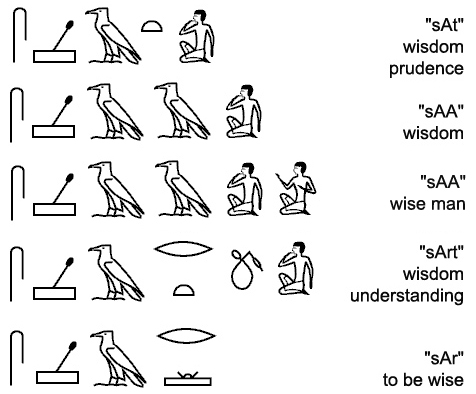


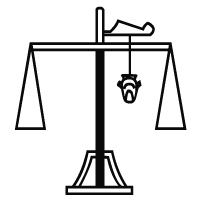

 ).
The notion of moving upwards is suggested by the determinative of the
double stairway (
).
The notion of moving upwards is suggested by the determinative of the
double stairway ( / 041), leading to a high place. This elevated place is nothing
less than the realm of the divine mind of Ptah, to which all possible
impressions ascend.
/ 041), leading to a high place. This elevated place is nothing
less than the realm of the divine mind of Ptah, to which all possible
impressions ascend. 

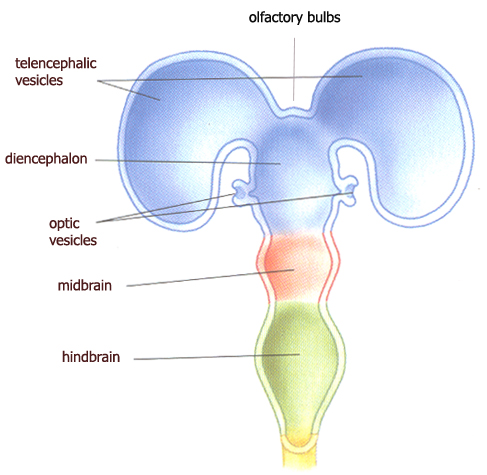
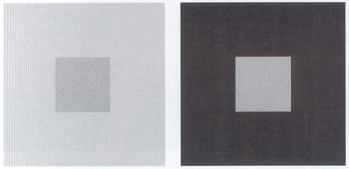
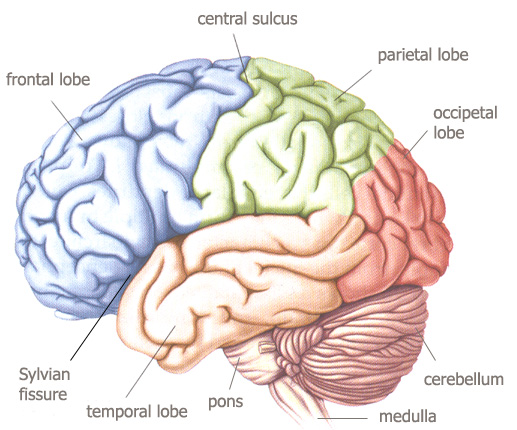
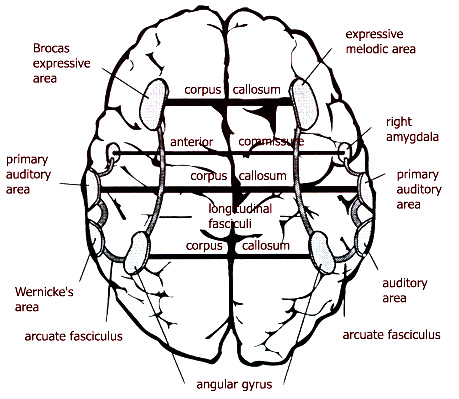
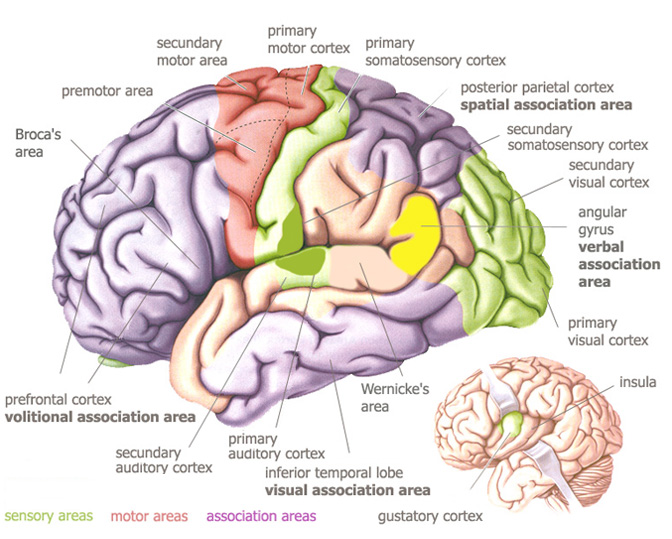
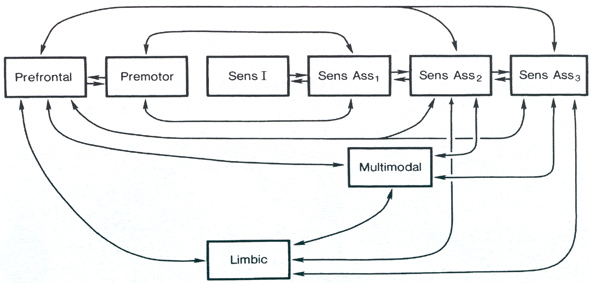
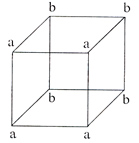
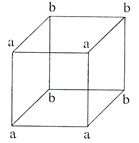
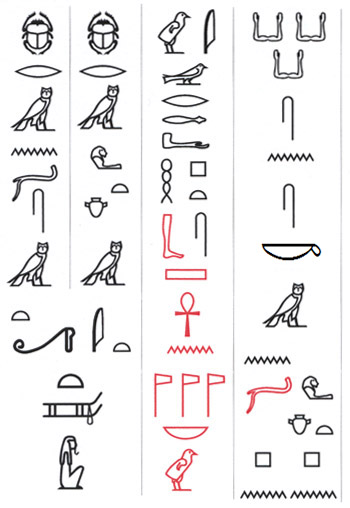
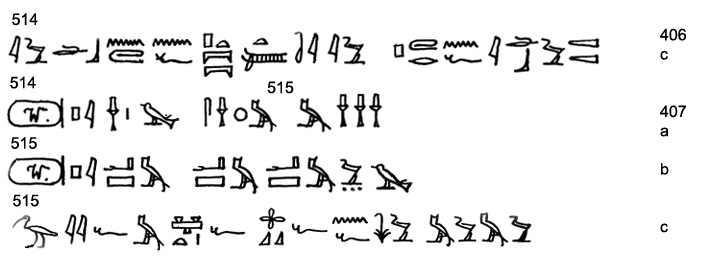
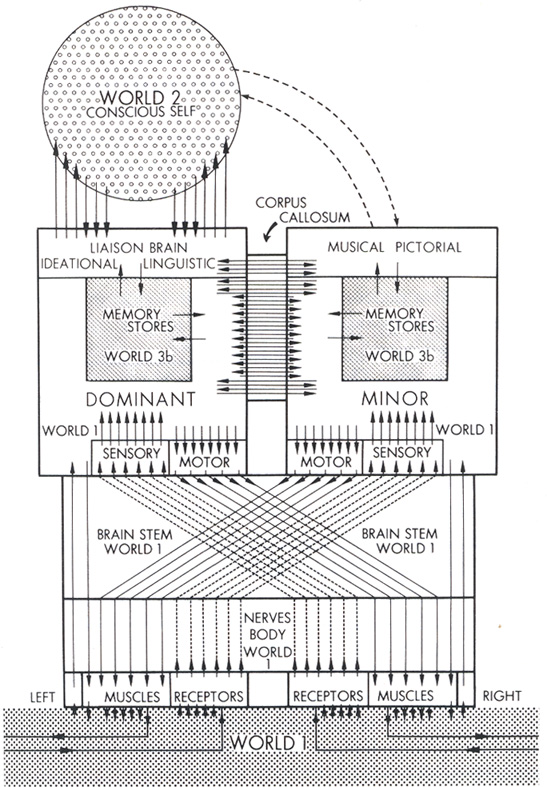
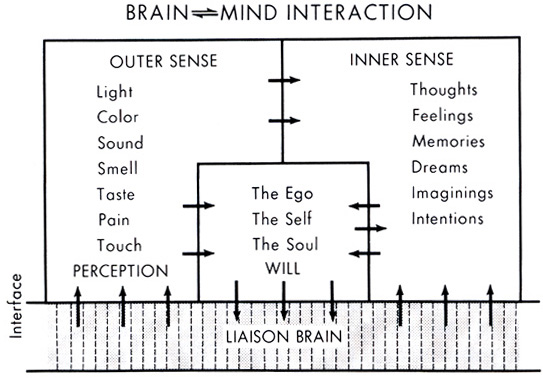
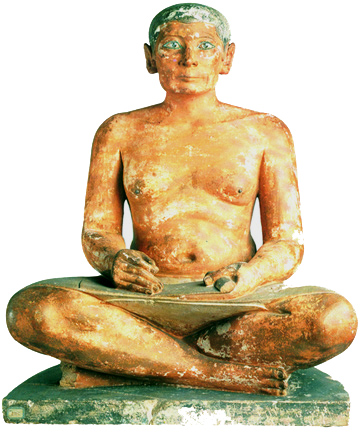
 ,
a single hieroglyph, representing a (mammal) heart + the determinative for "one"
(a stroke).
,
a single hieroglyph, representing a (mammal) heart + the determinative for "one"
(a stroke).
 , the forepart
of a lion ("HAt"), a bread ("t" - X1, phonetical complement) +
, the forepart
of a lion ("HAt"), a bread ("t" - X1, phonetical complement) +
 ("ib" - F34),
used as determinative for everything related to "heart". The first two signs
("HA" and "t") + stroke determinative meant "forehead", "forepart", "beginning",
"the best of", etc.
("ib" - F34),
used as determinative for everything related to "heart". The first two signs
("HA" and "t") + stroke determinative meant "forehead", "forepart", "beginning",
"the best of", etc.  , whereas
"Hatiiw" indicated "thoughts" ...
, whereas
"Hatiiw" indicated "thoughts" ... )
meaning thought or meditation (cf. to think, to think out, to say).
)
meaning thought or meditation (cf. to think, to think out, to say).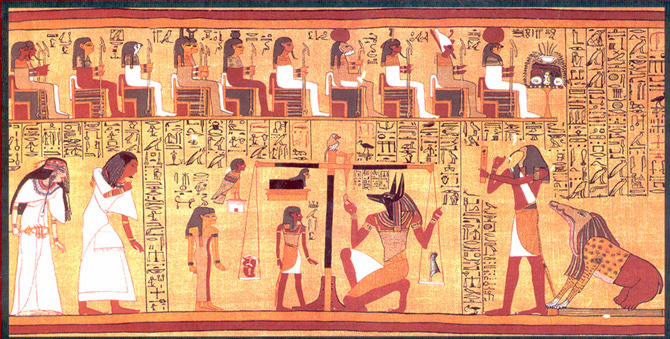

 , depicting
the Sun, signifies : "Sun", is a logogram, for this sign alone denotes the
Sun.
, depicting
the Sun, signifies : "Sun", is a logogram, for this sign alone denotes the
Sun. ,
depicting a mouth, signifies : "mouth", is also a logogram.
,
depicting a mouth, signifies : "mouth", is also a logogram. "rn" or "name" : the logograms of mouth and water