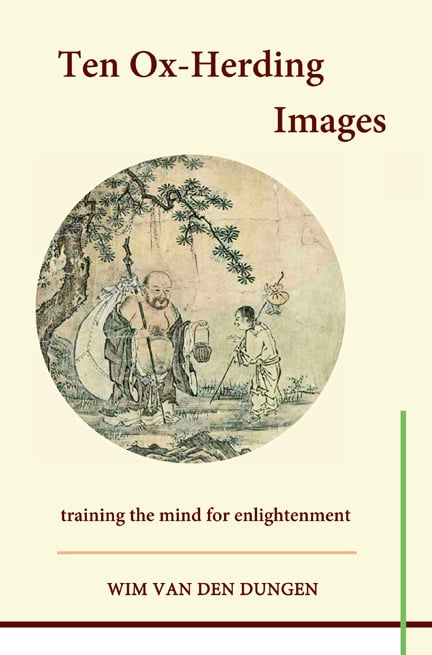
Ten Ox-Herding Images interprets the classical Ch’an sequence of the Rinzai monk Kakuan Shion Zenji of the 12th century as a map of awakening. The Ox symbolizes Buddha-nature or the very subtle, luminous mind ; the oxherd is the practitioner who seeks, recognizes, stabilizes, and finally releases this recognition. The first five images form a phase of struggle, moving from existential dissatisfaction through study, glimpse, capture, and training. The last five form a phase of ease, in which recognition becomes continuous, self-reference falls away, the world reappears as empty and interconnected, and awakening returns as compassionate action.
The commentary places the Ch’an images within the Buddhayāna as a whole. It relates their gradual sequence to Sūtra, Tantra, and Ati-Yoga and shows how progressive training can prepare and stabilize sudden recognition.
1. In Search of the Ox
Existential dissatisfaction initiates the search. The practitioner trusts that awakening is possible, but the Ox remains concealed by affliction, habitual thought, and wrong views.
2. Finding the Footprints
Study and reflection disclose indirect traces of the Ox. The path becomes intelligible, but the luminous mind has not yet been directly recognized.
3. A Glimpse of the Ox
A brief opening grants an experiential glimpse of the Ox. Grasping at the experience causes it to disappear, but its impact confirms the possibility of recognition and strengthens the will to continue.
4. Catching and Taming the Ox
The Ox appears wild and unruly because the clear mind is encountered through emotional affliction and conceptual obscuration. The practitioner struggles to stabilize what has been recognized.
5. Herding the Ox
Repeated practice makes recognition increasingly familiar. The mind can return to the Ox, but effort, vigilance, and discipline remain necessary.
6. Riding the Ox Home
The struggle ends. The luminous mind is continuously present and exists in harmony with the practitioner, giving rise to joy, spontaneity, creativity, and ease.
7. No Ox, Only Man
The Ox has been internalized and is no longer treated as a separate object to be pursued or possessed. Recognition becomes effortless, and wisdom and compassion arise together.
8. No Ox, No Man
A perfectly polished and reflective mirror stands in complete darkness. Nothing appears upon its surface, yet its clarity is unimpaired. Ox and oxherd, object and subject, are absent. There is only clear, nondual awareness without appearance.
9. Returning to the Source
The world reappears as it is : interconnected, empty of a substantial core, and unobstructed by reification. Ordinary things are encountered in their suchness rather than as independent entities.
10. In Town with Helping Hands
The awakened one returns to everyday life. Realization expresses itself as spontaneous participation, universal altruism, and compassionate action among sentient beings.

Ten Ox-Herding Images