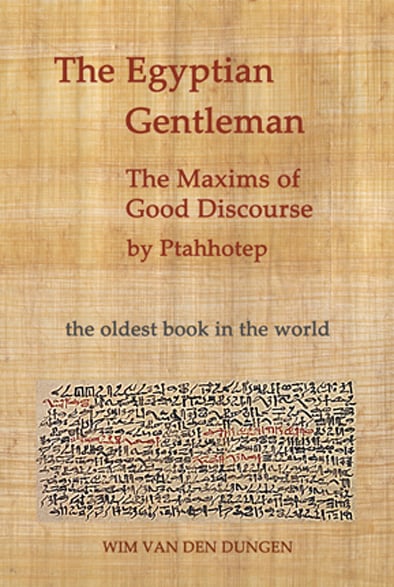
The book interprets Ptahhotep’s Maxims of Good Discourse as a deliberately composed sapiential teaching. Its governing movement leads from hearing to listening, from listening to understanding, and from understanding to right speech and action. A balanced heart sustains vital energy and allows Maʹat—truth, justice, equilibrium, and proper order—to become effective in personal conduct, social relations, and the passage from a good life to justification after death.
Prologue : The aged Ptahhotep asks Pharaoh for permission to transmit the wisdom of the ancestors to a “Staff of Old Age.” Framed as instruction from father to son, the text presents wisdom neither as innate nor as abstract theory, but as something received, heard, practiced, and renewed across generations. Its opening principle is decisive : no one is born wise.
Teaching : The thirty-seven maxims address authority, disagreement, appetite, friendship, family, office, crime, generosity, restraint, and the proper use of speech. Friends are sustaining riverbanks ; the accomplished “son-of-man” is known through his deeds ; punishment must establish an enduring example ; generosity must remain discerning. Their unity lies in forming a person whose heart, tongue, and conduct agree. The Egyptian gentleman listens carefully, speaks with mastery, acts without transgressing Maʹat, and fosters harmonious relations.
Epilogue : The teaching culminates not in mere hearing but in listening. The good son masters what he receives, acts upon it, exceeds his father’s instruction, and becomes capable of teaching his own children. Knowledge becomes wisdom only when good discourse takes form in action, while refusal to listen produces disorder, failure, and the depletion of life.
Faces of Maʹat : The final study broadens the Maxims through an examination of Maʹat in history and as order, the Eye of Horus, effective deed, wisdom, and salvation. It shows how the Egyptian gentleman’s practical rectitude belongs to a larger vision in which social harmony, the balanced heart, and posthumous justification are inseparable.