| |

Studies
in
Buddhadharma
On the
Buddhist Canon
 Contents
  SiteMap

The Theravâda Scriptures
The
Mahâyâna Scriptures
The Treasure-house of Tibetan Buddhism
The Wish-Fulfilling Gem Goes West ?
Critical
Considerations
"The wise are never arbitrary
when leading others into harmony with the truth. Wise, they are guarded by
truth, for they act in accord with the Dharma." - Dhammapada, verses 256 & 257.
"... the heart of the matter is that even with their differences,
all the Buddhist traditions are fundamentally of one taste. Please hold
this as the highest and most essential understanding."
Zangpo, Chökyi : Points to Remember about the View.
|
|
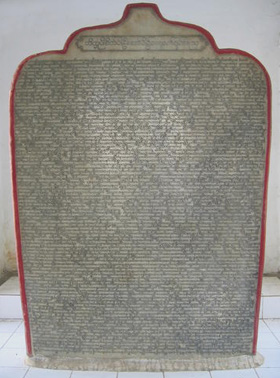
Kuthodaw Pagoda -
Burma
marble slab inscribed with a page of the Tripitaka - 1872 |
|
All extant Buddhist scriptures,
written in various Asian tongues, take up several library-shelves. Their
history of composition is rather complex and the status of many parts is
still under
dispute.
The
Theravâda Scriptures
1. The Pâli
Canon :
Fortunately, there is a consensus of sorts about certain texts written in Pâli, an
Indian dialect probably close to Magadhan, the language spoken by the
Buddha. Considered foundational by
Theravâda Buddhists in Sri Lanka, Burma &
Thailand, the Pâli Canon was first orally preserved. The earliest texts go back
to the time of
Buddha Śâkyamuni. The canon was probably written down only as
late as the first century BCE, but because of the mnemotechnics involved
(cf. the formulaic, repetitive, poetical style), their correct
transmission in not under dispute. In many Western minds, used to
fundamental theology based on revealed scripture, this has given rise to the flawed idea
"real" Buddhism can be found in the Pâli Canon rather than in the practice
of historical & contemporary Buddhist practitioners.
Indeed, despite the Pâli Canon, we only know approximately what the historical Buddha
really said. It is not impossible people lost touch with the
interpretative contexts of the surviving discourses. Given humour and irony were not
foreign to the Buddha, makes it even more difficult to understand these
texts as literal accounts of the religious life of their time.
According to tradition, the oldest discourses ("sûtra" in Sanskrit and
"sutta" in Pâli) of the Pâli Canon, like the Basket of Disciplinary Code
(Vinaya-pitaka) and the Basket of
Discourses (Sûtra-pitaka) were codified at the First Buddhist Council
(ca. 480 BCE), held shortly after the Buddha entered "parinirvâna". There
were 499 Arhats plus Ânanda present. On the basis of Upâli's account, the rules of
discipline were set down, and on the basis of Ânanda's the Sûtra-pitaka.
Then the text upon which all agreed was recited and thus memorized. Many
doubt the
historicity of this tale, but it reflects how the early
schools conceived the process of canonization. That a first collection
of texts was made relatively early, is however not in doubt.
Around 345 BCE, a Second Council with 700 Arhats was held at Vaishâlî. Better documented,
it is recognized as a historical event. The greater party (later to
become the Mahâsânghikas) refused to accept the addition of rules to the
Vinaya made by the smaller party (later to become the Sthaviras).
Although disunity in matters of discipline
was the reason for its convocation,
in the Singhalese tradition of the Theravâda, the ideological schism between the
Sthaviras and
Mahâsânghikas (ca. bhiksu Mahâdeva, ca.
320 BCE), was considered to be the
conflict leading up to it. However, other sources state the schism took
place on the basis of differences over the rules of conduct ("vinaya"),
and not over matters of doctrine, as would be the case later.
Scholars conjecture another meeting took place in the same period.
This Council at Pâtaliputra (ca. 308 BCE) is not recognized by the Pâli school of Sri Lanka
and deemed sectarian. Further less important councils were held during the
next centuries.
In Sanskrit, "tripitaka" or "Three Baskets",
designates the Pâli Canon, the scriptures of
the so-called Lesser Vehicle ("Hînayâna")
accepted by all Buddhists and partly considered authentic by hermeneutical science.
These three baskets consist of :
-
the
Vinaya-pitaka : (Basket of Disciplinary Code) accounts of the
origin of the Buddhist community or "sangha" and the rules of discipline
regulating the life of monks & nuns ;
-
the Sûtra-pitaka :
(Basket of Discourses) discourses spoken by Buddha Śakyamuni or his
immediate disciples, organized in five collections ("âgamas" in Sanskrit
or "nikâya" in Pâli) :
► Dîrghâgama (Dîgha-nikâya) : the "Long Collection", made up of 34 long sûtras ;
►
Madhyamâgama (Majjhima-nikâya) : the "Middle Collection" of 152 medium
length sûtras ;
► Samyuktâgama (Samyutta-nikâya) : the "Unified or Connected Collection" of 2.800
short sûtras ;
► Ekottarâgama (Anguttara-nikâya) : the "Graduated Collection, eleven sections with 2.300 sûtras ;
► Ksudrakâgama (Khuddaka-nikâya) : "Short Collection" of fifteen short miscellaneous texts ;
-
the Abhidharma-pitaka :
(Basket of the Special Teaching) : compendium of Buddhist
psychology & philosophy grown out or built around technical concepts.
Although some of these may have been introduced by the Buddha (cf. the
tradition claiming the Abidharma was recited during the First Council),
the bulk was composed between the 3th century and the first century BCE.
Two complete baskets have
survived : the Theravâdin (South-East Asia) and the Sarvâstivâdin
(North-West Asia). The latter, composed in Sanskrit, survived only in
Chinese and Tibetan translations.
Those oldest portions of the Pâli Canon narrowly concerning
the Buddha, like the Basket of Discourses and the Basket of
Disciplinary Code, were, like the rest of the discourses, not written down until three or four
hundred years after the physical demise of the Buddha. Because of the oral & social methods
used to safeguard his words, they were most likely better kept &
transmitted than we imagine today.
The Pâli textual tradition seems to stabilize about 100 CE onwards. At
this point the earliest Mahâyâna Sûtras are already extant ! So the notion
"real" Buddhism is to be found in the Pâli Canon rather than in historical
and/or contemporary Buddhist practice is, to say the least, questionable.
2. The
Sarvâstivâda Canon :
Under the reign of King Ashoka the Great (304 - 232 BCE), the
Sarvâstivâdins or "teaching
that says everything is", splits off from the
Sthaviras, the "adherents of the elders". They have their own canon,
composed in Sanskrit, partly preserved in Chinese & Tibetan translations.
The Abhidharma of the Sarvâstivâda school is considerably different from
that of the Theravâda school.
The Mahâyâna
Scriptures
1. The
Prajñâpâramita literature :
These sûtras were attributed to the Second & Third Turnings of the Wheel
of Dharma
by Buddha Śâkyamuni.
The centuries either side of the start of the common era mark the rise of
new sûtras, texts not belonging to the Tripitaka. In the earliest
sûtras of this new movement (the Saddharma-pundarîka Sûtra or Lotus
Sutra), the word "yâna" is used in the broader sense of "way" or "path".
Eventually, this "new way" identified itself as "Mahâyâna", or "Great
Way", a term becoming current only as late as the 4th century. Former Buddhist
schools were dubbed "Hînayâna", or "Lesser Way" ...
The distinction is foremost quantitative : the Greater Vehicle have a
universal salvic aim,
Buddhahood for
all sentient beings, while the Lesser Vehicle seeks personal
liberation
only.
Early Mahâyâna texts like the Saddharma-pundarîka Sûtra & the
Astasâhasrikâ-prajñâpâramita Sûtra lack key Mahâyâna terms. The
Vajracchedikâ Sûtra & the Kâśyapa-parivarta Sûtra do not even mention the
Bodhisattva ideal. These early Mahâyânists seem primarily concerned with
the Abidharma schools, the status of the Buddha & the relevance of lay
versus monastic status to spiritual realization.
From the first century CE to the middle of the first millennium CE, a vast
variety of Mahâyâna literature is produced and its important sûtras mainly focus
on the ideal of the
Bodhisattva, cultivating "Bodhicitta". Many define
themselves as "vaipulya" or "expanded", implying acceptance and knowledge
of the teaching of the mainstream scriptures, but adding a more
comprehensive perspective of the
Dharma, particularly
in terms of wisdom
& compassion.
The Mahâyana is not an institutional segregation, for there never was a
Mahâyana Vinaya ! Mahâyânists are ordained within the "nikâyas" of
non-Mahâyâna schools (in Tibet, all monks abide by the Sarvâstivâda
Vinaya). Becoming a Mahâyânist is like expanding the Lesser
Vehicle. The "sûtra" part of the Bodhisattva training (the
Great
Perfection Vehicle) does not contradict the teachings of the Lesser
Vehicle, but "expands" them.
The Sutric Bodhisattva achieves Buddhahood for the sake of all sentient
beings.
2. The Tantric literature :
These sûtras were attributed to the Fourth Turning of the Wheel of Dharma
and are intimately connected with the Third Turning. The last Turning is
not accepted by the non-tantric schools.
Within the context of the Mahâyâna, Buddhist
Tantra gave rise to again a completely new body of texts. The
emergence of this first phase of Vajrayâna or "Adamantine Vehicle", the
third phase of Indian Buddhism, dates from the early 2nd century CE
(other names for it are "Tantrayâna" & "Mantrayâna"). Its earliest tantras
are from the "kriyâ" tantra class (Action Tantra) and were translated into
Chinese from the 3rd century. This expansion of the Mahâyâna
consists in the adoption of additional "turbo" technology ("upaya",
or "skillful means") rather than in wisdom ("prajñâ").
In particular, rituals, specific yogic techniques & the use of Deity Yoga are outstanding.
This "esoteric" Buddhism remained Indian, secretive & a private minority
interest until the 8th century, when, with the arising of the Pâla dynasty
of Bihar & Bengal (760 - 1142 CE), the Vajrayâna entered the great
universities. Buddhist Tantra then becomes international. This second
phase marks the origin of the Vajrayâna proper, including its symbolism,
terminology & ritual. The latter is adaptive to circumstance, uses the
"standard" subtle apparatus of Indian yoga (the Vajra-body of winds,
channels, wheels & drops), adding the wisdom of seeing reality as it
is, i.e. empty & interdependent. It was largely from the Indian
universities at Vikramaśîla and Odantapurî that Buddhism was taken to
Tibet.
The Tantric Bodhisattva achieves Buddhahood for the sake of all sentient
beings as soon as possible.
The
Treasure-House of Tibetan Buddhism
The stages of the history of
Tibetan Buddhism run
parallel with the founding of its five major schools, less differentiated
on doctrine than on practice and hosting all tenets on emptiness. All
orders follow the "vinaya" of the Mûla-Sarvâstivâda School, the standard
since the founding of the first monastery, Samyé. They also share common
assumptions about what was inherited from India : Buddha provided
divergent dispensations relative to trainees, condified by Tibetan
doxographers into three distinct vehicles : the Lesser, Greater and
Diamond Vehicles. All orders share the Mahâyâna orientation.
Moreover,
these exegetes also divided the various tenets on emptiness into four main
schools : Great Exposition School, Sûtra School, Mind-Only School and
Middle Way School. Each is associated with particular lineages, texts,
practices, doctrines etc., but in all orders the Middle Way approach
of Nâgârjuna is considered definitive. The heritage of these orders came
to them from the scholastic institutions of northern India during the
second dissemination of Buddhism and from the "siddha" lineages centered
in Bihar & Bengal. Although often defined as "sects", from a Ri-mé
approach all schools lead to awakening.
In the late nineteenth century, because of the sectarian orientation of
the orders, previously causing competition, persecution and fractional wars, a
nonsectarian countermovement was initiated. This "Ri-mé" movement
challenged the scholastic approach of the Gelugpa order and focused on
Indian "root-texts". However, most of the Lamas adhering to this movement
favour the view of "Shentong" or "other-emptiness" (Mipam is a prominent
example of a Ri-mé Lama adhering to self-emptiness). In nonsectarian
Ri-mé, all schools find their way into the "great stream" and from there
flow into the "great ocean" of
Dzogchen. The
present studies are inspired by this lofty ideal.
-
ca.650 - 775
CE : the Nyingma or advent of Buddhism
:
During the reign of Songtsän Gampo (ca. 604 - 650), Buddhism came to Tibet
from India around the middle of the seventh century CE, resulting in the
decline of the native Tibetan culture & religion, shamanistic Bön
("invocation"). During the reign of king Trisong Detsen (742 - 797),
Kamalaśila (ca. 700 - 750), Śântaraksita (ca. 725 - 788)
and the Indian tantric master Padmasambhava (?) were invited. He subdued a
vast number of evil spirits terrifying the Tibetans. He did not
eliminate or annihilate these negative forces, but used them as protectors and/or as
fuel for the journey towards enlightenment. In 775,
he founded Samyé Monastery, the first Buddhist temple (Tib. "gompa") in
Tibet. The first school of Buddhism in Tibet (the so-called "Nyingma" or
"old translation school") traces its historical origins back to Padmasambhava and his
teachings. He brought the tradition of
Dzogchen ("Great Perfection") to
Tibet. He hid a great number of teaching in the form of texts (Tib.
"terma"). He is also known for the Bardo teachings.
Samantabhadra, the Buddha of the Essence of the Wisdom of the Dharmakâya,
is the origin of the lineage. He passed it down to Vajrasattva, who
transmitted the teaching to Garab Dorje (ca. 55 CE). The Nyingma school
divides the
Buddhayâna in Nine Graded Vehicles
(Hearers, Solitary Realizers, Bodhisattvas, Action Tantra, Performance
Tantra, Yoga Tantra, Mahayoga, Anuyoga & Atiyoga) ;
-
1056 CE : the
Kadam school or the revitalization of Buddhism
: after the
bitter persecution of Buddhism by the Bön-king Langdarma (between 838 &
841 CE), probably assassinated by a Buddhist hermit in 842 CE, Buddhism
was revitalized by the Indian master Atiśa (982 - 1054), initiating the
so-called "second dissemination". He stayed seventeen years in Tibet and
his lay disciple Dromtönpa (1005 - 1064) received and transmitted all of
his master's major lineages and "pith instruction spoken by the Buddha"
(or "Kadam"). In 1056, the latter founded Reting Monastery near Lhasa, and
source of the Kadampa lineage. These Kadampa Masters are outwardly modest
but inwardly very advanced, emphasizing mind transformation techniques
(Tib. "lojong") and taking & giving (Tib. "tonglen") ;
-
1069 - 1153 CE : the Kagyu school : the
Indian mahasiddhas Tilopa (988 - 1069) & Nâropa (1016 - 1100) are the
major patriarchs of the Kagyu, or "Ear-Whispered" tradition or Oral
Lineage (of spotless practice). Tilopa got them directly from Buddha
Vajradhara & Vajrayogini and transmitted them to Nâropa, who passed them
on
to Marpa Lodro (1012 - 1096), who's heart-son was Jetsun Milarepa (1052 -
1135). The latter transmitted the most powerful instructions of Tilopa to
Gampopa (1079 - 1153). Their central doctrine was called "Mahâmudrâ", or
"Great Seal", directly realizing the emptiness of the mind,
leading to instantaneous self-realization of the luminous nature of mind.
They are also known for the Six Yogas of Nâropa : inner
heat yoga, illusionary body yoga, clear light yoga, yoga of consciousness
transference to a higher plane, yoga of consciousness transference to
another body & bardo yoga ;
-
1073 - 1151
CE : the Sakya school
: in 1073, Gonchok Gyalpo (1034 -
1102) founded Sakya Monastery in southern Tibet (near
Shigatse) at a site of grey, pale Earth (Tib. "sakya") spotted as
auspicious by Atiśa in 1040. The greatest contribution of this school is
known as "The Path and Its Fruit" (Tib. "lamdre"), a system encompassing
the entire range of Sûtra and Tantra in terms of the meditational deity
Hevajra. These teachings are traced back to the ninth-century Indian
mahasiddha Virûpa, a life-long practitioner of the Cakrasamvara Tantra.
His teachings were passed on to Gonchok Gyalpo via the scholar and
translator Drogmi, a contemporary of Atiśa. Their greatest master was
Kunga Gyaltsen (1181 - 1151), better known as Sakya Pandita. Associating
themselves with the Mongols, they effectively ruled Tibet (cf. the
Sakya Dynasty between 1268 & 1364) ;
-
1409 CE : the Gelug school :
in 1409, Je Tsongkhapa (1357 - 1419), Tibet's most outstanding religious
reformer & yogi-scholastic, founded Ganden Monastery, the original gompa
of the Gelugpas, the Virtuous Ones. Other names for this school are
"Gandenpa", recalling the school's first monastery and "New Kadampa",
acknowledging Tsongkhapa's integration & propagation of Atiśa's Kadampa
lineage. He collected the three Kadampa lineages and integrated them along
with Sakya, Kagyu and other teachings. He also studied Dzogchen. His
emphasis on reason, ethics and the analysis of the mind are remarkable.
Placing great emphasis on pure moral conduct, the teachings of Tsongkhapa
insist upon the absence of conflict between absence of inherent existence
(the ultimate nature of emptiness) and valid conventional functioning
according to determining laws, or dependent arising. While the Nyingma,
Sakya & Kagyu schools formed the "Red Hats", Gelugpas were known as the
"Yellow Hats". This iconic distinction points to the powerful new
synthesis introduced by Tsongkhapa. His Gelug school was a fusion of
lineages from a dozen earlier sects. Even today, this is the most
prominent school, having the Dalai Lama among its ranks.
During the golden age of the five schools and their
numerous lineages, sects & subsects (775 - 1959), the native Tibetan shamanistic Bön
tradition adapted the specifics of Shamanism to Buddhism. It survived and
has recently been made part of Tibetan Buddhism by the XIVth Dalai Lama,
standing at the same level as the other schools and deemed "the fifth
school" (for the Old Kadam was incorporated in the Gelug school).
Yungdrung Bön is the root culture and religion of Tibet. According to
historical Bön texts, the kingdom of Zhang Zhung, where these teachings
are said to have originated, was the closest neighboring kingdom to Tibet,
existing until the end of the eighth century CE. Zhang Zhung extended from
what is today the upper part of western Tibet through Nepal, northern
India (Kashmir, Ladakh, Zanskar, etc.) to Pakistan (Kashmir) and the
Karakoram area in China. Tönpa Shenrab was the legendary founder of the
Bön, born 18.000 years ago (sic) ! He visited Tibet and introduced a series of
practices found in no other form of Buddhism outside Tibet, like putting
up prayer flags, making smoke offerings to protectors, performing
divination, using astrology, long life rituals, harmonizing the
environment, death-rituals, exorcisms, consecrations, empowerments, etc.
These shamanistic practices were later successfully adapted to Buddhism,
particularly in Tibet. This "New" Bön is organized in nine steps, of which
the first four are "causal" and the last five "resultant" or "fruition".
The higher-level teachings include Tantra & Dzogchen (the "Great
Perfection").
This short overview clearly shows how Tibetan Buddhism, except for Bön,
was dependent on India. When Buddhism officially entered Tibet (ca. 650 CE), Indian
Buddhism had already entered its "Tantric" phase, which came to a close in
the 11th century with the Kâlacakra Tantra. In Tibet, Buddhism was
revitalized, giving rise to the Old Kadam, Kagyu & Sakya schools. Again Indian
Buddhism initiated ...
The great scholar & encyclopedic writer Bu-ston (1290 - 1364) was primarily
associated with putting in order the accumulation of five centuries of
vast quantities of texts translated out of Sanskrit & Chinese. But at that
time, the Buddhist centers in India had been largely destroyed by the
Muslim invaders and Tibet became the principal storehouse of a vast
array of Buddhist teachings.
The Tibetans knew very well what they had learned and were able to put
this knowledge to practical use in the fields of divination, yoga, magic &
Tantra. As a result, they transmitted Indian Buddhist lineages for over more
than a millennium (ca. 650 - 1959), while some of the Indian lineages
began as early as ca. 150 CE. Novelty and creativity were and are not part
of the logic behind the transmission of these lineages. Adaptation
perhaps, but never invention. Neither can we say of Tsongkhapa he
came up with new concepts or that he was a revolutionary. Gelugpas
are known for their scholastic, rationalistic, conservative & pragmatic
stand. With Tsongkhapa, the ideal of a final synthesis of all schools had
been given body.
Lamaism, the socio-political organization created by the nobility & the various schools,
and centralized by the Gelug & the Vth Dalai Lama, has to be understood in this context.
Without lineages and their empowerments, much would have been lost.
Without the strict Guru/disciple context, pure transmission would have
been very difficult, if not impossible. Indeed, despite the vast written
corpus of Tibetan Buddhism, directly affecting human memory was and still is the
preferred mode of transmission. Such a "personal" approach guarantees the
unaltered continuity of the original teachings. If every master teaches
his disciple mastership, then the link is never broken. By adhering
to this strict discipline, most lineages survived. Thanks to the
teachings of the Venerable Rinpoches in the West, much of what was
"secret" is now published and so available to a wider number of people,
much to the joy of those who wish to see the Buddhadharma flourish
everywhere on this planet, and this in a scientific, nonpartisan spirit !
Nowadays, the traditional system of transmission is more of a hinderance
than an asset.
The
Wish-Fulfilling Gem Goes West ?
The following prophetic prediction is attributed to
Padmasambhava :
"When the iron bird flies, and horses run on
wheels, the Tibetan people will be scattered like ants across the World,
and the Dharma will come to the land of the Red Man."
Indeed, since 1959, when Tenzin Gyatso, the XIVth Dalai Lama, fled Tibet,
the history of the transmission of the
Buddhayâna entered a new phase. Before,
Lamas would never leave Tibet for the West and their vast & profound
teachings were kept secret and in the hands of a small elite (like the
Dalai Lamas, Throne Holders, Abbots & Senior Lamas). Since the sixties
of the previous century,
lots of texts have been translated & published in foreign languages,
Western scholarship took up the challenge to scientifically grasp Tibetan
history, language, culture, etc. and hosts of Venerable Rinpoches, on
prolific donation tours, visited the West to teach, empower & build
monasteries. As these teachers worked outside the protective circle of
their monastic culture, former "secrets" were divulged with ease and this
in a way unseen for over a millennium. After four decades of many
excellent translations,
teachings, empowerments, monasteries, retreats, etc. the teachings of Lord Buddha
were
adapted to the Western mind.
What to say about this ?
-
a better
understanding of Buddhism
: before 1959, the West had primarily been in
touch with Theravâda, the last surviving school of the Hînayâna (or
Individual Vehicle), and with Zen, the Japanese way of reading the Chinese
"ch'an-an" (or "ch'an"), a Mahâyâna school developed in the 6th & 7th
centuries CE. It was based on the Dhyâna Buddhism of Bodhidharma (ca. 470
- 543 CE) and on native Taoism. After the exile of the Dalai Lama, a more
comprehensive picture rose, in particular of the Mahâyâna & the Vajrayâna
;
-
an alternative
view on transmission
: although Lamas continue to stress the
importance of the Guru/disciple relationship, Buddhist teachings have been
disseminated without the restrictions at work in Tibet, where chosen
disciples (often reincarnated masters or "tulkus") had to spend decades of
preparations before receiving any core teachings. Today, numerous books,
audio-visual techniques & resident teachers provide the practitioner
with all the data needed to practice all Buddhist Vehicles, the Vajrayâna
included ;
-
an open
study & practice of Tantra
: in the practice of Tantra , all Lamas
stress the importance of empowerments or initiation ("abhiseka"). Some
stern Lamas say those who dare to practice without initiation end up
as hell-beings ! For Venerable Rinpoches it depends on the individual. In
certain rituals, disciples swear oaths which, if broken, condemns him or
her to such a special Vajra-hell. Such fear-induction is not productive, and reminds us of the
abuses of Medieval Catholicism. Given the vast amount
of recent publications on the subject, a constructive study & open
practice of Buddhist Tantra is finally possible. If Tantra is so secret,
then why publish ? In the Tibetan cultural context, empowerments ensured
the purity of the lineage. Nowadays, with all the media in the world, this
is hardly necessary, although the personal effect of a ritual of
empowerment cannot be denied. As the complexity of Tantra self-protects,
the argument saying it cannot be practiced without an Outer Guru is
questionable. Without vast compassion, Tantra does not work. Its
self-secret power is immense ;
-
the divorce of Buddhayâna & Lamaism : the
complete Buddhist path can be studied & practiced without relying on the
hierarchy imposed by Lamaism. The latter seems to reflect the theocratic
reflex entrenched in Tibetan culture. The distinction between Tibetan
culture and Buddhist spirituality identifies the outdated autoritarian
trappings of the Tibetan priesthood ... The notion Lamaism is necessary to
guarantee the Vajrayâna is like saying Roman Catholicism is necessary to
guarantee the purity of Christianity, a position untenable since the
Reformation ;
-
the rise of new Buddhist schools
: the fact inner tensions between the Lamas-in-exile have given
rise to renegate schools (cf. the conflict between the XIVth Dalai Lama & the
New Kadampa Tradition), proves the point of laicism and the concept of a
secular state, stressing the absence of religious interference in
government affairs and vice versa. Such secularism allows for the
rise of new schools, movements & groups, allowing Buddhism to diversify
and adapt to the modern, postmodern and hypermodern way of life. The fact
the current Dalai Lama is a lineage holder of all Tibetan schools,
runs against this pluralism and legitimizes a monist, buddhocratic view on
Vajrayâna Buddhism. History shows this approach is possible, but the
question is whether it is still tenable today and in the future.
Critical
Considerations
Judaism,
Christianity &
Islam lack
historical authenticity. Indeed, canonization, usually initiated after the
demise of the founding mystic, often, if not always, recontextualizes, interpolates and
"adapts" the original teaching, allowing some to be lost for posterity.
In
Judaism, the redaction of the Torah has had many historical
layers (cf. the Pentateuch, the work of Ezra, the Septuagint,
Rabbinical tradition after the destruction of the Second Temple in 70 CE). In
Christianity, the difference between Q, the
source-teachings of the
Jesus-people and the New Testament of the
orthodox centrists is remarkable. Also in
Islam, the various
redactions of the Koran made it possible to posit different
historical readings, sectarian interpretations & levels of meaning, as
Sufism
clearly demonstrates.
Buddhism is not a "religion of the book", and so offers no
revelation. Being non-theist or transtheist, its "scriptures" are Dharma
teachings intended to assist those seeking enlightenment. By imagining
84.000 Dharma doctrines, the Buddhadharma point to the open, flexible
nature of the Dharma, its capacity to change & adapt to new
circumstances and new audiences. Just as scientists continue to discover
new kinds of medicine, Bodhisattvas and
Buddhas are able to devise new skillful means to liberate &
enlighten sentient beings. This sets Buddhism apart as a dynamic science
of mind and religious philosophy.
Hence, within the context of the Four Turnings, new Buddhist scriptures
may see the light. Absence of closure implies continuous change &
(re)adaptation (so absent in theist theologies). So the goal of the
Buddhadharma
is not a life in accord with the fixed commandments of God, Gods,
Goddesses or Buddhas, rewarding us in
heaven or punishing us in hell, but actual
Buddhahood, the unconditional
state of true peace hic et nunc. In the Mahâyâna, this concrete goal is
realized for the sake of all sentient beings, and, using the
resultant technology of Tantrayâna, may even be ours in this
lifetime.

|
|