| |

Studies
in
Buddhadharma
A Very Short Political History of Tibet
 Contents
  SiteMap

"My brother said to me ... 'If You shut your
eyes to a frightening sight, You end up being frightened. If You look at
everything straight on, there is nothing to be afraid of.'" - Kurosawa, A. : Something Like an Autobiography,
1983.
|
|
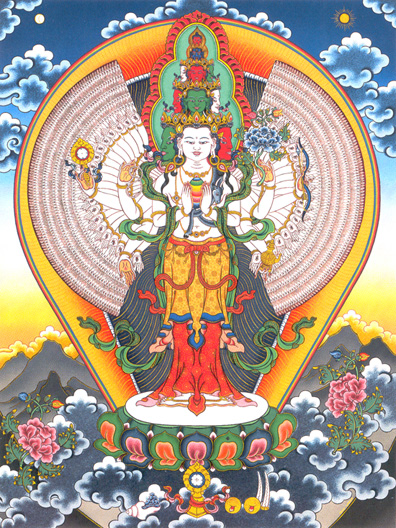
Avalokiteśvara, Buddha of Compassion
appearing as an Eighth Ground Bodhisattva (Weber, 1983)
Protector of Humanity & the People of Tibet |
|
A Short History of Tibet
The more one studies Tibet, the clearer its complexity becomes.
Just like the uncorrupted
Pyramid Texts of Unas, the much larger
corpus of millennia old Buddhist material preserved by Tibetan Lamaism
is remarkable and contains a multitude of skillful
methods and profound
insights into the ultimate nature of phenomena, the
wisdom of the Buddha
apprehending
emptiness.
In Tibet, native Bön (Shamanism, divination, magic, cult of the dead,
spirit-worship) and
monastic Lamaism (the monastic form prevalent in the four schools of
Tibetan Buddhism) intermixed. In the 1950s, both were forcefully ousted
and replaced by Communist dictates ... The biased Tibetan government-in-exile
"estimates" that due to
Mao's "violent" policies, between 1950 & 1959, ca.1.200.000 people were tortured & killed
(although this number has been criticized and "adjusted" to no more than
500.000, if true, a terrible figure indeed), 95% of the monasteries looted and sacred
texts & images destroyed. In the '60, the Cultural Revolution killed
ca.173.000 Tibetans. Tibetan Buddhism was systematically humiliated
(the most important temple, the Jokhang, was turned into a pig stall and
its historical Buddha statue destroyed !). These radical Communists tried to root
out religion, but -as in Russia- shamefully failed ...
The legitimacy of this Communist invasion can and should be questioned,
criticized and rejected. Nor can the
old political connections between pre-Communist China and Tibet be
overlooked. Obviously, nothing condones the violence with which
Communist China tried to so-call "liberate" Tibet. Nor
does it justify the Chinese claim Tibet was always part of China, which is
obviously not the case. In fact, at the time when Tibet was overrun by Communist China, Tibet was
actually independent !
Let us consider the political fact-line.
It is interesting, before dealing with the more recent history, to remember the
terms of the treaty signed between the Chinese and the Tibetan Emperor as
early as
822 CE :
"The Great King of Tibet, the Miraculous Divine
Lord, and the Great King of China, the Chinese Ruler Hwang-ti, being in
the relationship of nephew and uncle, have conferred together for the
alliance of their kingdoms. They have made and ratified a great agreement.
Gods and men all know it and bear witness so that it may never be changed
; and an account of the agreement has been engraved on this stone pillar
to inform future ages and generations.
The Miraculous Divine Lord Tri-tsug De-tseji and the Chinese King Wen Wu
Hsiao-te Wang-ti, nephew and uncle, seeking in their far-reaching wisdom
to prevent all causes of harm to the welfare of their countries now or in
the future, have extended their benevolence impartially over all. With the
single desire of acting for the peace and benefit of all their subjects
they have agreed on high purpose of ensuring lasting good ; and they have
made this great treaty in order to fulfil their decision to restore the
former ancient friendship and mutual regard and the old relationship of
friendly neighbourliness.
Between the two countries no smoke nor dust shall be seen. There shall be
no sudden alarms and the very word 'enemy' shall not be spoken. Even the
frontier guards shall have no anxiety nor fear and shall enjoy land and
bed at their ease. All shall live in peace and share the blessing of
happiness for ten thousand years. The fame of this shall extend to all
places reached by the Sun and the Moon.
This solemn agreement has established a great epoch when Tibetans shall be
happy in the land of Tibet, and Chinese in the land of China. So that it
may never be changed, the Three Precious Jewels of Religion, the Assembly
of Saints, the Sun and Moon, Planets and Stars have been invoked as
witnesses. An oath bas been taken with solemn words and with the sacrifice
of animals ; and the agreement has been ratified.
If the parties do not act in accordance with this agreement or if they
violate it, whichever it be, Tibet or China, nothing that the other party
may do by way of retaliation shall be considered a breach of the treaty on
their part.
The Kings and Ministers of Tibet and China have taken the prescribed oath
to this effect and the agreement has been written in detail. The two Kings
have affixed their seals. The Ministers specially empowered to execute the
agreement have inscribed their signatures and copies have been deposited
in the royal records of each party.
Tibet and China shall abide by the frontiers of which they are now in
occupation. All to the east is the country of Great China ; and all to the
west is, without question, the country of Great Tibet. Henceforth on
neither side shall there be waging of war nor seizing of territory. If any
person incurs suspicion he shall be arrested ; his business shall be
inquired into and he shall be escorted back.
Now that the two kingdoms have been allied by this great treaty it is
necessary that messengers should once again be sent by the old route to
maintain communications and carry the exchange of friendly messages
regarding the harmonious relations between the Nephew and Uncle. According
to the old custom, horses shall be changed at the foot of the Chiang Chun
pass, the frontier between Tibet and China. At the Suiyung barrier the
Chinese shall meet Tibetan envoys and provide them with all facilities
from there onwards. At Ch'ing-shui the Tibetans shall meet Chinese envoys
and provide all facilities. On both sides they shall be treated with
customary honour and respect in conformity with the friendly relations
between Nephew and Uncle."
When the last Emperor of Tibet died (Lang Darma in 842), the empire fell
apart. The fundamental & radical conflict between native Shamanism (Bön)
and Buddhist Lamaism had led to violent tensions and a drastic split
between, on the one hand, royals, aristocrats and leading Lamas adhering
to Buddhism and, on the other hand, those adhering to the native Bön,
safeguarding their own local authority against any central power. The
conflict between Buddhism & Bön had been there from the start (cf. Padmasambhava's role, from 763
onwards, in binding the "evil spirits" Shāntarasita was unable
to). As soon as Lang Darma was
enthroned, he turned against the monastics. For a century, Buddhism was
eradicated in Middle Tibet. This period is called the "dark age" or the
"age of fragmentation".
"This may have been a dark age -the light of the
dharma may have gone out- from the perspective of monastic institutions
and centralized authority, but it was no time of stagnation and decay. In
fact, the institutional darkness of the age and its remarkable creativity
were two sides of the same coin. The political fragmentation of Tibet was
precisely what allowed the populace to make Buddhism their own, freed from
the controls of a centralized monastic authority."
-
Dalton, 2011,
p.13.
From the 10th century onward, Tibet was a tapestry of monasteries, nomads
& nobles seeking no unified authority. This regionalism, both spiritually
as culturally, initiated fractional, tribal & violent geosentimental
divisions lasting for over three centuries. In the 11th century, the
Dharma of Lord Buddha was reintroduced. Initiated by the "old" Nyingma
school of Padmasambhava, the Dharma had been at war with Bön, hiding from
the nobility. With the murder of Lang Darma by a Buddhist monk, three
centuries of strong central authority ended. The Buddhadharma had strived
and, at the end, encountered oppositions from within the Tibetan mentality
(Bön). For more than a century after Lang Darma's death,
international exchanges were absent. Tibet fell apart and internal wars
between monasteries & their wealthy patrons were ongoing.
After having found ample sources in the North of India, many new Tibetan
schools saw the light. They appeared and ceased, but four great lineages
endured : "Kadam" (Atiśa), "Sakya" (Sakya Pandita) & "Kagyu" (Milarepa),
and of course the "Old Translation" Nyingmapas.
The presence of these early schools
of Tibetan Buddhism, each with their own focus and points of attention, as well as
the divisions between powerful, wealthy chieftains sponsoring the
monasteries (while later, the rich monasteries backed the aristocrats),
divided Tibet politically. This lasted until 1268, when Tibet became part of the
Mongol Empire.
At this point, fractions were united by superior force.
The Mongol Empire was created by Djingis Khan (1155/1162/1167 -
1227) and his 125.000 "nomadic barbarians". It exceeded the Roman Empire.
Between 1207 and 1215, he subdued the kingdoms on his southern borders :
Ujgurs, Tangut & Jin. For the moment, the Song Chinese, proud & strong,
were left alone. Until his death, Djingis Khan conquered a vast territory
West of China, including Iran, Afghanistan, Kazachstan, Turkmenistan,
parts of Turkey, Armenia, Azerbeidzjan and large parts of Russia & Europe.
In 1240, Djingis Khan's grandchild, Godan Khan, dispatched a small army to
Tibet. It encountered little resistance, killed 500 Tibetans, ransacked
several monasteries and left. But during their raids, their commanding
officer got fascinated by Buddhism and the spiritual powers of the Lamas.
In 1247, the monk Sakya Pandita became Godan Khan's teacher. When later
Kublai Khan (1215 - 1294) became prominent, he also showed interest in
Buddhism and was taught by Sakya Pandita's nephew, Phagpa Gyaltsen. When he
became the "Great Khan" (in 1260), Phagpa became his imperial teacher. In
1268, three years after Phagpa was send back to Tibet to be installed as
the Mongol vazal or vice-king of Tibet, the Mongols established their rule
in Tibet and erected the administrative system. In that same year, the
alphabet developed by Phagpa, devoid of Chinese characters, became the
official writing of the Mongol Empire (it remained in use for 110 years).
The Mongols began conquering the Song Chinese only as late as 1258, but
because of the fierce resistence, this took more than two decades. In
1271, Kublai Khan named his own dynasty, the "Yuan", completing the
destruction of the Song Chinese in 1279. The "Yuan" Dynasty was Mongol,
not Chinese. Kublai Chan tried to separate both and his Forbidden City was
intended to do just that. As a Mongol enclave in Beijing, its access was
forbidden to the native Chinese !
Despite propaganda, the Mongols first subdued Tibet
(1268) and then the Song Chinese (1279). So at the time when Tibet
actually became a vazal of
the Mongol Empire, the Song Chinese were still independent. The
Mongols ruled both countries independently from each other and treated
both in a different way, underlining their cultural autonomy. The Mongols,
establishing "khanates" in both China & Tibet, did not establish Chinese
authority over Tibet, although they brought both together under one rule.
So it is not the case that Tibet became part of the Chinese Yuan Dynasty !
The Mongols ruled both the Tibetans & the former Song Chinese. In 1368, the latter
drove the Mongols beyond the Great Wall and initiated the Ming Dynasty.
Meanwhile, in 1352, Changchub Gyaltsen rejected the Sakya Dynasty
installed by Kublai Khan in Tibet. In 1358, he was accepted by the
Mongols as the new vice-king, but he soon replaced Sakya-officials loyal to the
Mongols. The dream of a "Tibetan Empire" never vanished. He died in 1364 and his nephew headed the so-called "Phamo
Drupa-reign" or Gyaltsen Dynasty. In 1368, Tibet rejected any connection with the Mongols and
became again independent. This is an important moment. Seeking a strong
protector is not the same as having to obey the protector. Suzerainity is
not the same as sovereignty. In matters of independence, Tibet identifies
itself as a nation, but once independent succumbs (again) to its fractions.
|
|
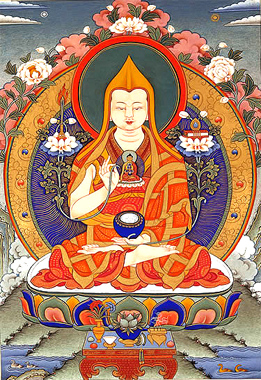
Lama Je Tsongkhapa
Founder of the Gelugpa Order |
|
At the end of the Phamo Drupa-reign (ca. 1434), a new
fraction rose in power. This Rinpung fraction of kings backed the Red Hat Kagyupas
and in ca.1500 this school found reasons to curtail the power of the fast
growing Yellow Hat Gelugpas, the new Kadampas initiated by Tsongkhapa (1357 - 1419). Kagyu monks ransacked Gelug monasteries and
destroyed them. From 1450 onwards, Tibetan fractions were constantly at
war. In 1565, Tsang kings supporting the Kagyupas take over political power in
Middle Tibet. The chaos was complete. The Tibetans, despite
Lamaism & the constant building of monasteries, were unable to unite !
Between the Mongols, conflicts were also unending. Although
not a "Great Khan" or Emperor, Atlan Khan (1543 - 1583) was the most
prominent leader of his time. He ransacked Chinese cities, and in 1550
burned the outer quaters of Beijing. In 1571, he signed a treaty with the
Ming Emperor. Atlan Khan was not one of the loyal subjects of the Chinese
Emperor, but wanted to be treated as an equal.
When Atlan Khan heard of Sonam Gyatzo, the head Lama of the Gelug school, he wanted to meet him. In June 1578, both
men met and exchanged honorary titles. Atlan Khan translated "Sonam"
(meaning "virtue") "Gyatzo" (meaning "ocean" or "dalai") as "Ocean of
Virtue". The full title he gave was : "Delightful Vajradhara, excellent &
brilliant Ocean of Virtue". As "Lama" was an honorary title for
reincarnated teachers ("tulkus"), the title "Dalai Lama" or "Ocean
Teacher" was coined. "Gyatzo" or "ocean" remained the last name of all
Dalai Lamas. Sonam Gyatzo became the IIIth Dalai Lama (he died in 1588),
while the Ith and IIth Dalai Lamas received this title posthumously
(the First was a pupil of Tsongkhapa, the founder of the Gelug Order).
Just like Phagpa Gyaltsen before him, Sonam Gyatzo became the teacher of
Atlan Khan. Within half a century, nearly all Mongols had become
Buddhists, and thousands of monks lived in Mongol monasteries. The Mongols
were very loyal Gelugpas, who venerated the Dalai Lama as the foremost of
the Lamas. Thanks to the Mongols, the institution of the Dalai Lama became
extremely powerful in Tibet, while the Gelug became the most prominent
school of the land. What a great opportunity for Tibetan Gelug Lamaism to enter
its "classical period" of dictatorship.
Conveniently, in 1589, the IVth Dalai Lama reincarnated as the great
grandchild of Atlan Khan. It was the first time a manifestation of
Avalokiteśvara was born in a non-Tibetan, a Mongolian boy called "Yonten
Gyatzo". The East Mongols, who accompanied him to Lhasa, stayed there to
protect him, for the conflict between Kagyu & Gelug and their wealthy
noble patrons was still very much alive. In 1605, the army of nobles,
defending the Kagyu-school, drove the Mongols out, but they returned in
1619. The tensions between the Mongol-backed Gelugpas and the Kagyupas
endorsed by the wealthy Tsangs were ongoing. These cultural differences also
reflect in the teachings and the mode of transmission.
The East Mongols were increasingly unable to help the Dalai Lamas. In
1617, the IVth Dalai Lama died, and some say he was poisoned. Lobsang
Gyatzo, the Vth Dalai Lama, the so-called "Great Fifth", was born in the
same year. His father belonged to the Nyingmas, who are not celebate.
Despite the institution of the Dalai Lama, the conflict with the Kagyupas
& their protectors continued. The Great Fifth studied the
teachings of the Nyingma, Sakya & Gelug schools. The king of Tsang (in
Shigatse) formed an alliance with the Kagyupas, who violently opposed the
Dalai Lama. This lineage remained foreign to him.
As the West Mongols were on the rise, Goesjri Khan, a king of the
Kosjot-Mongols, was asked by the regent, Sonam Rapten, to protect the
Vth Dalai Lama (1617 - 1682). Help was needed, for the intense
& violent conflict between Gelug & Kagyu split the country. Ironically, the East Mongols now took
sides with the king of Tsang & the Kagyupas. So the West Mongol king
Goesjri Khan had to fight Mongols who had supported the IIIth Dalai Lama !
It took three years before Goesjri Khan could install the Vth Dalai Lama
as the head of a united Tibet.
In 1642, the king of Tsang was killed and
the Great Fifth went to Shigatse to sit on his throne, with Goesjri
Khan and Sonam Rapten on both sides. This Enthronement Scene has become a
symbol for the Dalai Lamas as temporal & spiritual rulers of a united Tibet,
the start of a dictatorial spiritual rule.
Goesjri Khan became "king of Tibet" and the regent "desi" or prime
minister. Both often joined forces to implement Gelug policies "de manu
militari". They still had to fight in Bhutan, were prominant Kagyupas
remained active. Their presence shows the seed of conflict had not been
removed.
The Enthronement Scene is the clearest political statement of
so-called "national identity" possible. Without the Mongol Goesjri Khan, the Dalai
Lama would not have sat there. This is another variation on the theme of
suzerainity.
In 1644, the former Jin, now called "Manchu", crossed the Great Wall.
These non-Chinese entered Beijing and started the conquest of China,
eradicating the Ming, which would take 17 years to complete. Earlier, in
1636, the East Mongols had capitulated to them and two years later they
conquered Korea. Exactly like the Mongols before them, they gave their
Dynasty a Chinese name "Qing", meaning "pure" and also made sure the
native (Han) Chinese would not intermix with the Manchu (as had already
been forbidden during the Yuan Dynasty). The only Mongol
armies remaining undefeated were those of the West, like that of Goersjri
Khan. This situation prompted the Manchus to take interest in the Fifth Dalai
Lama, for his influence on the Mongols was well established.
In 1652, a decade after the violent "unification" of Tibet, the Manchu Emperor
Shunzi wrote to the Great Fifth for the third time. For the Dalai Lama
this was an opportunity to finish his work : convert Tibet, Mongolia &
China to Buddhism. For the Manchus, it was an opportunity to use the Dalai
Lama to pacify the Mongols. But even back then, in the minds of the native Chinese
(Han) advisors of the Emperor, Tibet had to be seen as a province of China
!
However, Manchu documents describe Tibet as a foreign country, a territory "beyond
the border" of the Great Wall. First it was decided the Emperor would meet
the Dalai Lama outside the Great Wall. To consider such a possibility
proves how important the Dalai Lama was. Then, to protect the Emperor, his advisors -seeing bad omens- convinced him to meet the Dalai Lama
in his palace in Beijing. Note how the Manchu Emperor invited the Dalai
Lama before finishing his conquest of China !
The Great Fifth was treated as the ruler of a smaller, independent nation.
In Januari of the year 1653, the Emperor and the Dalai Lama greeted each
other for the first time. Having tea, they decided to drink at the same
time. Because Tibet was a smaller nation, the throne of the Chinese
Emperor was a little higher, but the Dalai Lama sat down next to the
Emperor. The political motivation of the Manchu ruler is clear : he knew the Dalai
Lama was protected by the powerful army of the West Mongols and that in
their eyes he was a spiritual authority. By forming an alliance with him,
he hoped to assure his western borders would be secure while
continuing conquering the Ming.
In 1682, the Great Fifth died. Forseeing trouble, he asked the
desi to keep his death secret while looking for his reincarnation. The
Sixth Dalai Lama was found in 1685 and only in 1696 (when the Potala was
finished) did the desi announce the Great Fifth had died 15 years earlier and
that his reincarnation was 13 years old ! In 1697, Tsangyang Gyatzo became
the VIth Dalai Lama. The desi who had found the boy was a Nyingmapa and
he instructed the boy in Dzogchen & Tantra (involving erotical yoga). As a
consequence, the VIth Dalai Lama did not want to take monastic vows and
rejected those he had taken. In 1702, he decided to reject celibacy,
turning against the Gelug rules. He drank beer, sang, made fun and had
lots of girlfriends. Prominent Lamas and members of the royalty asked him
to change his ways, but he adamantly refused. The grandchild of Goesjri Khan,
Lhazang Khan, the king of Tibet, found the whole story of the hidden child
insulting and rejected the desi and "his" VIth Dalai Lama. He formed an
alliance with the Manchus ! In 1705, helped by his Mongols & the Manchus,
he killed the desi. In 1706, the VIth Dalai Lama, due to the treason of
Lhazang Khan, lost his throne.
From 1706 onwards, the institution of the Dalai Lama is linked with the
suzerainity of China over Tibet.
In 1709, the Emperor of China dispatched his first Emperial Envoy (the
amban). Lhazang Khan installed his own "VIth Dalai Lama", promptly
rejected by the Tibetans. Some monks asked another fraction of the Mongols
to help, and in 1717 these entered Tibet and killed Lhazang. But the VIIth
Dalai Lama, who had recently been found, remained under Manchu control. In
Tibet, because of these plundering Mongols, a period of violence ensued.
In 1720, the Manchu army, now welcomed by the Tibetans, returned to Lhasa
and remained three years. They expelled the Mongols and their Tibetan
dynasty, installed Kelzang Gyatzo, the VIIth Dalai Lama, and initiated a
loose Manchu protectorate (which would last 150 years). The Manchus
remained interested in Tibetan Buddhism, and in 1744 Emperor Yonghegong
turned his palace into a Tibetan Buddhist temple. Emperor Qialong built an
enormous version of the Potala in his summer palace in Jehol.
Between 1697 (the enthronement of the VIth Dalai Lama) and 1875 (the death of Trinley Gyatzo, the XIIth Dalai Lama),
Tibet was ruled by regents backed by the Manchus. The VIIIth Dalai Lama
was a contemplative who let the regent conduct the administration. The
other Dalai Lamas died too young to effectively rule (at 14, 16, 18 & 18). According to some Western
historians, these five Dalai Lamas were systematically poisoned. According to
the XIVth Dalai Lama, these boys died as the result of carelessness.
In
both cases, this only shows how weak the institution was.
Take note of this :
Since the collapse of the Tibetan Empire (842), Tibet needed a strong
military ally to pacify its internal problems. Internal conflicts between
Bön & Lamaism, between the kings and the central authority, between Kagyu
and Gelug, between the conservative nobility and the reformists, etc. were
-if not repressed by force- ongoing. During this history, fractions,
splits and geosentimental, feudal landscapes too often emerge. Without
Kublai Khan, Sakya Pandita's nephew, Phagpa Gyaltsen would, in 1268, not
have initiated the Sakya Dynasty, enforcing the peace in Tibet by way of
Mongol military power. Between 1368 (Tibet declares to be independent from
the Mongols) and 1578 (Sonam Gyatzo meets Atlan Khan), Tibet was split and
hostility reigned. Without the military help of Atlan Khan, Sonam Gyatzo,
the IIIth Dalai Lama, would not have succeeded in controlling the
Kagyupas. Without the army of Goesjri Khan, the Great Fifth would not, in
1642, have sat on the throne of the king of Tsang, and be declared the
supreme temporal & spiritual ruler of Tibet, presence (kundun)
of the Buddha of Compassion, Chenrezi (Avalokiteśvara). Without Goesjri
Khan's army, ordering Kagyupas to become Gelugpas would most likely not
have had any effect. Without the help of the Mongols, called upon by the
Tibetans, Lhazang Khan would not, in 1717, have been killed. Without the
Manchus, these selfsame Mongols would not, in 1720, have been expelled,
allowing the VIIth Dalai Lama to be enthroned. Apparently, between 1720
and 1897, the Tibetans fully accepted the suzerainity of the Manchu
Emperor, albeit in the form of a tributary relationship in harmony with
Buddhism (cf. worldly protector versus spiritual teacher).
During this
period, Tibet was an independent Medieval feudal state run by regents and
nobility.
The last chapter of this story is mixed with the colonial interests of the British Empire, in
particular its North-India politics.
In 1897, two years after he was enthroned, Trinley Gyatzo, the XIIIth Dalai Lama, no longer
took advise from his Manchu administrators. His advisor Agvan Dorjiev
(1854 - 1938) told him to look out for new powerful protectors. Maybe
Nicolas II, the Tsar of Russia, could help ? Because London thought the
Russians would indeed form an alliance with the Tibetans, endangering
the northern border of the Indian subcontinent, and given the weak Qing
Dynasty (caused by the Opium Wars led by the British earlier), they
organized a small invasion army and, in 1904, entered Tibet. So in July
1904, after appointing a regent to rule Tibet in his name, the
XIIIth Dalai Lama fled to Mongolia to teach Buddhism !
This may well have been his greatest blunder
!
Suppose the Great XIIIth would have welcomed Lieutenant Colonel
Younghusband and would have secured for himself a passage to London. There
he could have made a strong, convincing deal with the British Empire,
guaranteeing their northern India border. At this point in time, London
only wanted to guarantee Russia would not lean too much to the
subcontinent. Britain was still willing to give had the Office of the
Dalai Lama effectively stepped in the Arena of World Power. However, when Francis
Younghusband arrived in Lhasa, he was told the Dalai Lama was unavailable
! If the Dalai Lama had not listened to his conservative advisors, and had
not given in to what they thought the British were and would do, but would have granted
the Lieutenant Colonel his presence, Tibet probably could have become a
protectorate and then China would have "lost" Tibet to the British Empire.
Then, later, their membership to the international community could not
have been refused (as it was).
Because the Tibetans
wanted the British troops out of Tibet, the regent signed an agreement
with him, stating Tibet accepted the British annexation of Sikkim and
would pay them, effectively incorporating Tibet in the British Empire.
This 1904 document is the first treaty signed by Tibet in accord with
European law. If Britain would have honored this agreement, Tibet
would have become a protectorate like Sikkim. But without the seal of
presence of the Dalai Lama, the 1904 document remained but paper. Also
because the Manchus told London the Dalai Lama had only religious authority.
This helped to form the false convinction the Dalai Lama was politically powerless and
the 1904 treaty was without real political backing. The fact the
Dalai Lama himself never met, say the British PM, to explain the situation, did not
foster reliable ground. On the contrary, it merely underlined the remote,
irrealistic, absent & powerless nature of the institution of the Dalai
Lamas. Their fickle, unreliable nature.
In 1905, in defiance of the British, Chinese
imperial troops led by Zhao Erfang invaded Tibet,
destroying many monasteries. The Qings started to colonize East Tibet,
Mongolia & Manchuria. In 1906, when the British realized Tibet was anyway
too poor and too difficult to rule, they signed a treaty with the Qings,
stating they would not annex Tibet, nor interfere in its government. The
treaty affirmed Tibet was not outside Qing borders, while nowhere the
claim was made it was part of the Qing (Manchu) Empire ! In 1907, they signed a
treaty with Russia to the effect Russia would accept Chinese suzerainity
over Tibet. By this dirty game, London guaranteed its northern Indian
border as well as their annexation of Sikkim and the other Himalayan
protectorates Nepal & Bhutan ! The result of this on Tibet no longer
interested Britain ... The cricket game had moved on. At this point they considered the Dalai Lama to be politically
irrelevant. He had missed the train !
The recurrent economical interest of China is simple : China wants to secure for
itself the sources of the main rivers of Asia and these spring in Tibet !
In 1908, the XIIIth Dalai Lama left Mongolia and travelled to Beijing.
He was told to prosternate before the Qing Empress, which he refused. Finally,
he greeted her on his right knee ! During his stay, the Emperor Guangxu as well as the Emperess-doweger Cixi
died. The last Emperor Pu Yi was enthroned and his uncle became regent. In
1909, Zhao Erfang was again dispatched to Lhasa, and he was so cruel to
the Tibetans they called him "the Butcher". The XIIIth Dalai Lama, who had
returned to Lhasa, realized his attempt to win the hearts of the Qings
had failed, and he fled Tibet again. In March 1910, he arrived in India
and studied European statemanship. In 1911, the Qing Dynasty collapsed
and Sun Yixian initiated the Chinese Republic.
For Sun, the Qings, who
had ruled China since 1644, had been brutal (Mongol) dictators. He praised the Chinese race
(the Han) and praised the Ming Dynasty, his ancestors. In June 1912,
during his exile, the XIIIth Dalai Lama proclaimed the independence of
Tibet. But in that same year, Sun Yixian declared China to be a
multi-ethnic state, with Manchu, Mongol, Tibetan, Han and Ujgurs. For him,
the Tibetan declaration of independence was a farce. In January 1913,
after a popular insurrection had expelled the Chinese troops, the XIIIth
Dalai Lama was back in Lhasa. In 1914, the Simla
Conference was held, resulting in the "Direct Agreement between Britain
and Tibet", immediately rejected by the Chinese (although the treaty
recognized Chinese suzerainity over Tibet). The Simla Conference was
indeed ten
years too late. Things had moved on :
arrived at this point in time, the
Chinese Republicans rejected the treaty, considering Tibet a
province of China, going back to the notion of the "Greater China". To
them, the Britans had no claim whatsoever. But because of their inner
divisions, these Republican Chinese could not empower their claim over
Tibet.
From this moment until his death in 1933, the XIIIth Dalai Lama worked to reform
& modernise Tibet. But senior Lamas & high officials, sticking to "ngarlam",
the "traditional way", rejected these reforms, identifying them as
"British atheism". In fact, they wanted to maintain their feudal
privileges. When the Dalai Lama asked the monastery of the Panchen Lama
(Tashilunpo) to pay additional taxed to finance the army, the latter
refused and fled to Republican China for help !
This caused the Chinese to rightly claim Tibet was again unable
to settle its affairs without outside help.
At the end of his life, the Great XIIIth foresaw the destruction of the
monastic system in Tibet and the devastation of its land & culture. He
had seen clear but much too late !
Between the end of the Qing Dynasty (1911) and the establishment of the
People's Republic of China (1949), China was in turmoil. Civil war had
caused enormous suffering and the matter of Tibet was temporarily
suspended, although several Republican governments affirmed Tibet to be
part of China.
The suzerainity of China over Tibet was turned into the
sovereignty of China.
Then, as early as 1950, the ultra-nationalist People's Liberation Army of
Mao invaded Chamdo. For those Communist, the Buddhocracy of Tibet was
backward and feudal. They saw themselves as liberators, helping a people
oppressed by Medieval Lamas to begin anew. As the Republicans of Tjiang Kai-sjek had claimed earlier, Tibet
was deemed a province of China, and was now about to be returned to the
"Mother Land". Tibetan Buddhism was the cause of its retarded economical
state and barbaric system of law.
At that time, the young XIVth Dalai Lama still believed Mao's Communist China
could bring the necessary good reforms to Tibet. Moreover, nobody else was
willing to help him (London, Paris & Washington betrayed him, while the
matter of Tibet's invasion by Communist China was never put on the agenda of
the UN). On the 27th of September 1954, the XIVth Dalai Lama
was elected to be the Vice Chairman of the Standing Committee of the first
National People's Congress. He admired Mao and wrote verses of praise to
him. The "Seventeen Point Agreement" was signed by plenipotentaries of the
Central People's Government and the Tibetan government on 23 May 1951, in
Zhongnanhai, Beijing. The XIVth Dalai Lama ratified the agreement in the
form of a telegraph on 24 October 1951. Later it was said it was "signed
under duress".
But in 1956, during his visit of India, it it claimed that the XIVth Dalai
Lama learned about the atrocities
happening in Tibet in the name of Communism and realized the communist
take on Vajrayâna Buddhism and religion in general was unacceptable ...
This is possible, for the
type of Communism at work in those days had not yet come to grips with the
necessity of religious consciousness, identifying such cultures as
unnecessary while they are necessary and so part of the cultural
existences of peoples.
The Dalai Lama
returned to Tibet, was bombarded (by whom ?) in his Summer palace, and then, in 1959, after
having established the Tibetan Government-in-Exile on Tibetan soil,
rejecting the Agreement, fled to India ! There,
in Dharamśala, he established his HQ and developed, helped by the CIA, a vast, world-wide
network, with major communities in India, Europe, the United States and
all over the world. He internationalized the Office of the Dalai Lama and
the presence of such a unifying personalised office benefits the Tibetan
people, especially nowadays. China should totally revise its policy on
this, and this is easy when less conflicts is the goal.
"When the iron bird flies, and horses run on wheels, the Tibetan people
will be scattered like ants across the World, and the Dharma will come to
the land of the Red Man." - Prophesy attributed to Padmasambhava
Old Tibet, as the XIVth Dalai Lama himself insists, and history sadly confirms, was not
that pure, blissful land of compassion, heaven or "Shangri-La",
quite the contrary.
This outlook is a literary and later Hollywoodian fiction based on incomplete or
distorted information. After having
been a vast & violent Empire, Tibet had become a
Medieval, isolated feudal Buddhocracy with an appalling human rights
record. There was no word for "slave" or "serf", and these people were
named "nyamthag" (weak and poor) or "chabang", "poor
subjects". Although precise information is lacking, Western scholars
estimate 60% of the population were serfs. Half of these serfs owned land,
but had to pay very heavy taxes to the nobility and/or the monasteries. About
20% were nomads and 20% monks. Criminals were systematically tortured :
shackled, hands
chopped off, eyes gouged out, thrown in scorpion pits, starved to death,
publicly humiliated, etc. Serfs & slaves were told their unchangeable
position in the cast system was the natural result of wrong actions in
previous lives. To be sure of a better rebirth, this had to be willingly
accepted ! etc. etc. As everywhere else, this record is dark & sinister.
And all of this was still going on when the young XIVth Dalai Lama was on
his throne ! Of course, ...
It goes without saying these shameful historical facts do not condone any of the brutalities or
the
"cultural genocide" inflicted upon native Tibetans and their land by
Communist China under Mao. If we believe the XIVth Dalai Lama, he was ready, in
his lifetime, to implement all the necessary changes himself.
However, critical voices rightly say this would have invited a subreptive return to
an autocratic & Buddhocratic Lamaism, a system of thought which cannot be paired with
contemporary scientific standards on education & human rights.
In
1989, the XIVth Dalai Lama was
awarded the Nobel Peace Price, which he dedicated to all beings, but
particularly to the freedom of the Tibetan people. The prestige of this
price gave him access to the vast funds & services available in Europe and
the United States. In 2007, he received the Congressional Gold Medal from
the United States. In 2008, the year Communist China hosted the Olympic
Games, Time 100 declares the XIVth Dalai Lama to be Nr.1 on the list of
the World's Most Influential People. But ironically, in that same year, in
the context of the Dorje Shugden Affair, he stands accused in the Indian
courts of being more like a "totalitarian dictator", rather than the
reincarnation of the Buddha of Compassion his followers proclaims he is (he
is sued for heavy-handedly persecuting followers of Dorje Shugden).
Although the record of the "Great Fourteenth" is indeed "remarkable",
history allows us to doubt whether his Tibetan aristocrats & reincarnate
Lamas would have allowed him to make the very drastic reforms needed to
truly modernize Tibet. Senior Lamas and aristocrats wanted to keep their
privileges and the clergy thought the Buddhas & Bodhisattvas would protect
Tibet from the Communists ! These unhappy traditions & superstitions run
deep.
They still do.
|
|
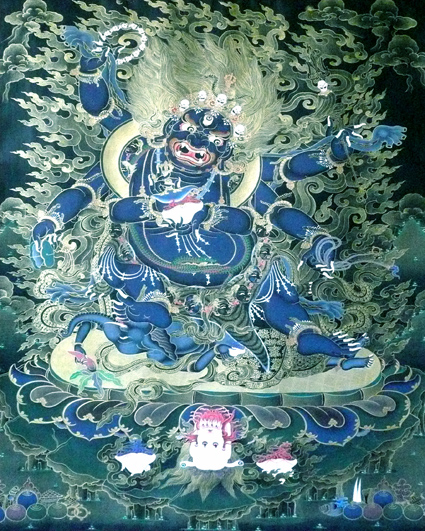
Mahâkâla, the Wrathful Form of the Buddha of Compassion
Dharma
Protector |
|
Excursus : the Dorje Shugden Affair
What is called "the Dorje
Shugden Affair" is a complex conflict within the Tibetan community. The
author has been studying this since 2008. He feels the time is right
for him to clarify Dorje Shugden as far as he can see ...
In this virulent conflict, two parties oppose each other.
On the one hand, there is the view of those who worship "Dorje Shugden",
considering this entity to be a Dharmapâla or "Dharma Protector", i.e. a
Buddha with extraordinary spiritual, but also material powers ! This
Supreme Being is specially dedicated to
safeguard what is deemed the "purity" of the teachings of Je
Tsongkhapa, the founder of the Gelug school of Tibetan Buddhism. What is
this purity ? Considering the Second Turning of the Wheel of Dharma as
definitive and final, and the Third Turning as mixed (provisional and
definitive), but never as definitive and more profound. They
resent the XIVth Dalai Lama for betraying, so they believe, his very
special connection with all Gelugpas, and this by calling his followers to stop worshipping
Dorje Shugden, the special protector of these teachings ! Their attack on the Dalai Lama
is in : A Great
Deception : The Ruling Lama's Policies, Western Shugden Society -
London, 2010.
On the other hand, there is the XIVth Dalai Lama, the spiritual leader of
Tibetan Buddhism, who at some point stopped worshipping Dorje Shugden and
advised his followers to do the same. For him, Dorje Shugden suddenly
became a "demon
king" or "Great Gyalpo", in particular a "gyalpo" of the
region of Dol ("Dolgyal") considered to be an evil, vindictive spirit posing as a Buddha
and causing harm to the Tibetan community in general, to the institution
of the Dalai Lama and to the life of the XIVth Dalai Lama in particular
!!!
The Dalai Lama thereby follows the conclusions of the Great Fifth as well
as the XIIIth Dalai Lama. A
study dedicated to elaborate on this theme was published last year (Bultrini,
2013).
|
Philosophically, the drama with the
Shugdenites boils down to the status of the Second & Third Turning of
the Wheel of Dharma. The Shugdenites are "exclusive" Rangtongpas. They
only accept self-emptiness, and hold that the absence of inherently
existening sensate & mental objects is the soteriological key to
generate Buddhahood. To them, the Second Turning is definitive &
final. Nothing more is needed. In the Rangtong view, the Third Turning
is a mixed bag, calling for interpretation & guidance. Theirs is the
"path of the pandit". Buddhahood is deemed possible, but Buddha-nature
is merely a potential, not an actual Buddha.
In Tibet of old, most Gelugpas and some Sakyas were exclusive
Rangtongpas. This contrary to the Nyingmas, Kagyus, Jonangpas and some
Sakyas, who saw the Second Turning & the Third Turning as respectively
definitive and ultra-definitive. Accepting the self-emptiness of the
original mind, they nevertheless directly experience this very subtle
mind of Clear Light as empty of anything other than what it is,
namely an untainted, unspoilt, free and unobstructed existence. Not a
(substantial) self-existence, but a mere (differential) existential
existence with inhering enlightened properties.
How unfortunate this ideological difference has literally caused
bloodshed. Shugden makes sure, if necessary by violence, that the
Gelugpa teachings remain "pure", i.e. free from contamination from
so-called "non-Buddhist" views. The Shugdenites adhere to the
"sect" and its "fixed" canon & practices.
The current Dalai Lama, a Gelugpa adhering to the non-partisan view
trying to integrate the five schools of Tibetan Buddhism, embraces the "path
of the pandit", as well as the "path of the yogi". Self-emptiness
clears the reification of all sensate & mental objects, whereas
other-emptiness directly introduces the mere existential existence of
Buddha-nature, this perfect(ed) symmetry-transformation at the root of
every mind. Rangtong is philosophical, Shentong is experiential. A
complementarity is at work and should be respected. |
It is not my intent to elaborate on all the various points of this
complex conflict, restricting myself to twelve points covering my view in
the matter.
1. Je Tsongkhapa (1357 - 1419), the founder of the Gelug school, did not
appropriate a special Dharmapâla to "protect" his teachings ;
2. In the early part of 1410, Tsongkhapa became seriously ill, and it is
reported this was caused by a particularly powerful malevolent entity not
further named. Ritual activity merely suspended the negative activities. A
deal was presented to Lama Je : for thirteen generations the spirit would
not harm the Gelugpas if regular offerings were made to it. Tsongkhapa
refused ;
3. Thurman (in
Bultrini, 2013, p.xv), counting 15 to 20 years per generation, brings
13 generations in the middle of the XVIIth century, the period when the
Dorje Shugden Affair began. The minds were ripe ...
4. in the XVIIth century, there were two major "tulkus" recognized to be
consciously connected with their previous incarnation : Lobsang Gyatzo
(1617 - 1682), recognized by Sonam Choephel, the chief attendant of the
IVth Dalai Lama and the Panchen Lama when he was still called "Chingwa
Taktse of Chongye", thereby becoming the Vth Dalai Lama, and Drakpa
Gyaltsen (1619 - 1656). The latter had been recognized by the Panchen Lama
as an exceptional being, but it had been decided otherwise and so he never
got it, causing divisions in the aristocracy & the clergy, who had
expected otherwise ...
To cut a long story short, Lobsang Gyatzo
integrated teachings from other schools (his family was linked to the
Nyingma and other schools), whereas Drakpa Gyaltsen was a hard core Gelug
(with Sakya roots) who did not try "other teachings". More than one Sakya
scholar disliked Other Emptiness and "purity" meant, in logic, absence of
logical choice, and in philosophy, Buddha-nature as potentiality, not
actuality. In practice this meant the Vth Dalai Lama accepted suddenism &
Other Emptiness teachings (Shentong), whereas the Drakpa-line rejected
them as heresy and strictly kept to the gradual, sutric path of
renunciation & slow preparation for the Tantras based on Self Emptiness
(Rangtong). Drakpa was a sectarian "purist". The Great Fifth was a
pluralist ;
5. Drakpa Gyaltsen died at the age of 38. Some said he died from an
infectious disease, his disciples said he was murdered (suffocated by a
scarf pushed in his throat), whereas the Great Fifth said his death resulted from an attack by
a demon who got into his system as a result of his "distorted prayers".
The Vth Dalai Lama was sure that shortly after his death, Drakpa had
transformed himself into an evil spirit (his disturbed
mind possessed by a "higher" demon, much like Crowley was by
Choronzon ? - cf. the Enochians). Causing too much trouble, the evil spirit was eventually
chased away, but received a small altar and the rank of a minor "guardian"
in the monastery of Dagchen Sonam, a master of the Sakya lineage ! Finally
home ! Among his various names, this guardian was called "Dorje Shugden" ;
6. Over the following centuries, (sectarian ?) Gelug masters offered
propitiatory rites and concluded Dorje Shugden was their ally against
the "heresies" of those introducing "impure" teachings. He became a
special Dharmapâla protecting the teachings of Tsongkhapa. On the
ground this meant his "task" was to keep these teachings "pure", in other
words, free from suddenism & Other Emptiness. Hence, Dorje Shugden was
called to protect the sectarianism and exclusivism of their Gelug
"catholicism" ;
7. all the Dalai Lamas from the VIth to the XIIth died young, mysteriously
or suddenly. Finally, in the time of the XIIIth Dalai Lama, Phabongkha
Rinpoche (1878 - 1941) emerged as the most important Gelug master. Via his
mother's family he had inherited a connection with Dorje Shugden and the
"keep it pure doctrine". He spread the cult among the aristocracy and the
great monasteries of central and eastern Tibet, thereby blocking every
attempt at modernization or opening of Tibet to the world. He treated the
entity as a sort of high deity. This clashed
directly with the efforts of the XIIIth Dalai Lama, who opposed the cult
and eventually forbade any Gelugpa dignitary involved from coming to his deathbed (Bultrini,
2013, p.205). After the death of the XIIIth Dalai Lama, the Shugden
fraction manifested (it had been covert during the former's reign) ;
8. when the Dalai Lama was six years old, Trijang Rinpoche, wo turned to
Shugden because of his guru Phabongkha, became his
spiritual mentor ("tsenshap"). It was Trijang who
introduced Tenzin Gyatzo to the worship of Dorje Shugden. He also made
sure the child would recite his prayers morning and evening ... (Bultrini,
2013, p.279). He followed what
his teacher told him to do and gave what he believed to be a deity its due.
In his autobiography, The Magic Play of Illusion, Trijang reports
the sad fate reserved for anyone who, for whatever reason, was in discord
or conflict with him ! Of course, thanks to Dorje Shugden ...
When later, the Dalai Lama,
continuing the practice in the name of the "purity" of the teachings of
Lama Tsongkhapa, also began to receive teachings from non-Gelug
schools, he realized the worship of the sectarian,
unitarist Dorje Shugden undermined his pluralist effort to
(a) integrate the five schools and (b) guarantee the survival of Tibetan
Buddhism as a single tradition. His integrative & pluralist non-sectarian
approach became public at the beginning of the 1970s. This prompted a
disciple of Trijang Rinpoche, Zemey Rinpoche, to publish The Yellow
Book. It listed all the deaths and misfortunes attributed to Shugden's
interventions when "corrupted" teachings were integrated in Gelugpa
practices ! The Dalai Lama was alerted and decided to ritually investigate
Dorje Shugden for himself, as well as to take heed of the warnings of the
State Oracle.
In 1996, he banned the practice of Dorje Shugden,
considering him a vindictive, worldly spirit and certainly not a Buddha as
his devotees claimed.
When a Lama with the reputation of Trijang suggests Dorje Shugden may kill
opponents, one may wonder if this does not give weaker minds the licence
to act in the name of Dolgyal ? This violent streak in the Tibetan mindset
is the demon to purify ...
9. as had happened in Imperial China, when some Chinese leaders discovered
that some Dorje Shugden Lamas could be made into allies against the Great
Fourteenth, analysts suspecting dirty politics very likely decided to support these
individuals in the media and give them financial assistance, both in Tibet
and abroad. Did this lead to the violent public demonstrations we have seen, run by
people dressed as
Gelugpa monks behaving like madmen in their defilement of the person of
the Dalai Lama, respectless for the Office of the White Lotus their
apparel evokes ?
In all cases Buddhists should respect one another ...
10. from the standpoint of common sense and honour it is clear the
teachings of Lama Je Tsongkhapa do not need a special protector to
keep them "pure". Lama Je himself received Old School teachings and some
of his teachers were Jonangpas (thus accepting Other Emptiness and
teaching Ati-Yoga). According to Lama Yeshe, Lama Je was the reincarnation
of the founder of the Old School, Guru Rinpoche !
Is
Dorje Shugden is a politico-spiritual metaphor for a narrow,
power-based sectarian view on Gelug teachings, one opposed to the
humanitarian, integralist, pluralist and all-embracing position of the
XIVth Dalai Lama ?
11. the XIVth Dalai Lama has no "legal" power to stop the worship of Dorje
Shugden, but he is called to advise his disciples. The fact he stopped
worshipping Dorje Shugden is indeed proof he thinks some of his teachers
were wrong in this respect and he is totally entitled to do so. But what
about the monks who suffered because of this man's decisions ?
12. as to the occult nature of Dorje Shugden, for the
Nyingmapa Terdak Lingpa, who did the rituals to clear the negative forces
assailing the Great Fifth after Drakpa's death, Dolgyal was not Drakpa
Gyaltsen, but the incarnation of a Karmapa monk who had malevolent
intentions rooted in a sectarian outlook (Bultrini,
2013, p.237). The Great Fifth said it was a very powerful and perfidious
spirit (a "dam-sri" or perpetrator of harmful actions). He added it was born from distorted prayers harmful to the
Buddhadharma and to sentient beings at large. The XIIIth Dalai Lama
agrees, so does the XIVth Dalai Lama. Wherever this spirit appears, the
lineage, work and statues of Padmasambhava come under attack. Indeed, the
Old Translation School (Nyingma) is the main target of this violent
entity.
|
|
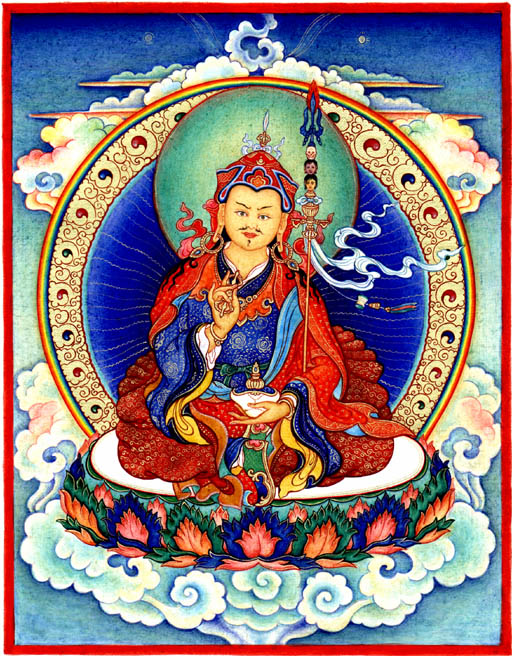
Padmasambhava, Founder of the Old
Translation School
Second Buddha - Tantric Guru |
|
Although in an Autonomous Tibetan Region part of China, Tibetan culture
(writing, education, religion etc.) should be free, this should not prompt
a return to the neo-feudal system of Buddhocratic rule or any form of religious intolerance. Given the autocratic
stance of Lamaism and ingrained cultural habits, these matters are to be
taken seriously.
Unlike many exile movements, the problem is
not in the first place their leader, centralizing all
lineages in his own person, but with the very conservative popular opinions of common Tibetans, often condoned (if not
stimulated) by some senior
Lamas. Moreover, combining political & spiritual power always leads to
abuse. The Office of the Dalai Lama is not exempt of this historical fact.
Claiming to be a democrat without stimulating the advent of a critical
opposition, is like trying to boil water without heat.
In the mid-1970s, the XIVth Dalai Lama, very much aware of the perils
of his own institution, told a Polish reporter the following :
"The Dalai Lama office was an institution created to
benefit others. It is possible that it will soon have outlived its
usefulness." (quoted in Verhaegen, A. : "The Dalai Lamas : The
Institution and Its History. Emerging Perceptions", in : Buddhist
Studies, Printworld - New Delhi, n°15, 2002, p.5). The conservative
Tibetan Lamas and aristocrats-in-exile responded by saying that since the Dalai Lama is a national
institution, it was up to the people of Tibet to decide whether or not the
Dalai Lama should reincarnate ! On the 15th of March 2011, the Tibetan
Cabinet accepted the Dalai Lama’s decision to retire as the political head
of the exiled Tibetan government. The Dalai Lama's government-in-exile is
not recognised by any country, including India.
Let us briefly summarize
the track-record of the institution of the Dalai Lama :
I & II : part of the Gelug school, waging war with the Kagyupas ;
III : installed by the Mongol Atlan Khan, pacifying the country by force ;
IV : a Mongol boy, family of Atlan Khan, military backed by the Mongols ;
V : a scholar, grand politician, visionary, occultist and all-together remarkable figure, military uniting Tibet
thanks to the Mongol Goesjri
Khana, but not without controversy (cf. the Drakpa-affair turning into the
Shugden-affair) ;
VI : an exceptional and gay figure, not accepted, probably murdered or exiled ;
VII : a grey figure, installed by the Manchus who run the regents ;
VIII : a contemplative with no interest in politics ;
IX - XII : died very young, possibly murdered or neglected, again
regents rule ;
XIII : a somewhat ambiguous figure, proclaiming independence, but missing
important opportunities and unable to
convince the Lamas to modernise and militarize ;
XIV : an exceptional figure, but banned from Tibet,
internationalizing the person of the Dalai Lama and promoting an
integrated, pluralist, non-sectarian take on the whole of Tibetan Buddhism
and Buddhism at large.
This record shows the institution never properly worked without the help
of the Mongols, the Manchus or, recently, the international community
(before the mid-1970s, the Free Tibet movement was funded by the Central
Intelligence Agency of the USA and via NGO's money continued to flow, even
directly into the pockets of the XIVth Dalai Lama). However, let us recall
not a single country in the world, nor the UN, accepts -despite the
constant lobbying of the "Great XIVth" and his countless devotees &
admirers- the Tibetan "government" in exile. Apparently, the institution
of the Dalai Lama always seeks strong protectors
to back its activities. Moreover, of the 14 Dalai Lamas, only three
(the Vth, the XIIIth & the XIVth) really made a difference. And unlike hereditary dynasties, the
tulku-system is more open to abuse and manipulation (the Dorje Shugden
issue is a spirito-political dispute concerning the choice of the Vth Dalai Lama !).
Let us recall the Bodhisattva Gautama, son of a chieftain, fled
politics in the middle of the night. As a Buddha, he never practiced
integrating politics & spirituality.
Was the institution of the Dalai Lama
a failure ?
The XIVth Dalai Lama is right when he claims the question of Tibet is not
about the institution of the Dalai Lama or his return to Tibet, but about
the life & culture of the 6 million Tibetans of today. He also
thinks Tibet (although truly independent in 1950) should relinquish this
independence, remaining part of China (his "Middle Way" approach). Lots of
frustrated young Tibetans disagree with him on this, but agree to let him
finish his work.
Cultural autonomy and a special kind of selfrule should
be given in accord with the Chinese Constitution, so the Dalai Lama says,
while -in theory- democracy and human rights remain his top priorities. He
suggests an international commission of experts should look into the
matter and agrees the secular principle separating State and Church is
valid (although the buddhocratic homogeneity sought suggests otherwise). He
confirms China brought material prosperity to Tibet, but demands cultural
autonomy for the Tibetans. Tibetan Buddhism is part of this culture. But
can it be divorced from its traditional authoritarian, sectarian and other
obvious
shadow elements advanced by his, at times, vitriolic critics ?
"The way schools are organized in the Tibetan
community in exile, with mandatory prayers and portraits of the Dalai Lama
in every classroom, frighteningly suggests a major step backward for
education in Tibet. The Dalai Lama's contradictions and constant reversals
from one day to the next are destroying his credibility. If he hopes to be
believed, he must make stronger commitments, contractualize them and
dissolve his 'government', and organization in which half (3 out of 6) of
his cabinet are family members and other relatives hold positions at
various levels in the Parliament and entities responsible for foreign
affairs." -
Vivas (2012, p.113).
Can critical political education of the Tibetans be forthcoming ? Can the
"political master-plan" of the Buddha of Compassion contain errors ? Is
the "divine" Dalai Lama able to make mistakes ? Can a truly liberal system
of democracy see the light ? Is the Dalai Lama always above all other
Tibetan leaders ? Is his status irrefutable and beyond criticism ? Is a
rational policy possible, or is the Dalai Lama, being a Buddha, per
definition always right ? Are irrational traditions more important than
rational approaches ? Is he more gifted than any other to develop
political policies ? Can the political & religious status of the Dalai
Lama be combined ? Is the mythical narrative of the Dalai Lama more
important than the rational truth of liberal authority ? Is the spiritual
"lottery" of choosing a Dalai Lama essential ? Can the Dalai Lama truly
"retire" and remain the Dalai Lama ? Can the current Tibetan government be
called "democratic" without true party politics ? Why has, after 50 years
of exile, the political mentalities of the Tibetans not really changed ?
Was education bad or lacking ? Why ? Can the institution of the Dalai Lama
be maintained hand in hand without the traditional reincarnation-system ?
Is the Dalai Lama's definition of "autonomy" not another form of
"independence" ? Is the supposed "divine wisdom" of the Dalai Lama to
supersede liberal & rational choices ? Have the Tibetans been the
political toy in the nasty play of the super powers ?
"... although this book has absolutely no empathy
for the Dalai Lama as an underhanded political leader, it is not a
pamphlet against Buddhism. Rather, it laments the way in which Buddhism
has been twisted for purposes that we would be astonished (and terribly
sadened) to find enshrined in an immortal sacred text." -
Vivas (2012,
p.119).
Due to the work of the Great XIVth, the person of the Dalai Lama has
become an international reality the invested powers no longer deny, be
they individuals, nations or international assemblies. He has achieved a
status no Dalai Lama before him ever had. China's opposition largely
contributed to this fame. But for the Chinese, he is an unreliable liar
and twister of thoughts.
The culture of Tibet and the institution of the Dalai Lama are
interconnected. At this point, as is in many other countries on the
planet, the mindset of the masses is clearly helped by outdated institutions,
representing a unity otherwise lost. Of course, constant reforms are
necessary, for like all other things, institutions are impermanent and so
constantly changing.
|
Philosophically, the drama between
the XIVth Dalai Lama and the Chinese Communist Party (CCP), is the
fact Mao Zedong and the Communist Party adhered to an exclusivist
materialism, considering religious-based political power as
inferior & "to be re-educated".
Let us recall Mao Zedong, for the
official ideology initiated by the Party, took from Marxism &
Leninism three crucial components : historical materialism,
dialectical materialism and the vision of a final communist utopia.
The latter cannot be achieved by way of blending religion &
politics. These are the guiding principles for the Chinese Communist
State. Are they set in granit ? Neo-Marxism and contemporary
socialist thinking is inclined to accept matter next to information
and consciousness, forming the cybernetic triad of hardware,
software & userware.
Historical materialism is the view making the mode of production
determine all social & political structures of any society. By
enlarging the set of "modes of production", information-based &
sentience-based interactions produce a negentropic surplus no
exclusive materialist view could. Because three independent
variables are at work, chaos cannot be excluded and higher-order
systems remain invited.
Historical materialism must slowly be
replaced by historical experientialism.
Dialectical materialism views the dynamic of fundamental social &
political change generated by the fundamental contradictions between
property systems and modes of production. An analysis of these
systems & modes in the light of quantum mechanics, cosmology,
biology, cybernetics and the science of mind may reveal other
categories of determination than the conflictual, as well as
objectify the presence of other fundamental ontological categories
besides matter. While matter (hardware) remains a crucial cosmic
operator, information (software) and consciousness (userware) are
also identified & made functional. Dialectical materialism is far
too limited to accommodate the hypermodernism of our times. It
should be replaced by Process Organicism. Politically, the vision of
a global utopia prevails.
Ontologically, both historical & dialectical materialism are reduced
to an axiomatic ad hoc choice for the monism of materialism.
For reasons explained elsewhere (Knowledge,
1995,
The Rules of the
Game of True Knowing, 1999,
Clearings : On Critical Epistemology,
2006,
Intelligent Wisdom : from Myth to
Nondual Thought, 2007,
Neurophilosophy of Sensation,
2007,
Criticosynthesis,
2008,
A Philosophy of the Mind and Its Brain, 2007 &
Critique of a Metaphysics of Process,
2010 - 2012), exclusive materialism
(as well as excessive or fundamentalist mentalism) is
flawed, for anticipating a substance-view, rather than a
process-view. In fundamental physics, all states, originating from
the Big Bang singularity, are interconnected, entangled. Information
is the set of all codes, but also the "code of light & life". The
capacity to choose between encoded states of matter makes
consciousness a non-reducible cosmic operator. Instead of a monism
of singularity, we need unity in plurality, a process instead of a
substance, etc.
Religion, the individual communicating with the
Divine, is a direct, immediate, first-person experience, but its
multiple organizations or "religions", including their politics, are
second-hand and third-hand cultural forms. They need time & profound
wisdom to, if necessary, transform. Such important changes are never
properly achieved by brute violence or repression. If matter it to
interact with information & consciousness, then more will be needed,
to realize the global peace of Project Fairness, than mere states of
matter. Then we need the revision of information and the awakening
of sentience. |
Note that while every prayer in Tibetan Buddhism ends
by dedicating it to the welfare of all sentient beings, for
centuries
monastics sustained a Buddhocracy run by an elitist minority ! Keep
this in mind. While
Tibetan Buddhism, as the keeper of the whole Buddhadharma, and as a spiritual training purged from authoritarian
policies clearly benefits the individual and genuine spiritual communities,
Lamaism & Dalai Lamaism, as political systems, cannot be said to
work. Only just & caring democratic systems, integrating conflict &
opposition in a constructive, peaceful way, guarantee the spiritual
freedom of the individual. But this ideal cannot be implemented from
above. It grows from the roots up.
For the moment we know the Great Fourteenth said he will not be
reborn in China, but he may of course always change his mind ! Recently, he
remarked the institution of the Dalai Lama has had its best time. On the 17th
of December 2014, he told the BBC he may be the last Dalai Lama !
But remember :
"... combining religion and government adds nothing
to either, but instead destroys the serenity and credibility of both."
- Vivas (2012,
p.118).
Buddhocracy proves to be as dangerous as theocracy. There is no coercion in
religion.
|
|



