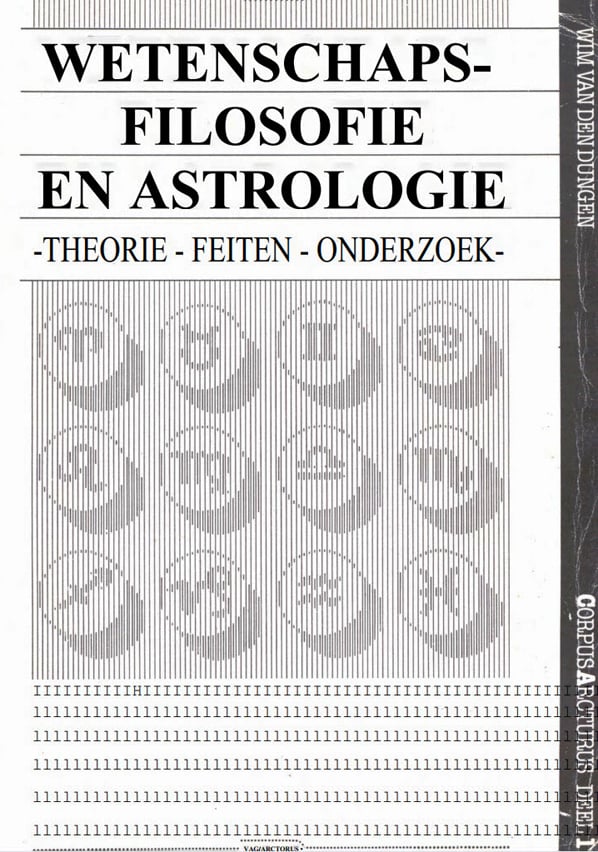
Wetenschapsfilosofie en Astrologie (1985) belongs to an early phase of my work and should be read as a historical document rather than as a statement of my present position. Written at a time when I still expected astrology to prove statistically significant, the book represents an ambitious attempt to determine what a scientifically defensible astrology might look like. Can astrology be reconstructed as a coherent theoretical system, subjected to explicit rules of testing ? Can it be distinguished from pop astrology, Tarot, pendulum dowsing, clairvoyance, occultism, spiritism, and forms of metaphysical speculation presented as fact ?
The philosophical framework reflects the debates in philosophy of science that shaped my thinking at the time. Popper, Lakatos, Kuhn, Feyerabend, and the epistemology of Erik Oger are brought to bear on questions of demarcation, theory construction, observation, falsification, and the status of metaphysics. Astrology is not simply defended against scientific criticism ; it is required to submit to methodological discipline. The underlying project was constructive : to replace the heterogeneous 'practices' of contemporary astrology with an internally coherent model whose theoretical claims could, where possible, confront empirical testing.
This scientific ambition was accompanied by an equally strong concern with conceptual architecture. The book distinguishes mathematical, theoretical, experimental, applied, and metaphysical or meta-theoretical levels of astrological inquiry, attempting to prevent one level from usurping the function of another. Metaphysical explanation is admitted, but only as speculation, and the text explicitly warns against turning such speculation into dogmatic claims about what reality 'is.' Even at this early stage the work contains a critical impulse that would later become much more decisive.
I no longer hold the central expectation governing the book. By the time of How to Read a Natal Chart (2026), the attempt to establish astrology through objective significance had ceased to be my primary concern. I once expected astrology to be statistically significant, whereas my current interest lies in its subjective and intersubjective relevance. The later approach no longer seeks a scientific proof of the symbolic richness of natal delineation, but treats the radix as a disciplined symbolic language whose proper measure is the relevance it may acquire in interpretation, self-exploration, and self-knowledge. The theory of delineation developed around it constitutes a meta-linguistic model.
The value of Wetenschapsfilosofie en Astrologie (1985) today is partly autobiographical and philosophical. It makes visible an earlier stage in the development of my thinking : a period in which astrology was still approached through the question of scientific validation and in which considerable effort was devoted to constructing a model capable of meeting that demand. Read alongside the later work, it documents the transition from a philosophy of astrology centered on possible scientific significance toward one centered on disciplined interpretation and psychological relevance.
The book is therefore made freely available here in PDF, not because its position is still endorsed, but because intellectual development is better shown than concealed. Earlier arguments, abandoned expectations, and changes of method belong to the history of a philosophy no less than the positions eventually retained.